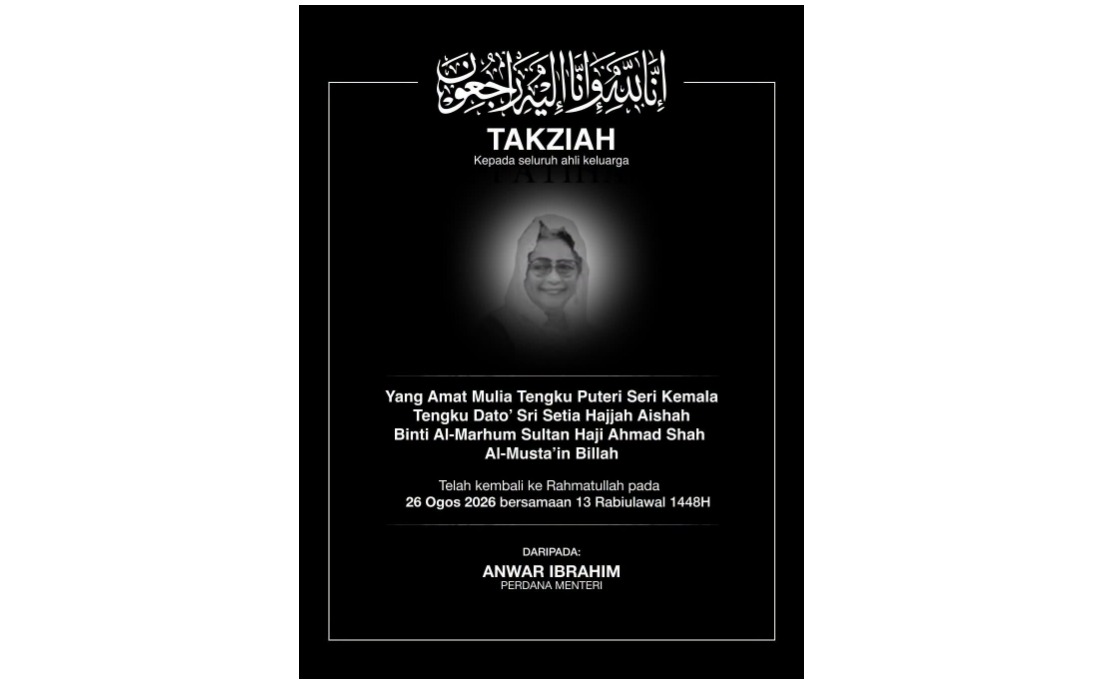
Prime Minister Datuk Seri Anwar Ibrahim has publicly expressed his sympathies to Al-Sultan Abdullah Ri'ayatuddin Al-Mustafa Billah Shah and members of the Pahang Royal Household following the death of Tengku Puteri Seri Kemala Tengku Datuk Seri Aishah, the Sultan's elder sister. The PM shared his condolences through a Facebook statement, reaching out to the grieving family during what is traditionally a solemn period in the royal calendar. The announcement underscores the formal protocols observed when prominent members of Malaysia's royal households pass away, with senior government officials offering public expressions of grief and support.
Tengku Datuk Seri Aishah passed away at a hospital in Kuala Lumpur at 9.15 pm on August 26, bringing to a close a life of distinction within the Pahang Royal Family. Her funeral arrangements were promptly organised in accordance with Islamic and royal traditions, with her remains scheduled for burial at the Pahang Royal Mausoleum in Pekan. This location holds particular significance for the Pahang royal lineage, serving as the final resting place for members of the sultanate's extended family and reflecting the deep historical roots of the royal house in the state.
In his condolence message, Prime Minister Anwar invoked religious sentiments befitting the circumstances, praying that Allah SWT would extend His mercy towards Tengku Datuk Seri Aishah's soul and absolve her of any transgressions. Such formulations are customary in Malaysian political discourse, particularly when addressing the death of prominent citizens and royal figures, as they reflect the Islamic values that underpin Malaysian society and governance. The PM's words carried the weight of his office while maintaining the respectful tone appropriate to addressing the sultanate.
The Prime Minister also extended his prayers and well-wishes to Al-Sultan Abdullah and Tengku Ampuan of Pahang Tunku Azizah Aminah Maimunah Iskandariah, seeking divine strength and resilience for them during their period of bereavement. By explicitly naming both the Sultan and the Tengku Ampuan, Anwar's message acknowledged the central figures of Pahang's leadership and their immediate emotional burden. He further extended compassion to the broader Pahang Royal Family, recognising that the loss reverberated beyond the immediate circle and affected numerous relatives connected to the sultanate.
The death of royal family members often triggers broader reflections on the role and continuity of Malaysia's constitutional monarchy system. As an institution woven into the fabric of Malaysian political and cultural life, the royal households command significant public attention and ceremonial recognition. When figures like Tengku Datuk Seri Aishah pass away, it prompts consideration of the legacies they leave and the bonds that connect the monarchy to the wider Malaysian community and government structure.
Pahang, one of Malaysia's largest and historically significant states, maintains particularly strong traditions regarding its royal lineage and ceremonies. The decision to conduct the funeral rites at the Pekan Royal Mausoleum emphasised continuity with established customs and honoured the departed's place within the state's royal genealogy. Such observances serve not merely as private family matters but as public affirmations of institutional stability and tradition that resonate throughout Malaysian society.
The incident also illustrates the symbiotic relationship between Malaysia's federal government leadership and its state-level monarchies. Prime ministers routinely acknowledge and participate in the ceremonial and symbolic dimensions of royal life, reinforcing the constitutional framework within which both branches of power operate. By publicly expressing condolences, Anwar fulfilled an important diplomatic and social function that maintains the collegial relationship between Putrajaya and the various sultanates.
Royal deaths in Malaysia typically generate significant media coverage and public expressions of sympathy, reflecting the prominent position these institutions occupy in the national consciousness. For many Malaysians, the royal families embody historical continuity and cultural identity, particularly in the states where sultanates have exercised influence for centuries. The passing of someone like Tengku Datuk Seri Aishah thus carries implications beyond the immediate family circle, touching on broader themes of heritage and national cohesion.
The timing and manner of official responses to such events reveals much about the state of institutional relationships in Malaysia. When the Prime Minister swiftly issued a public statement of condolence through social media channels, he demonstrated both respect for royal protocol and engagement with contemporary communication platforms. This blend of traditional courtesy and modern outreach reflects how Malaysian governance adapts to evolving means of public discourse while maintaining deference to established hierarchies.

