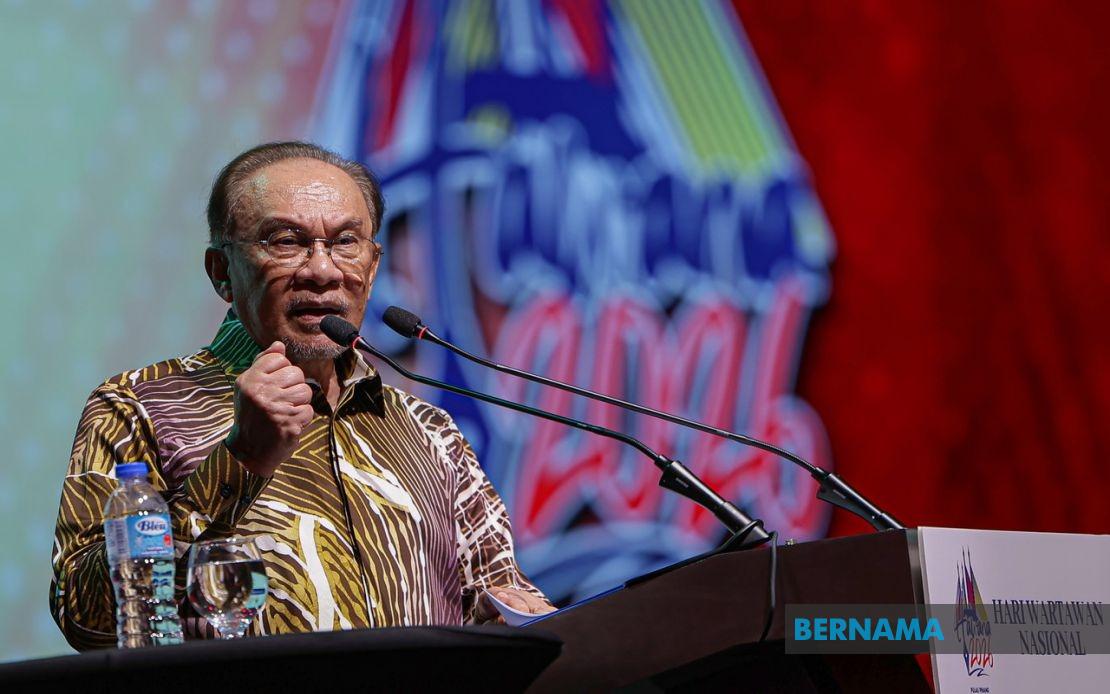
Prime Minister Datuk Seri Anwar Ibrahim has thrown his weight behind the appointment of former Federal Court judge Tan Sri Nallini Pathmanathan as chairman of the Malaysian Media Council (MMC), hoping that her elevation to the role will elevate the council's standing and restore public faith in its regulatory functions. Speaking at the National Journalists' Day (HAWANA) 2026 event in Butterworth on June 20, Anwar underscored the significance of selecting someone with unquestionable credentials and an established reputation for ethical conduct, emphasising that Nallini's distinguished career in the judiciary made her the right choice for the leadership position.
The appointment followed extensive deliberation by those responsible for the selection process, with particular attention paid to Nallini's track record on the bench and her reputation for principled decision-making. Anwar made clear that her arrival in the role represents more than a bureaucratic reshuffle; rather, it signals a renewed commitment to establishing the MMC as an institution worthy of public reliance. His remarks, delivered while inaugurating the national journalists' gathering, reflected broader government backing for structural reforms within Malaysia's media oversight framework.
The MMC board formally endorsed Nallini's elevation during a meeting held on May 26, with all members voting unanimously in favour of the decision. This consensus suggests that industry and government stakeholders alike recognise the value of appointing someone with her particular background and expertise. Nallini's transition from the Federal Court bench to the helm of a regulatory body tasked with maintaining journalistic standards represents a notable career trajectory that bridges the judiciary and media governance.
Established under the Malaysian Media Council Act 2025, the MMC operates as Malaysia's self-regulatory mechanism for the media industry, distinct from government bodies but nevertheless important to national governance. The council's mandate spans several critical areas: it works to maintain and elevate journalistic standards across newsrooms, handles and adjudicates public complaints concerning media conduct, champions ethical reporting practices, and—perhaps most significantly—serves as a guardian of media freedom as a cornerstone of democratic functioning. For a nation navigating the complexities of balancing press independence with social responsibility, the council's credibility becomes paramount.
The significance of this appointment becomes clearer when considered against the backdrop of persistent public scepticism toward institutions in Malaysia and across Southeast Asia. Media councils in the region have sometimes struggled with perceptions of bias or inadequate independence, hampering their effectiveness as arbiters of journalistic conduct. By appointing someone with Nallini's judicial pedigree, the government and MMC board appear to be deliberately addressing these concerns, betting that her standing in law and demonstrated commitment to principled reasoning will reassure both media practitioners and the general public.
Anwar's public endorsement at the HAWANA 2026 event carried particular weight given his position as Prime Minister and his own stated commitment to strengthening democratic institutions. His emphasis on Nallini's "impeccable credentials" served a dual purpose: it validated the appointment for sceptics while signalling to the media industry that the government takes the council's independence and effectiveness seriously. This rhetorical support, though perhaps expected from a prime minister, nevertheless underscores how officials view the MMC's role in the broader ecosystem of institutional checks and balances.
The event itself drew a constellation of senior government figures and media leaders, among them Penang Chief Minister Chow Kon Yeow, Communications Minister Datuk Fahmi Fadzil, and Communications Ministry leadership. The gathering of such figures alongside BERNAMA officials and members of the press underscored the ceremonial and political dimensions of affirming the MMC's importance. For HAWANA, an occasion dedicated to celebrating journalistic practice and honouring media professionals, the timing of Anwar's remarks amplified their resonance within professional circles.
For Malaysian readers and regional observers, the implications of this appointment extend beyond routine governance. Media self-regulation has assumed greater importance as digital platforms complicate the traditional journalism landscape and misinformation spreads with unprecedented speed. A well-functioning, credible MMC could help establish benchmarks for responsible reporting that might influence not only Malaysian outlets but also set regional precedents. Nallini's judicial experience with constitutional law and administrative matters potentially equips her to navigate the intricate questions about media freedom, privacy, accuracy, and public interest that frequently arise in complaints.
The appointment also reflects evolving thinking about institutional design in Malaysia. Rather than relying on government departments to oversee media conduct—a model that invites accusations of state censorship or manipulation—the MMC framework places regulatory responsibility in the hands of a self-governing body accountable to industry stakeholders and the public. Positioning a former judge at the helm attempts to imbue this structure with both legitimacy and the appearance of impartiality. Whether perceptions translate into actual effectiveness remains a question for coming months and years.
Looking ahead, Nallini's tenure will be scrutinised by multiple constituencies: media outlets hoping for fair and transparent adjudication of complaints, journalists concerned with protecting editorial independence, civil society advocates monitoring media freedom, and the government itself with its interest in stable public discourse. The unanimous board endorsement suggests internal alignment on her appointment, but external stakeholders—particularly in the media industry and civil society—will judge success based on the substance of her decisions and the council's operational autonomy in practice.

