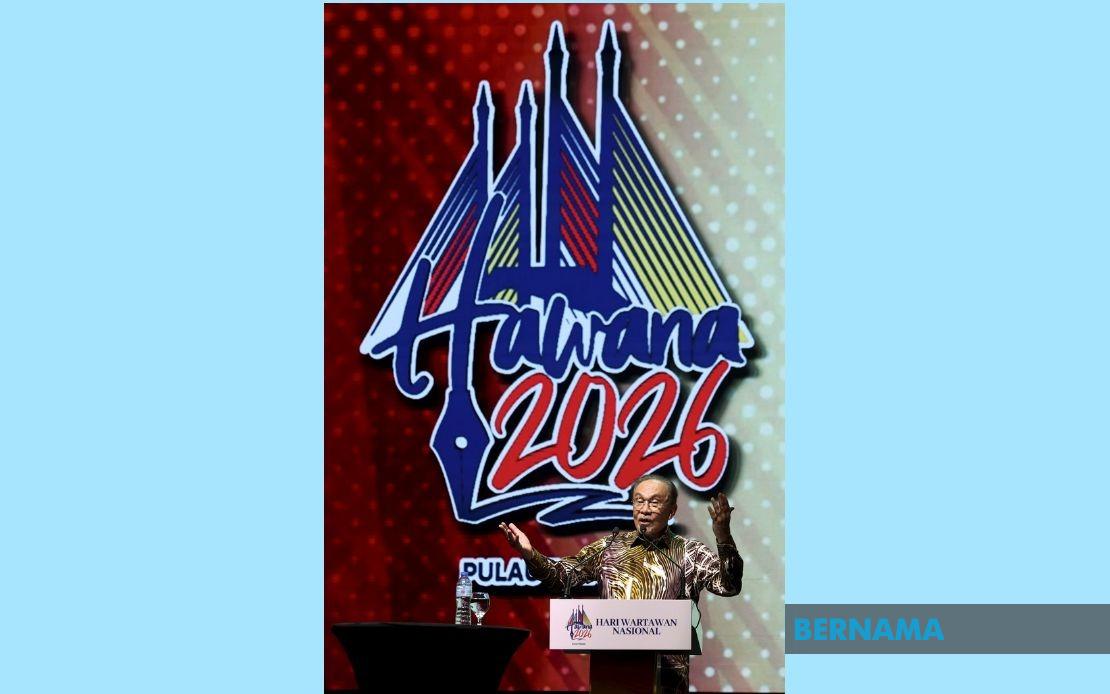
Prime Minister Datuk Seri Anwar Ibrahim unveiled a fresh RM1 million injection into the Tabung Kasih@HAWANA on Thursday during the National Journalists' Day (HAWANA) 2026 celebration in Butterworth, signalling the government's deepening commitment to protecting the livelihoods of Malaysia's journalism workforce. The announcement, delivered at PICCA Convention Centre@Butterworth Arena, underscores ongoing fiscal support for a sector that often operates under financial strain despite playing a critical role in sustaining public discourse and democratic accountability.
Speaking in his dual capacity as Prime Minister and Finance Minister, Anwar highlighted the tangible impact the fund has already generated. Since its inception alongside the HAWANA 2023 observance, the scheme has channelled assistance to 773 media practitioners nationwide, disbursing RM2.26 million in total support. These figures reveal both the scale of need within Malaysia's journalism community and the efficacy of targeted intervention when government and industry align on welfare objectives. The breadth of coverage across the nation suggests that financial hardship among journalists is not concentrated in urban centres but distributed across Malaysia's diverse media landscape.
The Tabung Kasih@HAWANA operates as a multifaceted safety net, extending beyond simple cash transfers to encompass medical expense reimbursement, family welfare assistance, and other tailored support mechanisms. This holistic approach recognises that journalists face interconnected vulnerabilities—illness, family emergencies, and income volatility—that a one-dimensional fund structure could not adequately address. For practitioners navigating the transition from full-time employment to freelance work or early retirement, such comprehensive provisions carry particular weight in preserving dignity and financial security during vulnerable periods.
The decision to allocate an additional RM1 million reflects what Anwar characterised as a spirit of compassion and care, framing media welfare as an ethical imperative rather than mere policy mechanism. This rhetorical positioning is significant for Malaysian readers because it signals that journalism—often perceived as an adversarial profession scrutinising power—merits state protection not as a quid pro quo for favourable coverage but as recognition of its intrinsic social value. The framing avoids the trap of instrumentalising welfare while simultaneously reinforcing the notion that state and media can coexist in relationship based on mutual respect for institutional independence.
The gathering itself carried symbolic weight beyond the financial commitment. Penang Chief Minister Chow Kon Yeow, Communications Minister Datuk Fahmi Fadzil, and senior ministry officials attended alongside leaders from Malaysia's major news organisations, including Bernama chairman Datuk Seri Wong Chun Wai and Bernama CEO Datin Paduka Nur-ul Afida Kamaludin. This convergence of state apparatus and media leadership underscores that journalist welfare has become a legitimate concern spanning multiple tiers of governance and institutional bureaucracy, no longer confined to informal networks or industry associations acting alone.
HAWANA 2026 drew more than 1,000 media professionals from Malaysia and international delegations representing Timor-Leste, Cambodia, and Laos, positioning the event as a Southeast Asian convocation rather than strictly domestic gathering. This regional dimension acquires relevance for Malaysian observers because it signals that issues affecting journalism—financial precarity, professional standards, institutional integrity—transcend borders and reflect shared challenges within a dynamic media ecosystem spanning multiple democracies and hybrid political systems. The presence of international participants suggests that Malaysia's approach to media welfare, including the Tabung Kasih initiative, may influence peer approaches across the region.
The overarching theme, 'Media Integrity Strengthens Credibility', carries implicit messaging about expectations governing journalism practice. By linking integrity to credibility—and implicitly to the legitimacy that media derives from public trust—the framing suggests that welfare support should accompany renewed commitment to professional standards and ethical conduct. For Malaysian readers who have witnessed periodic tensions between government and sections of the press, the emphasis on integrity may register as both acknowledgment that media sometimes falls short of public expectations and assertion that rectification requires structural support, not merely rhetorical exhortation.
The expansion of Tabung Kasih@HAWANA funding arrives at a moment when Malaysia's media landscape faces multiple pressures: digital disruption reducing advertising revenue, consolidation concentrating ownership, and the rise of non-traditional news sources fragmenting audiences. Against these headwinds, government financial support for individual practitioners offers a partial counterweight, though observers might question whether RM1 million annually provides adequate protection for a workforce numbered in the thousands. The allocation's adequacy depends heavily on distribution mechanisms and targeting criteria—factors the announcement leaves unexplored, leaving open questions about whether the fund prioritises hardship cases versus broader preventive welfare.
Historically, Malaysia's approach to media has oscillated between periods of regulatory stringency and engagement. The Tabung Kasih@HAWANA initiative represents a more conciliatory posture, attempting to build goodwill through material support rather than through editorial pressure or regulatory incentives. Whether such approach fundamentally alters media-state dynamics or merely provides temporary respite for individual journalists while underlying structural tensions persist remains an open question that Malaysian media observers will continue debating in coming months.
The announcement also carries implications for media workers in Malaysia who have transitioned out of traditional newsrooms. As freelancing and gig-based journalism expand, welfare schemes become increasingly vital since such workers lack employer-provided protections. By extending Tabung Kasih@HAWANA eligibility to former practitioners, the scheme acknowledges that journalism's value persists beyond formal employment relationships, a recognition that growing segments of Malaysia's journalism workforce require as their career trajectories diverge from previous generational patterns.
Moving forward, the success of this additional allocation will depend not merely on disbursement volumes but on whether the scheme achieves sustainable institutionalisation within government budget cycles. Media practitioners will scrutinise whether future administrations maintain or expand funding, whether application processes remain accessible and stigma-free, and whether the scheme evolves to address emerging vulnerabilities such as digital security threats or psychological strain associated with contentious reporting. These dimensions will ultimately determine whether Tabung Kasih@HAWANA becomes embedded welfare infrastructure or remains a gesture of goodwill vulnerable to budgetary pressures.

