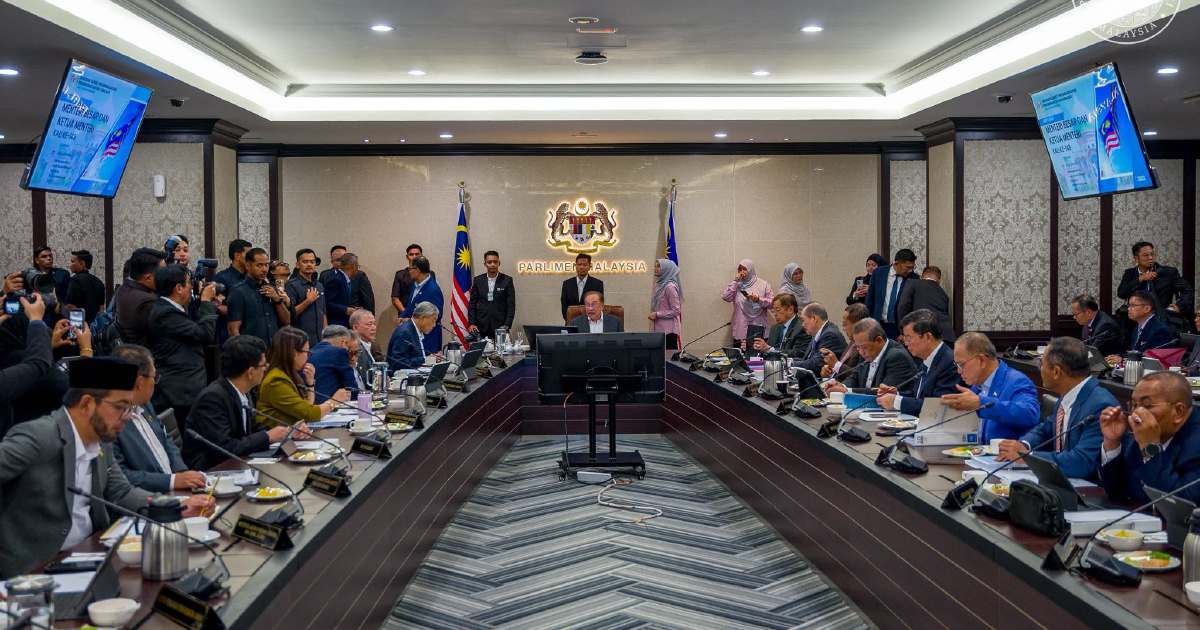
Prime Minister Datuk Seri Anwar Ibrahim has brought together Malaysia's regional leaders for the 149th Meeting of Menteris Besar and Chief Ministers at the Parliament building, signalling the federal government's commitment to coordinating a cohesive economic strategy at a moment when the nation faces mounting external pressures. The gathering underscores the administration's recognition that state-level cooperation is essential to executing recovery initiatives effectively across the country's diverse economic landscape.
The convening of this high-level assembly reflects a deliberate pivot towards collective problem-solving on the economy, a shift that becomes particularly significant when viewed against the backdrop of intensifying global instability. The Middle East conflicts that have unsettled financial markets and disrupted supply chains worldwide have created unpredictable conditions for Malaysia, a nation deeply integrated into regional trade and investment networks. By bringing state governments into the conversation, the Prime Minister is attempting to ensure that economic revitalisation efforts are not confined to federal departments but ripple through local administrations and into communities across all fourteen states and federal territories.
Economic revival has become an increasingly urgent preoccupation for Malaysian policymakers as external shocks continue to test the resilience of domestic sectors. The confluence of geopolitical tension and global economic uncertainty has prompted concerns about investment flows, currency stability, and commodity demand—issues that directly affect employment and business confidence at the state level. States that depend heavily on specific industries, such as manufacturing in the northern corridor or tourism in island economies, face distinct vulnerabilities that require tailored interventions rather than one-size-fits-all federal approaches.
The deliberate emphasis on unity among regional leadership carries symbolic weight in Malaysian politics, where state governments sometimes operate with competing priorities or intergovernmental tensions. By convening this forum under the Prime Minister's direct chairmanship, the administration sends a message that economic challenges transcend partisan boundaries and require coordinated governance. This approach potentially allows state leaders—regardless of their political affiliation—to voice concerns and propose solutions that reflect their constituents' specific circumstances, whether in Sabah and Sarawak, or the urban-centric economies of the Klang Valley and Penang.
The timing of the 149th meeting is strategically significant. Rather than waiting for conditions to stabilise or for external pressures to ease, the government is proactively convening stakeholders to design resilience-building measures now. This forward-looking posture contrasts with reactive policymaking and suggests a recognition that economic recovery cannot be delayed until the global situation improves. States must begin laying groundwork for business retention, workforce development, and infrastructure investment even as uncertainty persists.
Malaysia's position as a trading nation makes it particularly vulnerable to disruptions emanating from distant conflicts. The Middle East instability has potential ramifications for shipping routes, energy prices, and investor sentiment about emerging Asian economies. States that host significant industrial estates, ports, or financial operations face direct exposure to these ripple effects. By convening regional leaders, the Prime Minister creates a forum where early warning signs can be shared and preventive measures implemented before crises spread through the domestic economy.
The meeting also highlights the importance of vertical integration in economic governance. Federal authorities can articulate national priorities and coordinate macroeconomic policy, but states remain crucial implementers of business-friendly regulations, infrastructure maintenance, and labour market initiatives. When Menteris Besar and Chief Ministers align with federal strategy, the multiplier effects of policy become more pronounced. Conversely, misalignment or competing state-level policies can dilute federal efforts. This gathering represents an attempt to achieve that critical alignment.
The economic revival agenda likely encompasses diverse priorities ranging from attracting foreign investment to supporting small and medium enterprises struggling with input costs and financing constraints. States have vital roles to play in land development, regulatory approval speeds, and local procurement policies that influence business decisions. The meeting provides a platform for these issues to be discussed at the highest levels rather than remaining siloed in departmental channels.
Looking beyond immediate economic concerns, the gathering reflects broader governance trends in Malaysia. The consultation of state leaders on matters of national importance represents an attempt to deepen federalism's practical effectiveness, moving beyond constitutional divisions of power toward genuine collaborative policymaking. In an era when economic challenges often cross jurisdictional lines, this inclusive approach may prove more adaptive than centralised command structures.
For Southeast Asian observers, Malaysia's response to global instability offers a case study in how federalised systems can mobilise collective responses during uncertain periods. The region itself faces similar vulnerabilities from Middle East tensions and global economic flux. States and nations that successfully coordinate their responses—bringing all stakeholders into the process and tailoring strategies to local contexts while maintaining overall coherence—are likely to emerge from this period of uncertainty with greater economic resilience and public confidence in governance.

