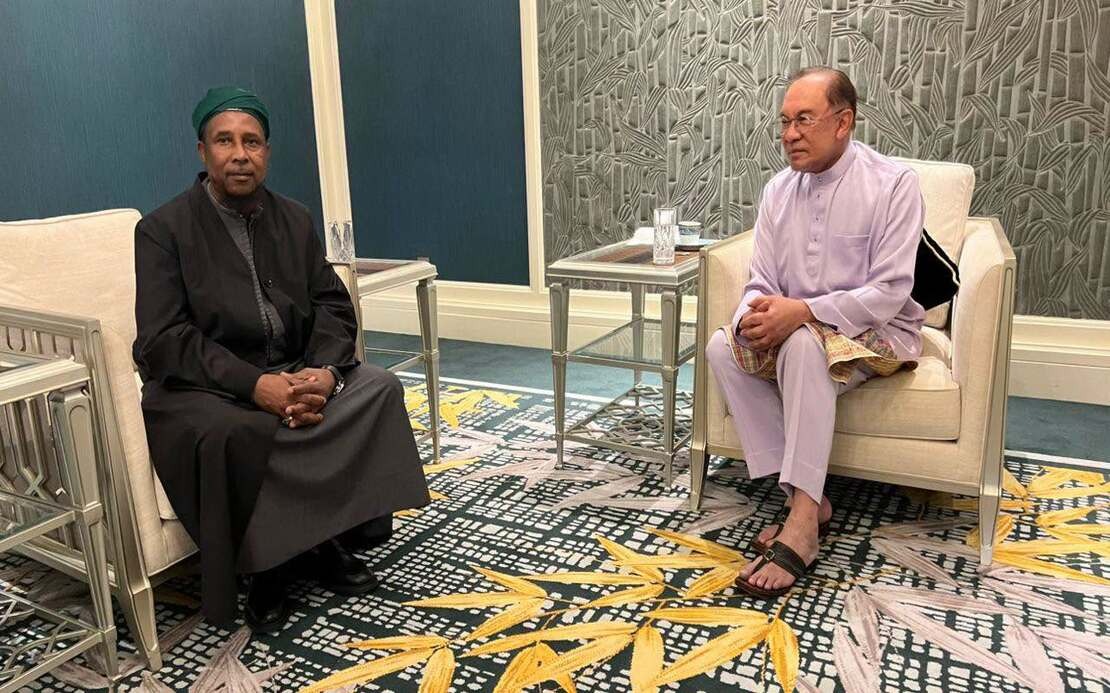
Prime Minister Datuk Seri Anwar Ibrahim received a farewell visit on June 26 from Gambian Islamic scholar Sheikh Muhammad Haydara Al-Jilani, marking the conclusion of the religious figure's month-long engagement across Malaysia. The meeting, held at the Prime Minister's official residence, coincided with the observance of the Day of Ashura on a Friday, lending spiritual significance to the occasion.
During their encounter, Anwar seized the opportunity to request the scholar's prayers for Malaysia's continued prosperity, internal peace, and national well-being. The Prime Minister emphasised his hope that the nation would remain under divine protection and blessing, reflecting the importance Malaysia's leadership places on spiritual guidance during significant Islamic occasions.
Sheikh Muhammad Haydara Al-Jilani's visit to Malaysia formed part of a broader dakwah—Islamic outreach—initiative that involved organising religious gatherings and educational sessions at multiple venues nationwide. The month-long programme demonstrated Malaysia's ongoing role as a hub for Islamic scholarship and cross-border religious exchange, particularly with West African Muslim scholars and institutions.
The timing of this farewell visit carries broader implications for Malaysia's position in the Islamic world. As a Muslim-majority nation with significant soft power in regional and global Islamic circles, Malaysia continues to facilitate platforms where prominent Muslim scholars can engage with local communities. The presence of Sheikh Al-Jilani and the resources allocated to his tour underscore the Malaysian government's commitment to enriching religious discourse beyond domestic boundaries.
The Day of Ashura, commemorated during the meeting, holds profound significance across Islamic traditions. For Shia Muslims, it marks the anniversary of the Battle of Karbala, while for other Muslim communities, it represents a day of spiritual reflection and heightened religious observance. Scheduling the farewell meeting on this occasion amplified its symbolic weight, positioning the Prime Minister's personal engagement as an act of spiritual solidarity.
Sheikh Al-Jilani's lecture series and dhikr programmes—devotional gatherings centred on remembrance of God—attracted participants across Malaysian cities and towns. Such initiatives typically draw religious scholars, community leaders, students, and the general Muslim public seeking spiritual enrichment. The scholar's background as a Gambian Islamic figure likely brought fresh perspectives to Malaysian Islamic discourse, particularly regarding African Islamic traditions and their compatibility with Southeast Asian Islamic practice.
The Prime Minister's public acknowledgment of this visit through his official Facebook statement reflects the personalised diplomatic approach Malaysia's government adopts toward international religious figures. By documenting the meeting in social media, Anwar signalled that interfaith and inter-scholar engagement constitutes a legitimate priority for his administration, sending messages both domestically and internationally about Malaysia's values.
Malaysia's hosting of international Islamic scholars serves multiple strategic purposes. Domestically, it presents the government as a steward of Islamic knowledge and piety, strengthening the Prime Minister's credibility among his Muslim constituents. Regionally, such visits position Malaysia as a centre of Islamic learning that attracts scholars from across the Muslim world. Internationally, they enhance Malaysia's soft power and demonstrate its role as a bridge between African and Southeast Asian Muslim communities.
The scholar's month-long programme also provides opportunities for knowledge exchange that extends beyond formal lectures. Interactions with Malaysian Islamic institutions, universities, and civil society organisations create lasting networks that can inform future scholarly collaborations and cultural diplomacy. These organic connections often yield long-term benefits that transcend the initial visit.
Sheikh Muhammad Haydara Al-Jilani's departure marks the end of one chapter in Malaysia's ongoing engagement with global Islamic scholarship. However, the relationships and momentum created through such visits typically catalyse future exchanges, invitations to Malaysian scholars to visit The Gambia, and collaborative research or educational projects. The Prime Minister's personal farewelling of the scholar suggests that Malaysia intends to maintain and deepen these connections.
For Malaysians and broader Southeast Asian observers, this interaction exemplifies how contemporary Islamic engagement operates at the intersection of spirituality, education, and diplomacy. The Prime Minister's explicit request for prayers for national stability and prosperity reflects a worldview where spiritual leaders possess authority that complements governmental structures. This integration of religious counsel into high-level governance continues to define Malaysia's approach to national leadership and international relations.

