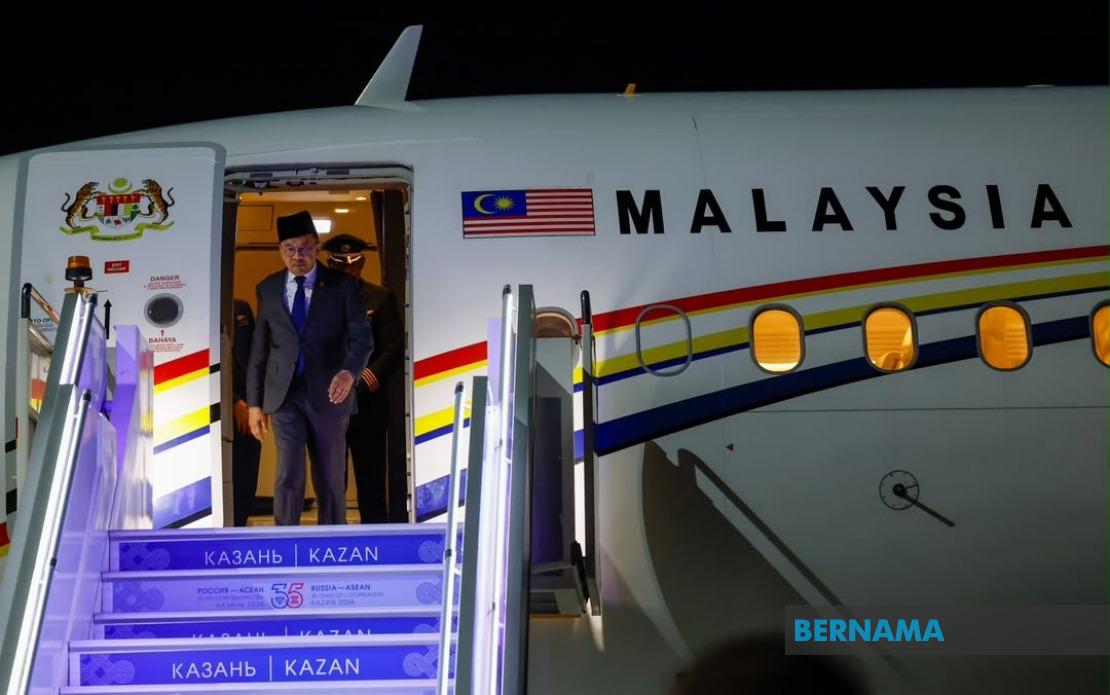
Prime Minister Datuk Seri Anwar Ibrahim touched down in Kazan on June 16 for a significant two-day working visit centred on the ASEAN-Russia Commemorative Summit scheduled for June 17-18. The aircraft arrived at Kazan International Airport at 10.20 pm local time, marking another chapter in Malaysia's deepening engagement with Russia during Anwar's tenure. His delegation included key economic ministers and senior officials, reflecting the strategic importance Kuala Lumpur attaches to the engagement.
The Malaysian contingent was headed by two senior cabinet figures instrumental in the country's economic direction: Minister of Investment, Trade and Industry Datuk Seri Johari Abdul Ghani and Minister of Economy Akmal Nasrullah Mohd Nasir. The presence of these ministers signals that discussions will centre heavily on economic cooperation rather than purely ceremonial diplomatic exchanges. Upon arrival, Anwar was formally received by Malaysia's Ambassador to Russia Datuk Cheong Loon Lai, whilst the Russian hosts fielded a delegation led by the Minister of Digital Development of Tatarstan Ilya Nachvin, Kazan Mayor Ilsur Metshin and state protocol officials.
This summit carries particular historical weight as it commemorates 35 years since ASEAN and Russia first established formal diplomatic relations in Kuala Lumpur in 1991. What began as an experimental dialogue partnership has evolved into a multifaceted strategic engagement encompassing everything from defence to development. The timing of this anniversary summit allows both blocs to take stock of three decades of interaction and reorient their partnership framework for an increasingly multipolar world where neither side can afford to be isolated.
The anticipated agenda reveals how comprehensively ASEAN-Russia ties have expanded. Discussions will span trade and investment, energy cooperation, food security initiatives, digital economy development, science and technology collaboration, cultural exchanges, educational partnerships and tourism promotion. This breadth reflects the reality that modern great-power relationships cannot be confined to any single sector. For Malaysia specifically, energy cooperation holds particular relevance given the nation's dual interests as both an energy producer and consumer, whilst food security remains a perennial concern for Southeast Asian economies vulnerable to global supply chain disruptions.
The summit is expected to produce four substantive outcome documents that will shape cooperation for years ahead. The Kazan Declaration on the 35th Anniversary of ASEAN-Russia Relations will serve as the ceremonial anchor, whilst the Joint Statement on Energy Cooperation and Joint Statement on Cultural Cooperation address specific sectors. Most significantly, the Comprehensive Plan of Action to Implement the ASEAN-Russia Strategic Partnership 2026-2030 represents a forward-looking roadmap spanning a five-year period, suggesting both sides view their relationship as durable rather than transactional.
Malaysia's prominent role in this summit underscores its commitment to maintaining ASEAN Centrality in regional diplomacy. This principle has become increasingly important as the region navigates geopolitical complexities arising from great-power competition. By ensuring the bloc remains a driving force in its own diplomatic architecture rather than a passive recipient of external powers' agendas, Malaysia reinforces ASEAN's bargaining position. The visit also demonstrates how Malaysia seeks to balance its relationships across multiple power centres, a delicate diplomatic act that requires constant calibration.
During his Kazan stay, Anwar is scheduled to meet Russian President Vladimir Putin and the Rais of the Republic of Tatarstan, alongside engagements with other ASEAN leaders attending the summit. These bilateral conversations will allow him to address both country-specific concerns and broader regional issues. His talking points will reportedly emphasise dialogue and peace promotion—a particularly relevant message in the current geopolitical climate—alongside economic resilience building, energy and food security advancement, and strengthening interpersonal connections between nations.
This represents Anwar's third visit to Russia since becoming Prime Minister in November 2022, illustrating the frequency and importance attached to the bilateral relationship. His previous visits revealed a calculated pattern of engagement: the September 2024 Eastern Economic Forum attendance in Vladivostok positioned him within Russia's Far Eastern development narrative, whilst the May 2025 official Moscow visit focused on high-level talks with Putin covering trade, investment, agriculture, education, aerospace and energy sectors. Each visit has been strategically sequenced to deepen specific cooperation areas whilst maintaining the broader relationship.
For Malaysian audiences and Southeast Asian observers, this summit represents more than diplomatic theatre. The outcomes will influence how ASEAN collectively approaches partnership with Russia across numerous sectors affecting regional prosperity. Energy cooperation agreements could impact fuel prices and security of supply, whilst trade frameworks may influence Malaysian exporters' access to Russian markets. The digital economy discussions carry implications for technology standards and cyber cooperation frameworks affecting the region's technological sovereignty.
The geopolitical context cannot be ignored. As Western economies have intensified sanctions against Russia and attempted to isolate Moscow diplomatically, ASEAN's willingness to maintain substantive engagement preserves multilateralism and prevents the world from fracturing into entirely separate blocs. This nuanced positioning, where Malaysia and ASEAN engage Russia without necessarily endorsing all its policies, reflects the sophisticated diplomacy required of middle powers in an increasingly polarised world.
Looking ahead, the documents produced at this summit will shape practical cooperation frameworks for half a decade. Beyond headline commitments, the true measure of success will lie in implementation—whether energy cooperation translates into concrete projects, whether educational exchanges produce sustained institutional partnerships, and whether trade frameworks generate tangible commercial benefits. For Malaysia, which occupies a central role within ASEAN, ensuring these partnerships deliver mutual benefits whilst maintaining the bloc's strategic autonomy represents the ongoing diplomatic challenge.

