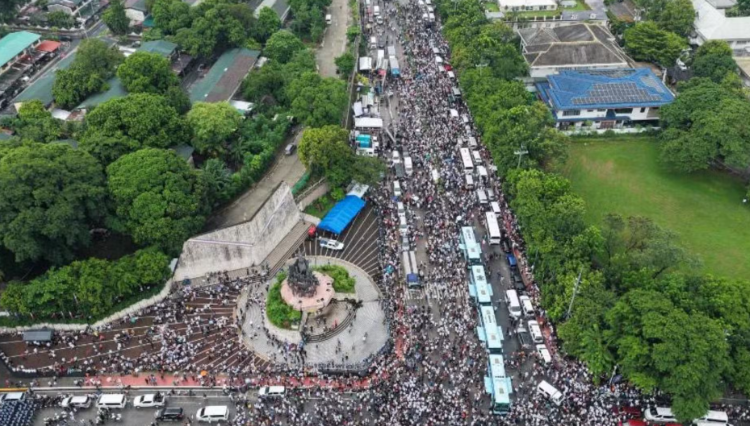
The Iglesia Ni Cristo, one of the Philippines' most influential religious organizations, demonstrated its formidable political muscle on Tuesday with a mass gathering in Manila that brought major traffic disruptions across the capital's key thoroughfare, EDSA. Thousands of church members descended upon the area to voice their opposition to charges being brought against Senator Rodante Marcoleta, a prominent lawmaker and church adherent whose arrest appeared imminent following allegations of financial impropriety. The timing of the protest—just one day after authorities announced the impending charges—underscored the sect's ability to mobilize its membership rapidly when its interests are threatened, a capacity that has long made the organization a consequential player in Philippine electoral politics.
The charges against Marcoleta center on his failure to properly account for 75 million pesos, roughly $1.2 million, in campaign contributions that were never spent during his election drive. Government ombudsman Jesus Remulla formally announced the graft case against the senator, triggering the church's swift response. For the INC, Marcoleta's legal predicament carries implications that extend well beyond one senator's personal legal standing. The church views the case as emblematic of what it characterizes as selective justice, a term that featured prominently in spokesman Edwil Zabala's video statement to supporters gathered on EDSA. Zabala explicitly warned authorities that imprisoning Marcoleta would not silence the organization, signaling the INC's determination to maintain its political influence regardless of legal outcomes directed at its members.
The significance of Marcoleta to Philippine politics lies substantially in his relationship with Vice President Sara Duterte and his expected voting behavior during her upcoming Senate trial. With impeachment proceedings initiated against the vice president following her spectacular rupture with President Ferdinand Marcos, the Senate faces a pivotal vote requiring 16 affirmative ballots from the 24-member chamber to secure her removal and permanent political disqualification. Marcoleta is widely regarded as an automatic vote in Duterte's favor, meaning his potential detention or legal complications could theoretically alter the calculus of her trial. The INC's public mobilization therefore serves dual purposes: protecting one of its own from legal jeopardy while simultaneously safeguarding Duterte's political position, given the substantial overlap between the church's interests and those of the Duterte political dynasty.
The relationship between the INC and the Duterte family extends decades and represents one of the most strategically valuable alliances in Philippine politics. The church's demonstrated capacity to deploy hundreds of thousands of supporters for political demonstrations, as evidenced by massive rallies in recent months, gives it leverage that transcends its formal institutional role. In January, the organization marshaled enormous crowds opposing Duterte's initial impeachment, an effort that ultimately succeeded when the Supreme Court reversed the House proceedings. Now, just months later, the church again finds itself mobilizing its base, this time to protect a senator whose vote may prove decisive in determining whether the Vice President can survive removal efforts initiated by the Marcos administration.
Authorities estimated that between 8,000 and potentially tens of thousands of INC members congregated along EDSA throughout Tuesday, though regional police spokeswoman Hazel Asilo anticipated further crowd growth as the day progressed. The demonstration created severe transportation disruptions affecting the morning commute, with only bus lanes remaining passable amid the gridlocked thoroughfare. The disruption itself functioned as a political statement—the INC's demonstrated capacity to paralyze the capital's transportation infrastructure served as a tangible reminder of the organization's organizational prowess and political leverage. For ordinary Filipinos attempting to navigate their daily routines, the protest represented an intrusion of elite-level political maneuvering into their lived experience.
Marcoleta's legal troubles arrive amid a broader pattern of mounting legal jeopardy for Duterte-aligned senators, suggesting a systematic effort to weaken the vice president's support within the legislative chamber. Senator Jose "Jinggoy" Estrada faces separate corruption charges related to his involvement in a massive fraud scheme surrounding bogus flood control projects, a scandal that has proven genuinely popular in generating public outrage. Senator Ronald "Bato" Dela Rosa, another prominent Duterte loyalist, has essentially disappeared from public life after narrowly evading arrest on an International Criminal Court warrant for his role in the elder Duterte's lethal drug war. The convergence of these legal challenges targeting Duterte's political supporters suggests either a coordinated political strategy or at minimum a pattern of accelerating accountability efforts directed at figures associated with the previous administration.
The INC's own conduct in recent months illustrates the church's deep investment in Philippine political outcomes. In November, the organization staged a rally estimated to draw hundreds of thousands of supporters, ostensibly focused on demanding accountability regarding the flood control scandal but effectively lending political cover to Duterte and her allies by redirecting blame toward President Marcos. This rhetorical maneuver—portraying Marcos as culpable for corruption affecting ordinary Filipinos—proved particularly effective given widespread public frustration over the scandal's human and financial costs. By framing accountability mechanisms as selective persecution, the INC has positioned itself as a guardian against what it characterizes as weaponized justice, a messaging strategy that resonates within its membership.
The larger context involves fundamental questions about Philippine democratic institutions and the rule of law's impartiality. When religious organizations of the INC's scale mobilize politically to influence legal outcomes affecting their members, it raises substantive questions about whether justice systems function according to universal principles or become subject to political and organizational pressure. The church's argument regarding selective justice carries rhetorical force, yet it fundamentally misrepresents the situation—Marcoleta faces charges because of specific alleged conduct concerning campaign finance, not because of religious affiliation. Nevertheless, the INC's framing has proven resonant within its constituency, suggesting that substantial portions of the Philippine electorate interpret legal proceedings against Duterte-aligned figures as politically motivated persecution rather than legitimate accountability.
President Marcos himself appeared sufficiently concerned about the INC's mobilization to cancel a planned luncheon with foreign press on Tuesday, opting instead to monitor developments directly. This presidential-level response underscores the genuine political significance of the church's demonstrated capacity to disrupt normal governance and generate public pressure. For Malaysian and Southeast Asian observers, the situation illustrates how religious organizations in the region can operate as autonomous political actors wielding influence that sometimes exceeds formal institutional mechanisms. The INC's position as a powerful voting bloc with demonstrated organizational capacity creates an asymmetry wherein the organization can impose costs on political actors who displease it.
Vice President Duterte's Senate trial commences July 6, with proceedings that will determine whether she can survive what represents a second impeachment in rapid succession. The trial's outcome depends substantially on senators' votes, meaning that protecting key supporters like Marcoleta from legal complications carries strategic importance. The INC's Tuesday rally functioned simultaneously as pressure exerted on authorities to reconsider Marcoleta's prosecution, defense of a church member facing legal jeopardy, and political positioning ahead of the trial. Whether these simultaneous objectives can be achieved remains uncertain, but the church's demonstrated willingness to disrupt the capital and mobilize its constituency suggests it will continue deploying its organizational resources to protect its political interests and allies.

