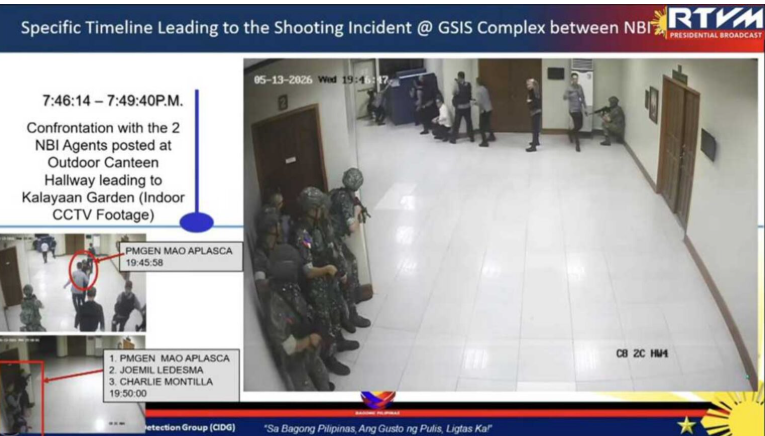
The Philippine Department of Justice has initiated a formal investigation into potential criminal charges against government officials in connection with a shooting incident at the Senate building on May 13 and the escape of Senator Ronald dela Rosa from protective custody the following morning. Justice Secretary Fredderick Vida announced that a dedicated panel of prosecutors is examining the circumstances surrounding both events, with particular focus on establishing whether they are related.
According to Vida's account, the prosecution team has gathered substantial evidence through interviews with National Bureau of Investigation personnel and media representatives, supplemented by closed-circuit television recordings. The CCTV footage shows that shots were fired from the fifth floor of the Senate building, with ballistic evidence suggesting a sniper was involved. The shots were directed at an identifiable vehicle belonging to the NBI that was stationed at the GSIS premises at the time of the incident.
The investigation represents a significant development in what appears to be a complex security breach involving some of the highest-ranking officials in the Philippine government. The timing of the two incidents—the shooting followed hours later by Dela Rosa's unexplained departure from protective custody—has raised serious questions about the coordination of security protocols and potential lapses in institutional oversight. For Malaysian observers, the case highlights vulnerabilities that can emerge in executive protection arrangements even in established democracies.
Vida acknowledged that while the investigation remains in its preliminary stages, initial findings suggest that multiple public officials may have been involved in or aware of the events in question. He refrained from identifying specific individuals but indicated that the scope of involvement extends beyond lower-ranking personnel. This measured approach suggests the DOJ recognizes the gravity of investigating senior government figures and understands the need to build an airtight case before making accusations.
The Justice Secretary emphasized that the department intends to handle the matter with complete professionalism, objectivity, and impartiality, assuring the public that no official will receive preferential treatment regardless of rank. At the same time, Vida cautioned against premature judgments, noting that all evidence must be thoroughly examined before conclusions are reached. This balancing act reflects the institutional tension inherent in investigating officials at the highest levels of government.
The incident raises broader questions about institutional autonomy within the Philippine system. The fact that officials from the NBI, a body theoretically independent from political interference, were present during the shooting and involved in Dela Rosa's custody suggests the involvement of law enforcement agencies in events that may have extended beyond routine security operations. For Southeast Asia more broadly, the case illustrates how shooting incidents and protective custody escapes at such prominent locations signal deeper institutional problems that demand transparent investigation.
Senator Dela Rosa is a prominent political figure whose sudden departure from protective custody under such circumstances appears highly irregular and suggests either a deliberate removal or a coordinated action. His history as a former police chief and key figure in contentious drug policy initiatives makes him a figure of considerable controversy, which may explain both the protective custody arrangement and the subsequent security breach. The fact that his escape coincided with the shooting raises the possibility of coordination, though establishing such links requires careful evidentiary work.
The CCTV evidence referenced by Vida appears to be the cornerstone of the investigation's progress thus far. Footage showing the precise location from which shots were fired—the fifth floor of the Senate building—should theoretically enable investigators to identify who had access to that area and trace movements of relevant personnel. Security protocols at the Senate would typically restrict access to such areas, meaning the shooter either had legitimate authorization or breached security systems.
For the Philippine justice system, successfully prosecuting public officials in connection with these events would represent a significant test of institutional independence. Prosecutors must navigate political sensitivities while maintaining credibility with the public and international observers. The DOJ's emphasis on pursuing the matter "without fear or favor" suggests awareness of these pressures and a commitment to overcoming them.
The investigation also has potential implications for regional security arrangements. If coordinated action by multiple officials is confirmed, it would demonstrate vulnerabilities in systems designed to protect senior government figures and maintain institutional stability. This could prompt reviews of protective custody protocols across Southeast Asian countries and inform discussions about checks and balances within executive security frameworks.
Vida's statement that "no individual is above the law" carries particular weight given that the suspects appear to include public officials, some of whom likely possess significant institutional power. The Justice Department faces the challenge of proving this principle through concrete action. The months ahead will reveal whether the investigation produces concrete charges, convictions, or whether obstacles emerge that impede progress.
The investigation's outcome will have lasting consequences for public confidence in Philippine institutions. A thorough, transparent process that holds officials accountable regardless of rank would strengthen democratic institutions. Conversely, perceived compromises or political interference could undermine public trust in the justice system and create precedent for similar incidents in the future. The DOJ's stated commitment to objectivity will be tested as the investigation proceeds and approaches politically sensitive findings.