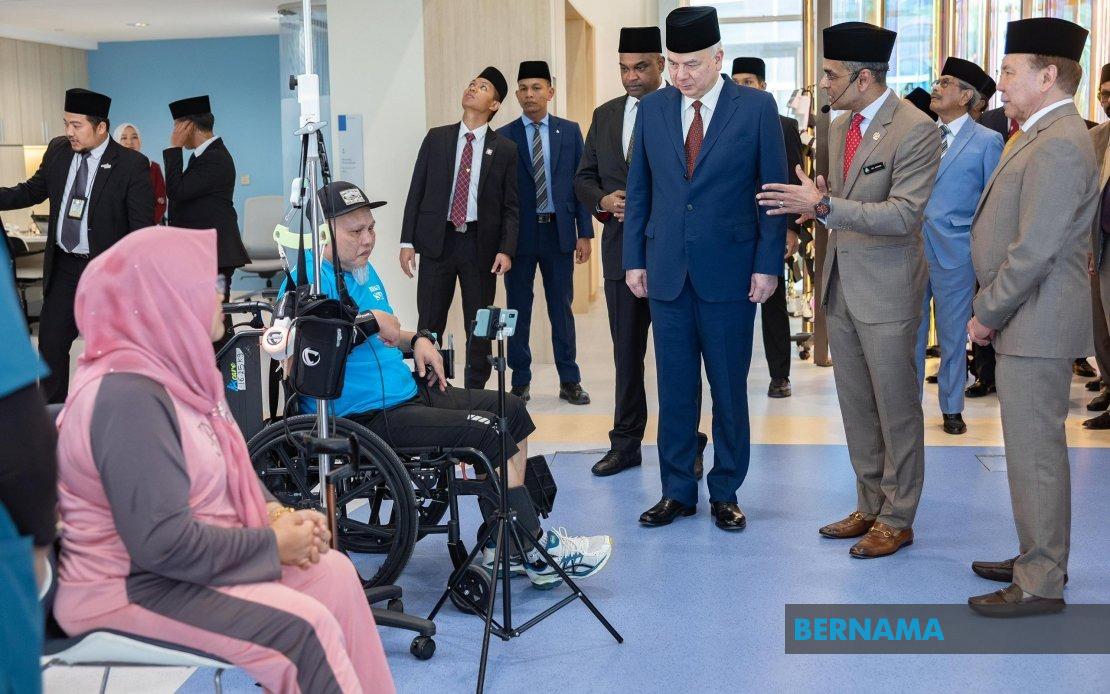
Sultan Nazrin Shah of Perak has inaugurated a state-of-the-art rehabilitation facility that represents Malaysia's commitment to modernising social healthcare and workplace injury recovery services. The Neuro-Robotics and Cybernetics Rehabilitation Centre, officially named Pusat Rehabilitasi Perkeso Sultan Nazrin Shah, was opened on June 16 in Meru Raya, Ipoh, marking a significant institutional investment in the country's approach to helping injured and disabled workers rebuild their lives through technology and specialist care.
The facility's architectural design draws inspiration from traditional Malaysian art forms, specifically the intricate techniques of gold-thread embossing, blending contemporary functionality with cultural aesthetics. This thoughtful design choice signals that the rehabilitation experience need not sacrifice dignity or beauty in favour of clinical efficiency. The centre brings together an integrated team of medical doctors, assistive technology specialists, physiotherapists, occupational and vocational therapists, alongside social workers and mental health professionals, creating a comprehensive ecosystem for patient recovery that extends beyond purely physical rehabilitation.
In his address, the Sultan articulated a vision of rehabilitation that transcends basic medical intervention. He emphasised that the true measure of such a facility lies not merely in its technological capabilities or architectural grandeur, but in the expertise, compassion and commitment of the human beings staffing it. This framing is particularly significant in Malaysian healthcare discourse, where rapid modernisation sometimes risks overshadowing the relational and dignity-centred aspects of care. Sultan Nazrin's remarks pivot attention toward the cultural and social dimensions of rehabilitation, treating recovery not as a technical problem to be solved but as a human journey requiring holistic support.
The Sultan's address conveyed a broader philosophical statement about national progress and social responsibility. He argued that true advancement cannot be measured solely through conventional economic metrics or physical infrastructure development. Instead, he positioned rehabilitation and disability support as central to evaluating a nation's maturity and moral foundation. This perspective challenges the growth-at-all-costs mentality that sometimes dominates policy conversations in the region, proposing instead that inclusive social programmes and the protection of vulnerable populations constitute essential components of genuine development.
The centre originated during the tenure of Ipoh Barat Member of Parliament M. Kulasegaran, who championed the initiative while serving as Minister of Human Resources from 2018 to 2020. This continuity in political commitment, spanning multiple administrations, suggests some degree of cross-party consensus on rehabilitation policy priorities. The project's realisation demonstrates that even during periods of political transition, certain social healthcare priorities can maintain institutional momentum when they enjoy sufficient political sponsorship and bureaucratic support.
Sultan Nazrin specifically highlighted how the facility could serve different patient populations. For stroke survivors, the centre offers the prospect of regaining lost motor function. Workers recovering from neurological injuries gain access to comprehensive programmes designed to rebuild both physical capability and mental resilience. Individuals with traumatic brain injuries may access services targeting memory restoration, speech therapy and psychological rebuilding. This patient-centred framing underscores that rehabilitation outcomes vary significantly across diagnostic categories, requiring tailored interventions rather than one-size-fits-all approaches. The Sultan's enumeration of these diverse pathways emphasises that the facility's value extends across multiple injury types and demographic groups.
A particularly noteworthy aspect of the Sultan's remarks concerned the post-rehabilitation employment landscape. He drew specific attention to PERKESO's partnership with 7-Eleven, which provides workplace training for rehabilitation graduates with the prospect of subsequent employment. This innovation addresses a critical gap in many rehabilitation systems globally—the transition from medical recovery to economic reintegration. Without meaningful employment prospects, even successful medical rehabilitation may leave individuals and families struggling financially. The Sultan's emphasis on this partnership model signals recognition that vocational reintegration constitutes a essential component of dignity restoration for injured workers.
The Sultan explicitly appealed to Malaysia's private sector to expand such partnerships through corporate social responsibility initiatives, employment placements and vocational training. This appeal reflects pragmatic understanding that rehabilitation services alone cannot fully address the economic needs of recovered workers; they require complementary employer engagement. The Malaysian business community's response to such appeals will partly determine whether rehabilitation graduates successfully transition to self-sufficiency or remain economically marginalised. This represents both an opportunity and a test of corporate commitment to inclusive practices beyond charitable donations.
The opening also underscored the need for broader social attitude shifts regarding disability. Sultan Nazrin called explicitly for the elimination of prejudice toward persons with disabilities, framing such attitudes as barriers as significant as physical impairments. This social dimension of disability recognition reflects contemporary understanding in disability studies that access and inclusion require attitudinal change alongside institutional investment. Malaysia's cultural and religious contexts—emphasising communal responsibility and collective welfare—provide potential foundations for mobilising such attitudinal shifts, though achieving them requires sustained public messaging and institutional leadership.
The facility's naming after the Sultan himself carries symbolic weight beyond honouring protocol. It signals royal endorsement of rehabilitation as a priority concern within the Perak state and broader national agenda. Such symbolic gestures, while sometimes viewed cynically, can influence institutional priority-setting and public perceptions regarding the legitimacy and importance of social programmes. The fact that a reigning Sultan personally inaugurated a rehabilitation centre—delivering substantive remarks about social philosophy rather than merely attending a ceremonial function—communicates that such work enjoys elite institutional support.
For Malaysian workers and their families, the centre's opening offers both immediate practical benefits and longer-term reassurance. Those facing catastrophic workplace injuries or neurological conditions now have access to world-class rehabilitation infrastructure. More broadly, the facility's existence and royal endorsement signal that Malaysian society recognises obligations toward its injured and disabled citizens. This matters beyond the direct beneficiaries; it shapes how all workers experience their relationship to the social safety net and influences their willingness to engage with workplace safety protocols and rehabilitation programmes.
The Sultan's closing remarks positioned this rehabilitation initiative within a larger framework of national purpose and social contract. He emphasised that genuine progress requires societies to protect human dignity, support vulnerable populations and create pathways for individuals to rebuild after experiencing illness, injury or disability. This perspective, articulated by a reigning monarch at a major infrastructure opening, attempts to establish rehabilitation and inclusive social policy as matters of fundamental national concern rather than peripheral charitable concerns. Whether this rhetorical positioning translates into sustained funding, political prioritisation and private sector engagement remains to be demonstrated through implementation over coming years.