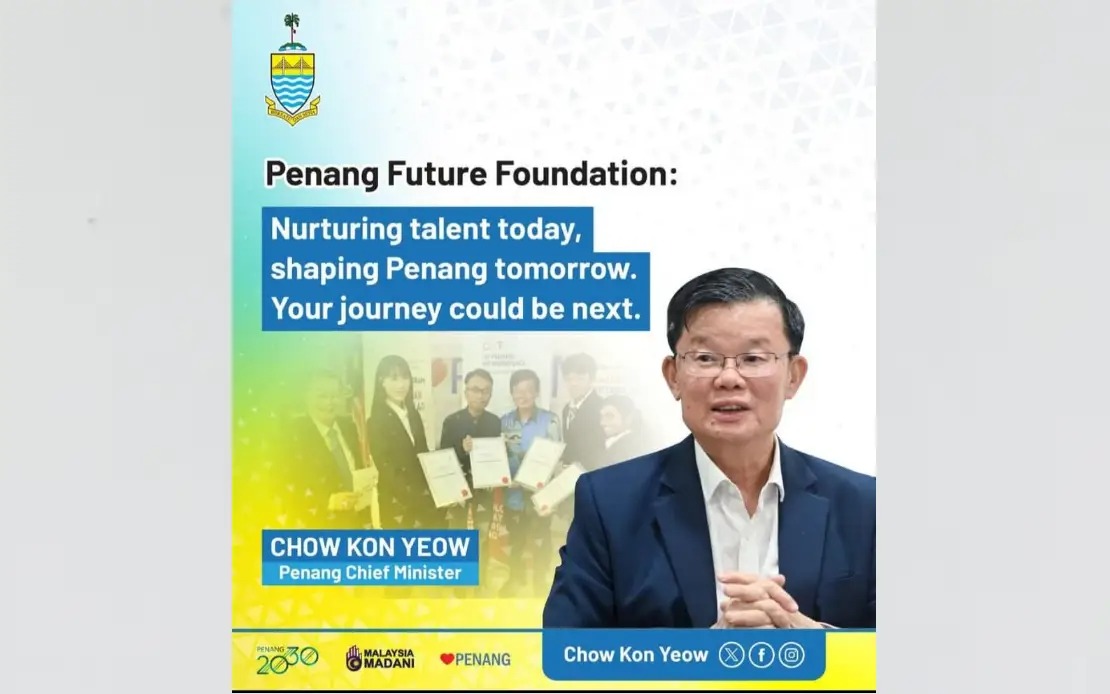
The Penang Future Foundation, a state government-backed scholarship programme launched in 2015, has channelled nearly RM47.7 million across 863 awards to accomplished Malaysian students over the past decade. Chief Minister Chow Kon Yeow revealed the milestone achievement, underscoring the initiative's significance as Penang positions itself for sustained economic expansion and continued positioning as an attractive destination for corporate investment across Southeast Asia.
Now entering its 11th year of operation, the foundation represents a strategic investment in human capital development, drawing financial support from both government coffers and private sector partners. The dual-funding model reflects recognition among Penang's stakeholders that competitive advantages in attracting multinational corporations and expanding local industries depend substantially on access to a skilled workforce. The scholarship programme thus functions as both a talent pipeline and a retention mechanism, addressing the persistent challenge of brain drain that affects many Malaysian states competing for high-performing graduates.
In the previous academic year alone, the foundation extended support to 58 scholars pursuing qualifications in high-demand disciplines. Science, Technology, Engineering, and Mathematics programmes dominate the awards portfolio, accompanied by accountancy and finance qualifications. This sectoral focus aligns with Malaysia's broader economic transition toward knowledge-intensive industries and digital transformation, areas where Penang maintains particular strengths given its established semiconductor, electrical, and electronics manufacturing clusters.
Chow emphasised that maintaining Penang's competitive edge over the coming five decades necessitates deliberate efforts to attract and retain top-tier talent from across the country. The foundation opens its selection criteria to all Malaysian applicants regardless of state origin, reflecting the reality that economic dynamism depends on drawing the highest-performing students from nationwide talent pools. This nationwide recruitment strategy has become increasingly important as Malaysian universities compete globally for bright minds, with many graduates seeking opportunities abroad.
The foundation operates through two distinct scholarship tiers, each addressing different academic performance levels. The PFF Penang Scholar programme targets high-achieving students maintaining cumulative grade point averages of 3.67 or higher, catering to those demonstrating exceptional academic excellence. The PFF Mutiara Scholar award accommodates applicants with CGPA between 3.00 and 3.66, broadening access to talented students who may face financial constraints despite solid academic credentials. This tiered approach recognises that financial barriers often prevent capable students from pursuing tertiary education, regardless of their academic merit.
For Malaysian students considering their educational pathways, the upcoming application cycle presents a significant opportunity. The 2026 scholarship window opens on July 15 and closes on August 5, providing a compressed but manageable timeframe for interested applicants to prepare their submissions. Students are advised to monitor the foundation's official website at www.penangfuturefoundation.my for detailed application requirements, selection criteria, and supporting documentation guidelines as the application period approaches.
The scholarship initiative carries particular relevance for Malaysian families seeking to manage educational expenses while maintaining quality of life. Tertiary education costs have risen substantially across Malaysia, with overseas qualifications commanding premium fees that place higher education beyond reach for many talented students from middle and lower-income backgrounds. By subsidising education through merit-based scholarships, the Penang Future Foundation addresses both individual circumstances and broader economic imperatives.
From a regional perspective, Penang's commitment to talent development reflects broader Southeast Asian trends as nations compete for skilled workers in emerging sectors. Thailand, Vietnam, and Indonesia have launched similar programmes, recognising that workforce quality increasingly determines competitiveness in manufacturing, technology, and service sectors. Penang's long-established reputation as Malaysia's premier industrial hub rests substantially on the quality and dedication of its workforce, making continued investment in education and talent development strategically essential.
The foundation's track record since 2015 demonstrates measurable impact on educational access and economic capability building. Nearly 900 Malaysian students have benefited from financial support that enabled them to pursue qualifications that might otherwise have remained unattainable. Many of these graduates have subsequently contributed to Penang's economic ecosystem through employment in major corporations, professional services firms, and entrepreneurial ventures, creating multiplier effects throughout the state economy.
Looking ahead, the foundation faces both opportunities and challenges. As Malaysia's economy evolves toward greater emphasis on innovation, digitalisation, and sustainable development, scholarship allocation may require reorientation toward emerging fields such as renewable energy, artificial intelligence, biotechnology, and green finance. Simultaneously, the foundation must balance geographic diversity in scholarship distribution while maintaining academic standards that ensure recipients can effectively contribute to their chosen sectors.
Prospective applicants should recognise that merit-based scholarships represent investment propositions for both the foundation and the awardees. The foundation expects recipients to leverage their qualifications toward meaningful contributions within Malaysia's economy, while scholars gain not only financial support but also membership within a cohort of high-performing peers. This network effect creates lasting professional connections that often generate collaboration opportunities throughout recipients' careers.

