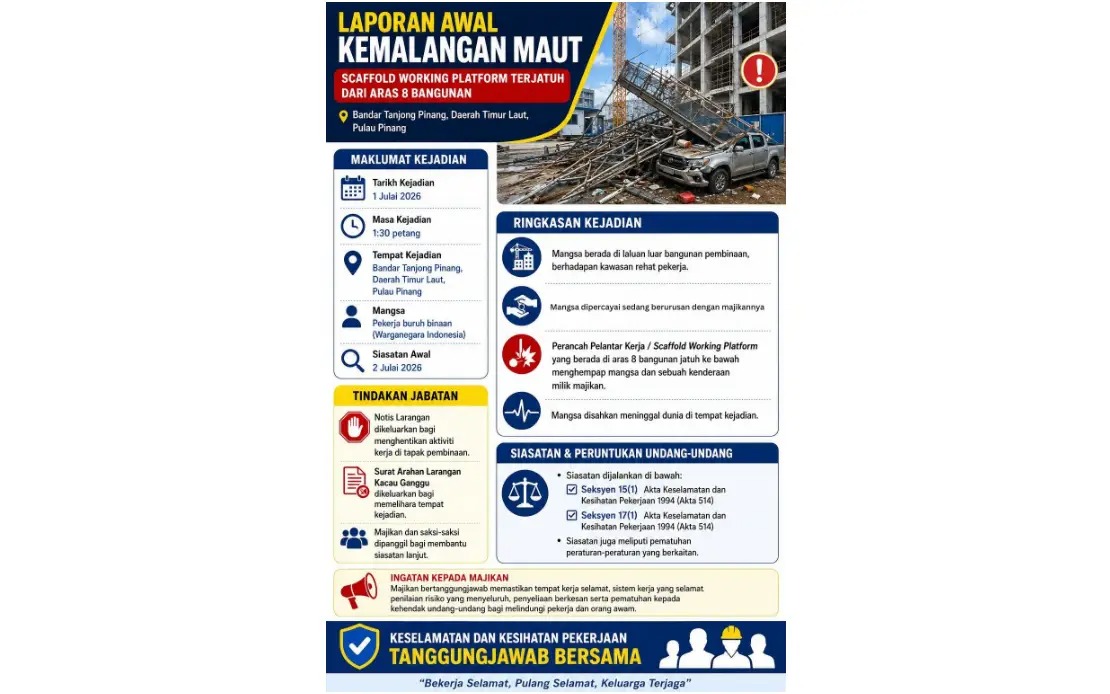
The Department of Occupational Safety and Health (DOSH) in Penang has issued a prohibition notice requiring the immediate cessation of all work activities at a construction site in Bandar Tanjong Pinang, triggering a formal investigation into a fatal accident that claimed the life of an Indonesian worker. The incident, which occurred on July 1 at 1.30 pm, has prompted authorities to take swift enforcement action and underscores the ongoing challenges facing Malaysia's construction sector in maintaining workplace safety standards.
According to the DOSH statement, the fatality resulted from a scaffolding working platform that detached from the eighth floor of the building and fell onto the victim, who was positioned at a lower level on an external walkway adjacent to the workers' rest area. The worker was in communication with his employer at the time the platform came loose, and the falling structure not only struck the individual but also damaged a vehicle belonging to the employer. The collision represents a serious breach in the chain of safety protocols that should protect workers at elevated construction sites.
The regulatory response has been comprehensive. Beyond the work stoppage order, DOSH has issued a non-disturbance directive to preserve the accident scene in its original state, a critical measure that will allow investigators to gather evidence and reconstruct exactly what transpired during the collapse. This dual approach—halting operations while maintaining forensic integrity—reflects international best practices in workplace accident investigation and demonstrates Penang DOSH's commitment to establishing accountability.
The investigation currently underway will examine compliance with specific provisions of the Occupational Safety and Health Act 1994, particularly Sections 15(1) and 17(1), which establish the fundamental duties owed by employers to their workers. These sections require employers to ensure that workplaces are maintained in a safe condition and that all machinery, equipment, and structures are properly installed and maintained. The focus on these particular legal provisions suggests investigators suspect inadequacies in scaffolding maintenance, installation procedures, or structural integrity assessments.
Employers and witnesses are being systematically interviewed as part of the investigation process. The comprehensive nature of this inquiry reflects the seriousness with which Malaysian authorities treat fatalities in the construction industry, an economic pillar in Penang and throughout Southeast Asia. For Malaysian readers, this incident serves as a stark reminder of the human cost when safety protocols are compromised or overlooked in the pursuit of project timelines and cost efficiencies.
Penang DOSH has made clear that enforcement action will follow if the investigation reveals violations of workplace safety legislation. This position is significant because it signals that regulatory bodies are prepared to pursue criminal or administrative penalties against responsible parties, whether main contractors, subcontractors, or site supervisors. Such accountability measures are essential for deterring future negligence and creating a culture of genuine safety consciousness throughout the construction industry.
The incident highlights a persistent vulnerability in Malaysia's construction ecosystem. Foreign workers, who constitute a substantial portion of the workforce on major building projects across the country, are often among the most vulnerable to accidents due to language barriers, limited familiarity with local safety protocols, and sometimes inadequate training in hazard recognition. The death of this Indonesian worker points to systemic gaps that extend beyond a single site and warrant broader examination of how the industry safeguards migrant labour.
Penang DOSH's statement emphasizing that all workplace accidents are taken seriously, particularly those resulting in fatalities, reflects a shift towards more stringent regulatory oversight in the state. The directive to employers, developers, main contractors, and subcontractors underscores expectations that all parties involved in construction projects must ensure work is properly planned and executed safely. This messaging is not merely procedural; it represents a public commitment to protecting worker welfare and preventing further tragedies.
The implications of this incident extend beyond Penang's borders. As a major manufacturing and construction hub in Malaysia, the state's safety standards and enforcement approaches influence industry practices throughout the region. Neighbouring states and international partners often observe how Malaysia's regulatory bodies respond to high-profile workplace failures. A rigorous investigation followed by meaningful enforcement action sends a powerful signal that safety violations carry genuine consequences, potentially raising standards across multiple jurisdictions.
For construction companies operating in Penang and throughout Malaysia, this incident serves as a cautionary reminder of the non-negotiable importance of scaffolding maintenance programmes, regular safety audits, and worker training initiatives. The costs of implementing comprehensive safety measures pale in comparison to the financial, legal, and reputational consequences of fatal workplace accidents. Insurers and risk management professionals will likely scrutinize construction site safety records more closely in the wake of this death, potentially increasing pressure on project managers to invest more substantially in preventive measures.
The investigation's eventual findings will likely generate broader discussion about whether current regulations adequately address the specific hazards associated with high-rise construction in Malaysia. Stakeholders may call for enhanced oversight mechanisms, mandatory safety certifications for scaffolding contractors, or revised building codes that impose stricter requirements for elevated work platforms. The regulatory conversation sparked by this tragedy may ultimately yield systemic improvements that benefit future generations of workers across the industry.
As authorities complete their investigation into the Bandar Tanjong Pinang incident, the construction industry faces mounting pressure to demonstrate that worker safety is not merely a compliance requirement but a fundamental operational principle. The work stoppage order represents more than an administrative action; it embodies society's expectation that human life takes precedence over project schedules and financial considerations. This fundamental principle will likely continue to shape workplace safety discourse in Penang and throughout Malaysia in the months ahead.

