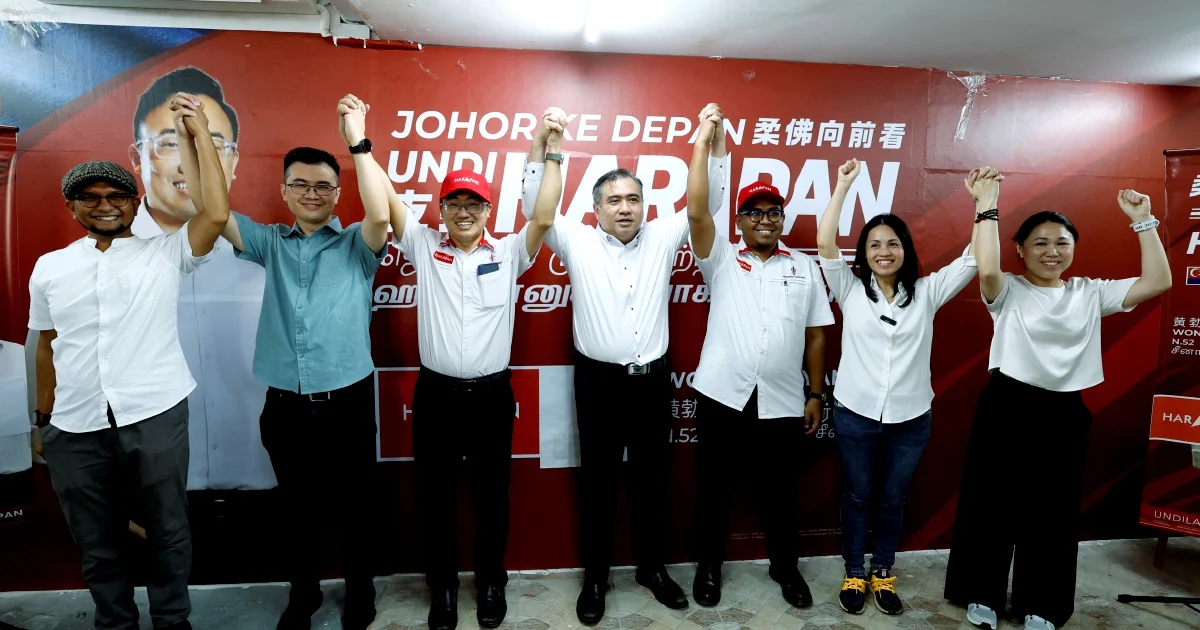
Pakatan Harapan's strategy for the Johor state election prioritises securing electoral victory before addressing the succession question for Menteri Besar, with the coalition's top leadership to determine its candidate at a later stage if it prevails at the polls.
The decision to defer naming a specific contender reflects a calculated political approach, concentrating the coalition's campaign messaging on broader governance themes rather than internal power dynamics. By postponing the announcement, PH appears intent on avoiding distractions that could fragment voter support or invite scrutiny of competing ambitions within its ranks during the crucial campaign period.
This deferment strategy carries implications for multiple stakeholders within the coalition. Different component parties may harbour their own candidates for the role, and premature disclosure could trigger internal tensions that undermine unity messaging to voters. The approach effectively buys time for negotiations among PH's constituent parties, allowing them to assess their respective electoral contributions before determining cabinet positions.
For Johor voters, the decision means choosing between coalition visions without knowing precisely who would lead state affairs if PH wins. This reflects a broader pattern in Malaysian politics where campaign promises occasionally precede clarity about implementation structures and personnel. However, it also suggests PH leadership retains confidence in the appeal of its broader platform independent of a pre-announced figurehead.
The deferment carries strategic weight in Johor's political landscape, where the state remains competitive between ruling coalitions. By maintaining flexibility on the Menteri Besar question, PH preserves space to accommodate different power-sharing arrangements among its partners while responding to pre-election dynamics. Coalition formations in Malaysian state politics frequently involve post-election negotiations, and PH's approach aligns with this pragmatic tradition.
Internally, this stance could influence party positioning within the coalition. Components with stronger anticipated electoral performances may expect greater say in determining the Menteri Besar, creating incentives for robust campaign mobilisation. The eventual decision will likely reflect the electoral footprint each party contributes to PH's Johor result, making party-level campaign success directly consequential for leadership selection.
For the broader Southeast Asian context, PH's approach illustrates how Malaysian coalition politics operates distinctly from first-past-the-post systems where single-party dominance determines leadership immediately. The requirement to negotiate among multiple parties creates both flexibility and uncertainty, characteristics that shape how Malaysian political campaigns unfold and how governance structures subsequently take form.
The postponement also signals that PH prioritises messaging discipline during the campaign. By keeping the Menteri Besar question open, the coalition avoids scenarios where internal candidate rivalries consume media attention or where one announced hopeful becomes a lightning rod for opposition attacks. This tactical choice reflects lessons from previous elections where intra-coalition tensions proved counterproductive.
Regional observers note that such deferments have become increasingly common in Malaysian electoral contests, particularly in multi-party coalition environments. The practice acknowledges that campaign phases and governing phases operate under different logics, with the former demanding unity and the latter permitting differentiation. PH's Johor approach exemplifies this temporal separation.
The timing of any eventual announcement will prove politically significant. Naming the candidate too soon after an election victory risks appearing presumptuous before formal results tabulation. Delaying excessively could create perceptions of indecision or internal discord. PH's leadership council will likely calibrate the announcement timing to coincide with formal government formation procedures, creating an appearance of systematic transition.
For opposition parties, PH's deferment presents both opportunities and constraints. Attack strategies focusing on presumed successors become impossible without named targets. Conversely, opposition parties might leverage uncertainty to raise questions about PH's internal coherence and readiness to govern. The absence of a named Menteri Besar candidate becomes itself a campaign argument, requiring PH to defend the strategic logic of postponement.
The stance also reflects pragmatic recognition that electoral coalitions in Malaysia sometimes shift between campaign announcement and actual government formation. Parties occasionally perform significantly differently than anticipated, altering the balance of power among coalition members. Deferring the Menteri Besar decision preserves PH's ability to adjust to actual electoral outcomes rather than binding itself to pre-election assumptions about relative party strengths.
Moving forward, Malaysian political observers should expect the Menteri Besar decision to emerge only after comprehensive post-election negotiations among PH component parties. The timeline, likely measured in weeks rather than days post-polling, will reflect the complexity of determining not just the top state position but broader cabinet portfolios and power distributions. This sequential approach, while deferring closure, permits the coalition to maximise internal alignment before announcing its governing team.

