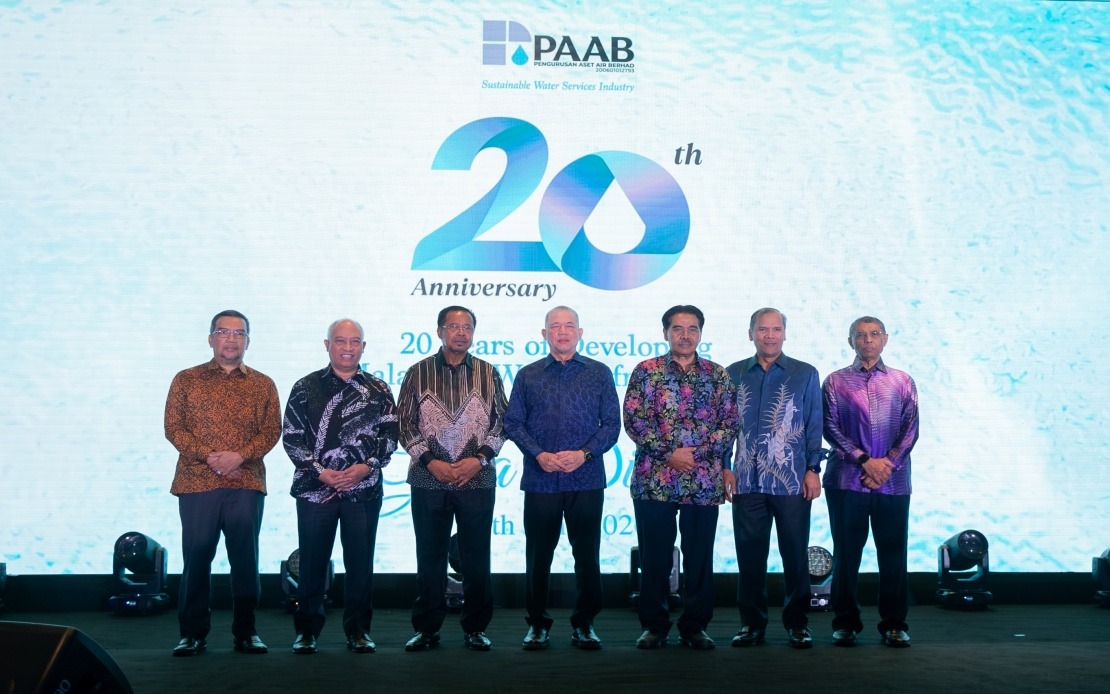
Pengurusan Aset Air Berhad (PAAB), the state-owned entity entrusted with Malaysia's water sector restructuring, has reached a significant milestone this week by marking two decades of operations since its establishment on May 5, 2006. The occasion underscores a critical juncture in the country's efforts to overhaul and modernise its water supply infrastructure, an undertaking that has commanded unprecedented levels of government capital and strategic coordination across multiple stakeholders.
Over its 20-year lifespan, PAAB has functioned as the financial backbone of the water industry's transformation, assuming water-related debt burdens and channelling investments into physical assets nationwide. The scale of its interventions is substantial: PAAB has financed the takeover of water industry loans totalling RM23.04 billion while simultaneously investing RM23.84 billion in new infrastructure development. Combined, these figures amount to RM46.88 billion, positioning the agency as one of Malaysia's largest infrastructure investors and reflecting the magnitude of capital requirements to modernise a sector long characterised by underinvestment and operational fragmentation.
The investment has yielded tangible outcomes visible across the country. As of December 2025, ten states have formally adopted the National Water Services Industry Restructuring Plan, triggering completion of major infrastructure projects. These accomplishments include the construction of 21 new water treatment plants with a combined daily capacity of 2,085 million litres, installation of 42 storage tanks capable of holding 783 million litres, and upgrades extending to 3,263 kilometres of pipelines. These figures translate into measurable improvements in the nation's water delivery capacity, though questions remain about whether the pace of expansion matches growing demand in urbanising areas and water-intensive industries.
Deputy Prime Minister Datuk Seri Fadillah Yusof, who holds the Energy Transition and Water Transformation portfolio, officiated the anniversary dinner at Menara Felda Platinum Park and used the platform to inject urgency into the national conversation around water security. His remarks centred on the persistent problem of non-revenue water—the proportion of treated water lost through leakage and theft before reaching consumers—which currently stands at approximately 40 per cent nationwide. This figure represents both a significant waste of treated water and an economic loss, as utilities cannot recover costs for water that never reaches paying customers.
Fadillah's intervention signals growing impatience within government regarding the pace of water sector reform. He explicitly criticised reliance on extended timelines, noting that waiting until 2050 to fully resolve non-revenue water losses is incompatible with Malaysia's economic aspirations and immediate challenges. His argument reflects a pragmatic assessment: as Malaysia seeks to attract foreign direct investment in data centres and other water-intensive industries, stable supply becomes a competitive necessity rather than a nice-to-have amenity. Companies investing hundreds of millions of ringgit in such facilities require guarantees that water supply will not be disrupted, a promise difficult to honour when 40 per cent of the supply chain hemorrhages water.
The Deputy Prime Minister emphasised that addressing the non-revenue water problem demands coordinated action among federal agencies, state governments, and operational companies working simultaneously rather than sequentially. This multi-stakeholder approach reflects the fragmentation that has historically plagued Malaysia's water sector, where responsibility is distributed across federal and state governments, multiple operators, and regulatory bodies. Improving system performance requires breaking down silos between these entities and compelling them to adopt common standards and data-sharing protocols.
PAAB's own leadership articulated the long-term strategic vision underlying these interventions. Jaseni Maidinsa, the agency's chairman, outlined a phased approach spanning four decades: Migration from 2008 to 2020, Stabilisation from 2021 to 2030, Consolidation from 2031 to 2040, and Full Cost Recovery from 2041 to 2050. This framework attempts to balance immediate operational needs with fundamental restructuring of the water industry's financial model, which has traditionally relied on government subsidies to keep tariffs affordable. Full cost recovery would require tariff adjustments to levels that reflect true supply costs—a politically sensitive transition requiring careful sequencing and public communication.
Breaking down PAAB's capital expenditure of RM23.84 billion through December 2025 reveals the distribution of investments across project lifecycles. Completed projects handed over to operators account for RM8.33 billion, representing assets now in productive use. Projects currently under construction have absorbed RM1.84 billion, indicating ongoing implementation. The largest allocation, RM13.67 billion, remains in design and planning stages, suggesting that the heaviest construction activity lies ahead. This pipeline of future projects indicates that infrastructure development will remain a dominant theme in Malaysian water policy for years to come.
The agency's success metrics have evolved beyond simple financial accounting. PAAB increasingly measures its impact through indicators of water supply quality, reliability, and equitable access for consumers. This reorientation reflects recognition that investing billions in pipes and treatment plants matters only insofar as these systems deliver clean, safe water to households and businesses without interruption. Quality dimensions include not merely physical water purity but also consistency of supply, absence of service disruptions, and reasonable pricing.
For Malaysia's regional standing, the water sector restructuring holds significance beyond national borders. Southeast Asia faces escalating water stress as rapid urbanisation, agricultural intensification, and climate variability strain finite freshwater resources. Malaysia's experience—spanning governance reforms, capital mobilisation, technological adoption, and stakeholder coordination—offers instructive lessons for neighbouring countries grappling with similar challenges. The PAAB model of centralising financing while devolving operations could serve as a template for regional peers seeking to attract capital and expertise into water infrastructure.
Looking forward, the anniversary moment crystallises both progress and unfinished business. Two decades of PAAB's existence have demonstrably upgraded Malaysia's water infrastructure at a scale previously unimaginable. Simultaneously, persistent challenges such as non-revenue water losses and uneven service quality across regions indicate that structural transformation remains incomplete. The Deputy Prime Minister's insistence on accelerated action suggests that policy attention and resources will intensify, potentially accelerating the planned transition toward full cost recovery and improved system resilience. For Malaysians, this trajectory promises more reliable water supply but also eventual exposure to tariff adjustments reflecting true infrastructure costs—a trade-off that future policy debates will inevitably confront.

