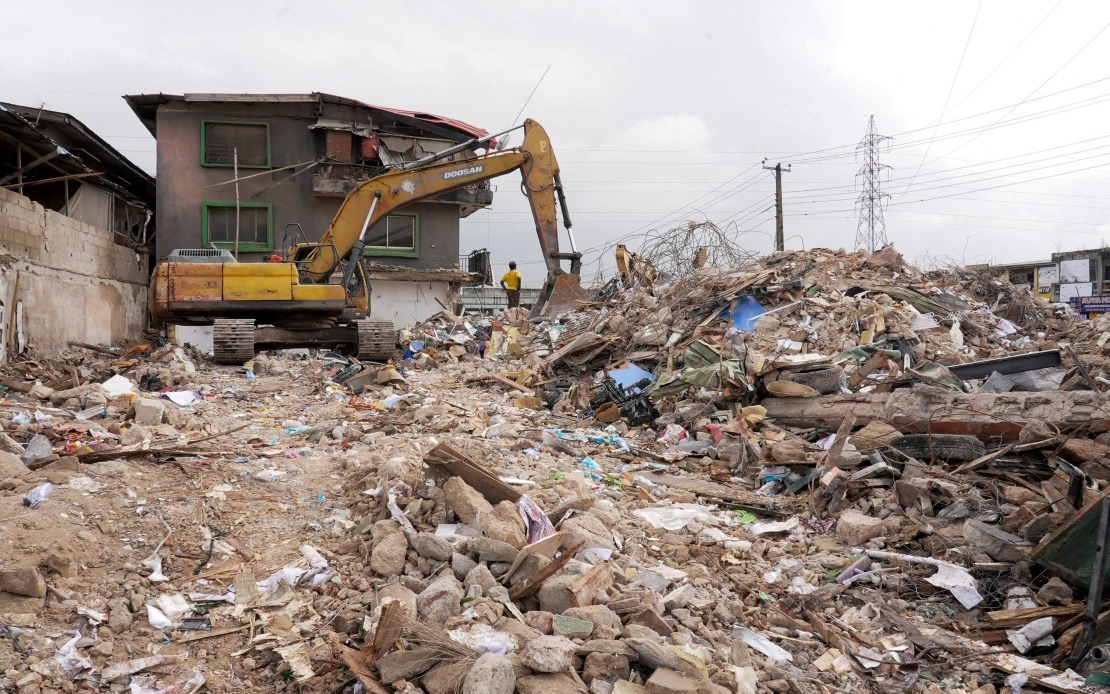
A devastating structural failure at a three-storey shopping complex in Lagos, Nigeria's most populous state, has claimed nine lives while rescue teams managed to extract 27 survivors from the wreckage. The building, located in Alakija along the Lagos-Badagry Expressway, gave way on Thursday morning, triggering an immediate response from multiple emergency agencies that coordinated rescue efforts throughout the following day.
Alaakija, a rapidly expanding satellite settlement increasingly serving Lagos's sprawling metropolitan demand, has become the site of significant commercial development. The collapse of this shopping facility underscores the vulnerability of newer districts that experience rapid, sometimes haphazardly planned construction. The expressway corridor itself forms a crucial commercial and transportation spine for the region, connecting the megacity to outlying areas and facilitating daily movement of thousands of workers and traders.
Olufemi Oke-Osanyintolu, permanent secretary at the Lagos State Emergency Management Agency, confirmed that rescue personnel worked continuously following the Thursday morning incident to systematically locate and extract those trapped beneath tonnes of concrete and steel. The coordination requirement for such operations demands significant resources and expertise—teams had to carefully move debris while ensuring unstable sections did not shift, potentially causing additional fatalities. The agency confirmed that all individuals found in the rubble had been accounted for by early Friday, marking the conclusion of active rescue work.
Among those pulled alive from the collapse were shop proprietors and customers engaged in regular commercial transactions when the structure failed. Numerous neighbouring residents also found themselves ensnared, expanding the geographical scope of the disaster beyond the shopping complex itself. The injured survivors sustained injuries ranging from minor to serious, with medical facilities across Lagos receiving patients for treatment and ongoing care. Hospital admissions following building failures typically strain local healthcare infrastructure, particularly in contexts where multiple trauma cases arrive simultaneously requiring specialized attention.
The China Civil Engineering Construction Corporation, which maintains active operations in the region implementing railway infrastructure projects, joined state and federal rescue teams in the excavation and recovery efforts. This involvement reflects both the international dimension of Lagos's development landscape and the practical reality that construction equipment and expertise held by major project contractors can prove invaluable during emergencies. Such cooperation, while essential in crisis situations, also highlights how development projects can intersect with community safety concerns.
Investigators remain unable to definitively establish why the structure failed, though a formal inquiry has been initiated. Determining causation requires detailed structural analysis and examination of blueprints, construction permits, and materials used during assembly. Preliminary findings will likely take weeks to develop fully, as forensic engineers must assess whether failure resulted from design flaws, implementation errors during construction, material degradation over time, or some combination of factors.
The incident sits within a broader context of recurring structural failures across Nigeria that have drawn international attention and criticism. Experts consistently point to interconnected vulnerabilities within the construction sector: many existing buildings utilise substandard materials that deteriorate rapidly under tropical climate conditions and intense usage; building codes and safety regulations remain frequently violated with minimal enforcement consequences; and older structures lack the maintenance investments necessary to preserve structural integrity. Lagos, accommodating over 20 million residents in its metropolitan area, faces particular pressure as population growth outpaces careful urban planning.
For Malaysian audiences and Southeast Asian observers, the Lagos collapse carries cautionary implications. Rapid urbanisation across the region has similarly stretched building inspection capacity and enforcement mechanisms. Countries including Malaysia, Indonesia, and the Philippines have experienced comparable incidents when construction oversight systems prove inadequate or corruption undermines compliance. The vulnerability of commercial districts in rapidly growing satellite towns particularly resonates, as these areas often prioritise speed of development over adherence to safety protocols.
Nigeria's construction sector has long struggled with capacity constraints and inconsistent regulation implementation. The frequency of such collapses suggests systemic rather than isolated problems requiring comprehensive reform. Building permits require genuine technical review; inspection during construction phases must be rigorous and documented; material testing before installation should be mandatory; and enforcement against violations requires political will and resources that remain constrained. Without such foundational improvements, recurring tragedies appear inevitable as Lagos continues its rapid expansion.
The human cost of this particular collapse—nine confirmed deaths and dozens injured—represents not merely a statistical tragedy but reflects individual losses affecting families and communities. The survivors face physical recovery processes that may extend months, alongside psychological trauma from experiencing sudden structural failure. For the merchants and workers engaged in routine economic activity when the complex failed, the incident fundamentally disrupted livelihoods and commercial operations on which many depend.

