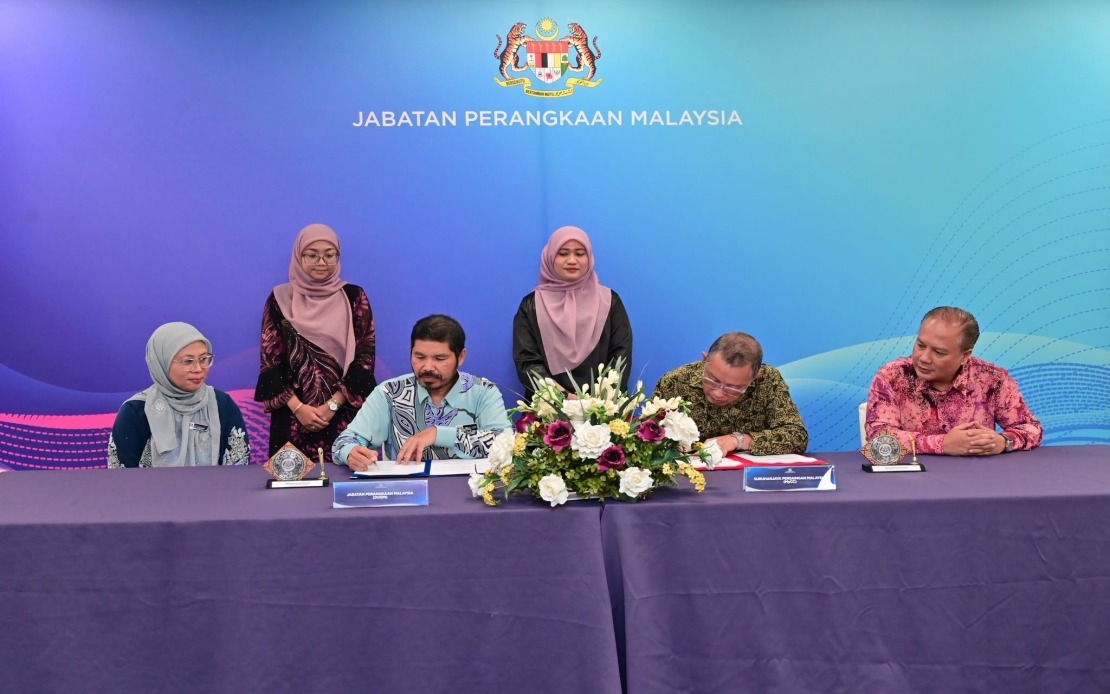
The Malaysia Competition Commission and the Department of Statistics Malaysia have established a formal partnership aimed at leveraging data analytics to strengthen competition oversight and economic policy implementation. The agreement, signed in Putrajaya on June 18, represents a significant shift toward data-driven governance in how Malaysian authorities assess market conditions and enforce regulatory frameworks across the economy.
Tan Sri Idrus Harun, heading MyCC, and Chief Statistician Datuk Seri Dr Mohd Uzir Mahidin formalized the understanding during a ceremony at DOSM's Putrajaya offices, with Datuk Iskandar Ismail and Siti Asiah Ahmad witnessing the signing. This collaboration underscores the government's recognition that modern competition enforcement requires sophisticated information sharing between specialized agencies tasked with different but complementary mandates.
The arrangement creates a structured framework through which the two organizations will exchange administrative and economic datasets, enabling more nuanced analysis of market structures and pricing dynamics. Rather than operating in isolation, MyCC and DOSM can now coordinate their expertise in statistics and competition economics to develop deeper insights into sectoral trends and policy outcomes. For Malaysian businesses and consumers, this integration promises more informed regulatory decisions grounded in comprehensive data rather than ad-hoc assessments.
Capacity building represents a cornerstone of the partnership. Both agencies plan to conduct joint training programmes, facilitate staff exchanges, and share specialized knowledge that strengthens institutional capabilities. As global data volumes expand exponentially and technology reshapes competitive landscapes, developing internal expertise in data analytics has become essential for regulators seeking to remain effective. The collaboration addresses this need while fostering a culture of continuous learning across government bodies.
One significant dimension involves monitoring strategic economic sectors alongside government policy implementation. MyCC and DOSM will jointly track how policies translate into actual market behavior, identifying whether competition remains fair and transparent across industries. This is particularly relevant in Malaysia's context, where state-linked enterprises operate alongside private competitors, and where supply chain vulnerabilities became apparent during recent global disruptions. Joint oversight can help authorities detect bottlenecks, pricing anomalies, or anti-competitive practices before they damage consumer welfare or economic efficiency.
The emphasis on understanding supply chains and price movements carries immediate practical implications for Malaysian households and businesses. Rising living costs, particularly food and fuel prices, remain politically sensitive. By combining statistical data on price trends with competition authorities' market intelligence, policymakers can better diagnose whether inflation stems from structural supply constraints, demand shocks, or anti-competitive behavior warranting intervention. This analytical sophistication reduces the risk of misdiagnosing economic problems and implementing counterproductive responses.
Regionally, this partnership reflects broader recognition across Southeast Asia that data governance and competition policy must evolve together. As ASEAN economies pursue digital transformation and cross-border trade intensifies, the ability to analyze market data comprehensively becomes competitive advantage. Malaysian authorities' commitment to this approach positions the country as a regional leader in sophisticated competition enforcement, potentially influencing how neighboring economies organize their regulatory apparatus.
Data itself increasingly functions as a commodity in modern economies, a reality MyCC explicitly acknowledged in statement. Tech platforms, financial institutions, and e-commerce operators generate vast troves of consumer information, creating new forms of market power distinct from traditional monopolies. By developing stronger analytical capacity around data flows, MyCC can better identify when dominant firms leverage information asymmetries to disadvantage competitors or consumers. DOSM's statistical expertise becomes invaluable in quantifying these phenomena.
The collaboration also addresses information asymmetries within government itself. Multiple Malaysian agencies collect economic data for different purposes—taxation, employment, trade, welfare—often without systematic coordination. By creating pathways for DOSM to integrate administrative datasets across agencies while providing MyCC with refined analytical products, the MoU creates efficiency gains. Rather than duplicate data collection efforts, government bodies can pool resources and achieve more comprehensive understanding of economic dynamics.
For foreign investors and multinational corporations operating in Malaysia, this enhanced oversight framework warrants attention. Stronger competition enforcement, informed by better data, could reshape market dynamics in sectors where foreign firms compete. Conversely, transparent, analytically rigorous enforcement based on evidence rather than discretion often appeals to international investors who value predictable regulatory environments. The MoU's emphasis on fairness and transparency across sectors potentially signals Malaysia's commitment to evidence-based competition policy.
The partnership also carries implications for consumer protection mechanisms. When DOSM's pricing and household consumption data aligns with MyCC's investigations of market conduct, authorities can more precisely identify vulnerable groups affected by anti-competitive practices and design targeted interventions. This granular understanding moves beyond sector-wide interventions toward precision enforcement addressing actual consumer harm.
Implementing this MoU requires sustained commitment and resource allocation beyond the agreement itself. Both agencies must integrate their IT systems, establish data governance protocols protecting confidentiality, and develop joint analytical methodologies. Success depends on cultivating institutional cultures where personnel routinely collaborate across organizational boundaries, sharing insights and building trust.
As Malaysia positions itself as a high-income economy navigating complex global supply chains and technological disruption, sophisticated competition oversight informed by comprehensive data analysis becomes increasingly critical. This partnership between MyCC and DOSM represents a pragmatic step toward more intelligent, effective governance—benefiting businesses operating in fair competitive conditions and consumers protected from market abuse.

