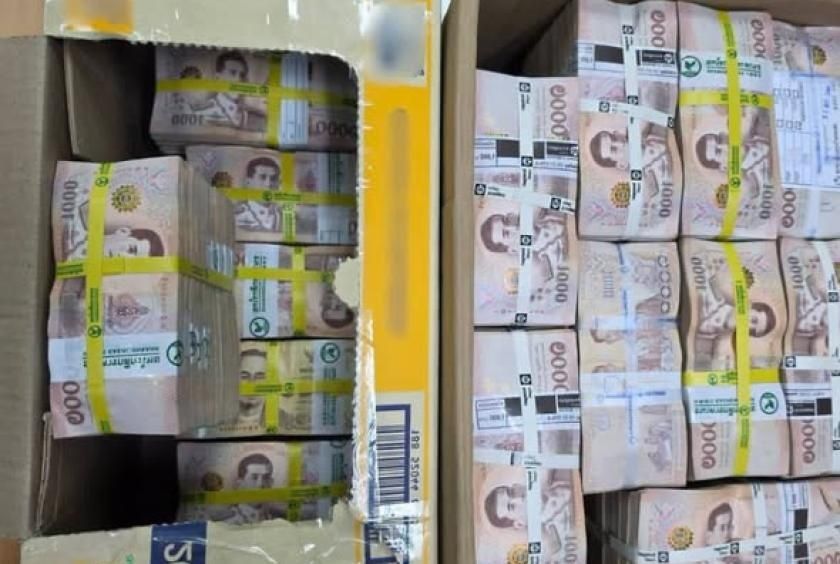
A 31-year-old Myanmar driver faces serious charges after Thai customs officials intercepted a vehicle laden with more than 23 million baht at the Mae Sai border crossing, one of Southeast Asia's busiest land gateways. The arrest underscores persistent vulnerabilities in cross-border financial controls and the continued appetite for illicit currency movements across the Thai-Myanmar frontier.
The interception occurred at the Thai Friendship Bridge checkpoint in Mae Sai, where customs inspectors conducting routine vehicle checks identified a private car bearing Myanmar registration plates. What appeared to be ordinary food provisions concealed a carefully packaged haul of Thai currency worth approximately USD 689,077. The discovery represents a significant single seizure and raises fresh concerns about smuggling networks operating between the two countries.
During the detailed inspection, officers uncovered bundles of high-denomination 1,000-baht notes meticulously concealed within commercial packaging. The smugglers had divided the cash between at least two cartons ostensibly containing dried fish and potatoes, staple trade goods frequently transported across this border. The first carton contained approximately 17 million baht, while a second yielded 6.023 million baht, demonstrating a sophisticated approach to disguising illegal currency movements.
The sophistication of the concealment method—mixing currency with legitimate agricultural products—mirrors tactics employed by organised smuggling networks throughout the region. Such approaches exploit the sheer volume of daily commercial traffic at Mae Sai, one of Thailand's principal trade arteries with Myanmar. The border crossing processes thousands of vehicles daily, creating opportunities for dedicated criminal groups to attempt currency contraband amid legitimate commerce.
Thailand's foreign exchange control regulations strictly prohibit the movement of large cash amounts across borders without proper authorisation and declaration. The suspected violation carries serious legal consequences under the Customs Act, which carries penalties including substantial fines and imprisonment. The authorities have indicated that this case likely represents merely the visible portion of broader smuggling operations, with investigators now working to identify accomplices and organisational links.
The arrest reflects ongoing tensions between Myanmar's economic instability and the Thai financial system's attractiveness. As Myanmar's domestic currency has weakened significantly following the 2021 military coup, Thai baht has become an increasingly preferred store of value for significant wealth transfers. Such dynamics drive demand for illicit currency movements, particularly among individuals seeking to move assets beyond government oversight or tax authorities.
Mae Sai's strategic location has long made it vulnerable to such contraband flows. The border town serves as a crucial hub for legitimate trade, remittance movements, and humanitarian exchanges between the two nations. However, its infrastructure and traffic volume have equally enabled criminal networks to operate with relative impunity, particularly when moving high-value but compact items like currency that prove difficult to detect amid legitimate goods.
The investigation's continuation suggests authorities suspect a more extensive network behind this single interception. Law enforcement typically pursues such cases by tracing money flows, identifying receiving parties on both sides of the border, and mapping the broader organisational structure. Previous similar cases have revealed connections to money laundering syndicates, informal banking networks, and individuals seeking to circumvent Myanmar's economic restrictions.
For Malaysia and other Southeast Asian nations, this seizure carries particular significance as it illustrates the region's ongoing struggle with illicit financial flows. Currency smuggling operations frequently intersect with broader organised crime ecosystems involving drug trafficking, human trafficking, and arms movements. The sophistication demonstrated in this case—professional concealment, cross-border coordination, and substantial capital deployment—indicates established criminal operations rather than isolated amateur attempts.
Thailand's customs authorities have intensified border security operations following increased awareness of smuggling patterns. Enhanced scanner technology, intelligence sharing between agencies, and intelligence coordination with neighbouring countries have improved detection capabilities. However, the continued emergence of smuggling attempts suggests that criminal networks continually adapt their methods, shifting routes and techniques to evade enforcement.
The broader context reveals fundamental structural challenges in cross-border financial governance throughout Southeast Asia. Disparities in currency values, capital controls, and economic conditions between neighbouring countries create powerful incentives for smuggling. Myanmar's particular vulnerability—combined with limited informal banking alternatives and legitimate remittance restrictions—has made it an epicentre of such activities.
As investigations deepen, authorities will likely examine whether this network maintained regular smuggling routes or whether this represented a one-off opportunity. The professionalism of the operation and the substantial amount involved suggest established operations rather than opportunistic smuggling. Such networks often employ drivers as expendable elements, complicating efforts to reach higher-level organisers.
The case serves as a reminder that border security requires constant vigilance and coordination. While this single interception prevented illegal capital movement, countless other attempts likely succeed each week across the region. Addressing the underlying drivers—Myanmar's economic crisis, remittance restrictions, and currency arbitrage opportunities—requires comprehensive regional cooperation and structural economic reforms alongside traditional law enforcement efforts.

