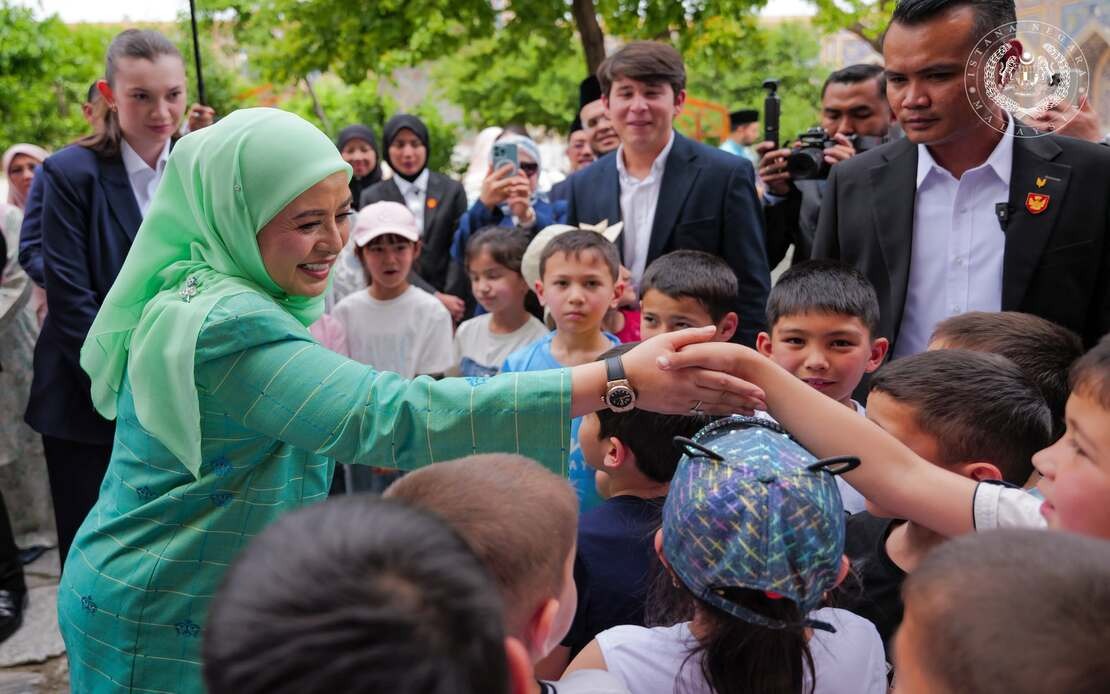
Queen Raja Zarith Sofiah of Malaysia has identified mutual respect as a cornerstone principle underpinning the nation's long-standing social harmony and cohesion. Speaking through a message shared on Sultan Ibrahim Sultan Iskandar's official Facebook page, Her Majesty underscored how this foundational value has been integral to Malaysia's identity and continues to strengthen both national unity and collective well-being among its diverse population.
The Queen's remarks arrive at a moment when many nations grapple with social fragmentation and polarization. Malaysia's multicultural fabric—composed of Muslims, Christians, Hindus, Buddhists, and adherents of other faiths alongside various ethnic communities—requires constant reinforcement of values that transcend religious and cultural boundaries. Her Majesty's public articulation of mutual respect serves as a reminder to all Malaysians that their nation's stability depends on intentional cultivation of courtesy and consideration across all segments of society, whether within families, workplaces, or broader civic spaces.
Rooting her message in Islamic teaching, the Queen drew attention to a prophetic hadith transmitted through the renowned scholar Al-Bukhari. The tradition, attributed to Prophet Muhammad through the companion Abu Hurairah, encapsulates three ethical imperatives: refraining from harming one's neighbours, extending honour to guests, and maintaining speech that is either beneficial or silent. These principles resonate across Malaysia's Muslim-majority population, which comprises roughly 70 percent of the 34 million citizens, while simultaneously reflecting universal values embraced by non-Muslim communities. The deliberate invocation of this specific hadith during contemporary times carries symbolic weight, positioning Islamic ethics as a vehicle for national unity rather than division.
What distinguishes Her Majesty's intervention is its grounding in lived example rather than abstract exhortation. In February of this year, the Queen personally welcomed more than 100 foreign tourists at the main entrance of Istana Negara, the royal palace, engaging warmly with visitors from numerous countries. This interaction exemplified the graciousness that Her Majesty advocates, demonstrating how courtesy toward outsiders reflects a nation's character and values. For Malaysia, where tourism represents a significant economic sector and soft power asset, such royal gestures carry diplomatic and commercial implications beyond their immediate ceremonial context.
The emphasis on treating guests with honour holds particular relevance for Malaysia's position as a regional hub for business, education, and leisure. The nation attracts millions of international visitors annually, and their experiences shape global perceptions of Malaysian culture and values. When the Queen personally engages with tourists, she signals that hospitality is not merely commercial transactionalism but springs from deeper cultural commitments. This approach distinguishes Malaysia from competitors in the regional tourism market and reinforces the nation's brand as welcoming and respectful.
Furthermore, the Queen's stress on mutual respect carries implications for Malaysia's internal stability and social cohesion. The nation has experienced periodic tensions between religious communities, disputes over language and education policy, and occasional friction between ethnic groups. These conflicts, while generally contained within constitutional and democratic frameworks, periodically threaten the cooperative spirit necessary for shared prosperity. By elevating mutual respect to the level of national principle worthy of royal endorsement, Her Majesty provides moral authority for ordinary Malaysians to practice civility and restraint in their daily interactions, even when disagreements arise.
The invocation of the neighbour in Islamic tradition carries particular significance in contemporary Malaysia. Neighbourliness, understood in the broadest sense, extends beyond physical proximity to encompass all members of the national community. In an era of polarized social media discourse and increasing sectarian consciousness, this reframing of the neighbour as fellow citizen—regardless of religion or ethnicity—offers a counter-narrative to divisive rhetoric. The Queen's public endorsement of this principle provides cover and encouragement for Malaysian voices advocating bridge-building and dialogue.
Her Majesty's message also resonates with Malaysia's constitutional framework, which explicitly enshrines principles of equality before the law and protections for minority rights alongside recognition of Islam's special position. The nation's founding architects deliberately constructed a social contract acknowledging religious diversity while preventing majoritarian tyranny. By emphasizing mutual respect grounded in Islamic teaching, the Queen demonstrates how the nation's constitutional pluralism and its Islamic foundations need not exist in tension but can reinforce one another.
The timing of the Queen's remarks, released through the Sultan's social media presence, reflects evolving modes of royal communication in Malaysia. Rather than relying solely on formal state pronouncements or ceremonial occasions, the palace increasingly engages directly with citizens through digital platforms. This democratization of access to royal messaging allows Her Majesty's views to reach broader audiences and facilitates more immediate engagement with contemporary concerns. For younger Malaysians especially, such direct communication may carry greater persuasive force than traditional channels.
Looking forward, the Queen's emphasis on mutual respect offers a constructive framework for addressing Malaysia's persistent challenges around religious freedom, minority protection, and interethnic relations. Rather than imposing top-down restrictions or engaging in zero-sum competitions over cultural dominance, the nation's leadership can emphasize shared values and reciprocal obligations. This approach requires neither abandoning Malaysia's Islamic identity nor compromising constitutional protections for minorities, but rather finding common ground in universal principles of decency and consideration.

