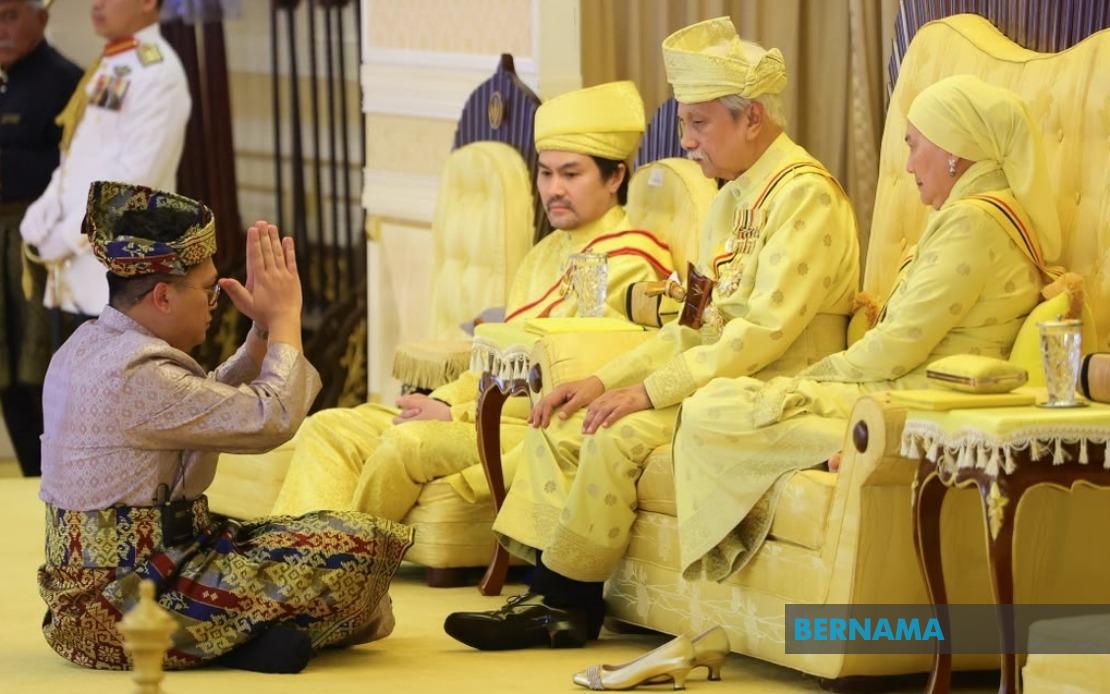
Negeri Sembilan's paramount ruler, Tuanku Muhriz Tuanku Munawir, has formally installed Muhammad Faris Johari as the 11th Undang of Luak Sungei Ujong during a traditional ceremony held at Istana Besar Seri Menanti in Kuala Pilah on June 27. The appointment marks an important transition in the state's customary leadership structure, with the 28-year-old receiving the honorific title Datuk Klana Petra as part of the formal investiture process.
The installation followed longstanding Negeri Sembilan protocol, beginning with the Orang Empat Istana, the council of four senior chiefs, formally requesting Tuanku Muhriz's permission to proceed with the ceremony. Following this initial deference to royal authority, Muhammad Faris publicly pledged his allegiance to the ruler, reaffirming the hierarchical relationship between the customary leadership and the constitutional monarchy that defines governance in the state.
In his address to the assembly, Tuanku Muhriz underscored the importance of maintaining the pledges undertaken during the installation, calling for sincerity, integrity and unwavering commitment to duty. The ruler's remarks reflected broader concerns about preserving institutional continuity within Negeri Sembilan's unique governance framework, which combines modern administrative structures with centuries-old customary traditions rooted in Adat Perpatih, a matrilineal system distinct from the patrilineal adat systems found elsewhere in Malaysia.
The Yang Dipertuan Besar specifically reminded the Orang Kaya, the collective term for hereditary chieftains holding positions like Undang, of their obligation to maintain unwavering loyalty to his institution and to foster relationships with the Palace characterised by respect and close cooperation. This injunction carries particular weight in Negeri Sembilan, where the customary leadership retains significant symbolic and practical authority over nine districts, known as luaks, each governed by an Undang.
Among those witnessing the ceremony were Tunku Ampuan Besar Tuanku Aishah Rohani Tengku Besar Mahmud, the state's first lady, alongside other senior members of the royal family including Tunku Besar Seri Menanti Tunku Ali Redhauddin Tuanku Muhriz and Tunku Panglima Besar Tunku Zain Al-'Abidin. The presence of high-ranking government figures, including Menteri Besar Datuk Seri Aminuddin Harun and departmental heads, underscored the state administration's endorsement of the customary appointment process.
Muhammad Faris comes to the position with solid professional credentials, holding a bachelor's degree in accountancy from Universiti Teknologi MARA and professional certification through the Association of Chartered Certified Accountants obtained in 2022. Born on October 30, 1997, he represents a younger generation entering Negeri Sembilan's hereditary customary positions, potentially bringing contemporary perspectives to roles that have historically been dominated by older incumbents. His background in accountancy may prove relevant to managing the administrative and financial responsibilities typically associated with district-level leadership.
The newly appointed Undang is married to Sharifah Amirah Syed Ismail Ash-Shahab, further embedding him within the state's elite social networks. In Negeri Sembilan's context, where family connections and marriage alliances carry significant political weight, this union may strengthen his standing among other prominent families and customary leaders.
Tuanku Muhriz's remarks about the essential role of mutual respect, trust and consensus in preserving constitutional monarchy and customary traditions address ongoing tensions in Malaysian governance around the balance between traditional institutions and modern democratic processes. His emphasis on these principles reflects recognition that the Undang system, while historically rooted, must adapt to contemporary expectations of accountability and inclusive decision-making to remain relevant and respected.
The ruler's call for the general population to collaborate with customary leadership in fulfilling government responsibilities highlights an often-overlooked dimension of Malaysian administration: the continuing role of hereditary chieftains in delivering services and maintaining social cohesion at the district level. In rural Negeri Sembilan areas, Undang positions function not merely as ceremonial roles but as active conduits between government and communities.
The state's commitment to preserving and transmitting Adat Perpatih values, as articulated in the royal address, reflects consciousness that Malaysia's customary systems face gradual erosion as younger generations migrate to urban centres and adopt alternative social structures. Negeri Sembilan's deliberate emphasis on maintaining these traditions through formal ceremonial installations and public articulation of their importance serves as a counterweight to modernisation pressures.
This installation occurs amid broader Southeast Asian developments concerning how traditional institutions navigate rapid social and economic change. Malaysia's approach, whereby hereditary systems continue alongside democratic and bureaucratic structures, offers a distinctive model compared to regional neighbours that have either entirely dismantled customary governance or retained it with minimal integration into formal administration.
The ceremony's timing also warrants attention: installing a new Undang represents a moment when a state can reaffirm its distinctive identity and governance model to both internal and external audiences. For Negeri Sembilan, where the Yang Dipertuan Besar is elected by the Orang Kaya rather than holding hereditary authority, such installations reinforce the participatory elements within the state's constitutional framework.
Later the same day, another royal audience formalised the installation of the 22nd Undang of Luak Rembau, indicating that multiple vacancies or transitions within the customary leadership structure were being systematically addressed. This sequential approach suggests institutional mechanisms for managing succession and maintaining governance continuity across the state's nine districts.

