More than 4,300 entrepreneurs across Melaka have accessed nearly RM100 million in financing support through programmes managed by the Ministry of Entrepreneur Development and Cooperatives (KUSKOP), marking a significant injection of capital into the state's microenterprise and small-to-medium business ecosystem as of the end of May. The substantial funding commitment underscores the ministry's strategic focus on enabling venture capital accessibility for Malaysia's entrepreneurial base, a critical factor in sustaining competitive advantage across sectors ranging from food production to professional services. This regional initiative comes as part of a coordinated national effort to strengthen business resilience and economic participation among owner-operators who form the backbone of local economies throughout Southeast Asia.
Minister Steven Sim has framed the financing disbursements as instrumental to achieving broader economic multiplier effects within the national system. When entrepreneurs receive funding to expand operations, Sim explained, the resulting business growth creates cascading benefits that extend far beyond individual proprietors. Employees hired by expanding firms gain employment opportunities and wage income, while suppliers secure additional demand for goods and services. Communities benefit through increased consumer spending, tax contributions, and revitalised commercial districts. This interconnected economic model reflects international development thinking that treats MSME funding not as a welfare programme but as strategic infrastructure for inclusive growth.
The financing mechanism channels capital into circulation within Malaysia's domestic economy at precisely the moment when regional businesses face headwinds from global supply chain volatility and shifting consumer behaviour. Rather than allowing such capital to remain dormant in government treasuries, the KUSKOP approach distributes resources directly to entrepreneurs who can deploy them immediately for inventory purchases, equipment upgrades, premise renovations, or staff expansion. This demand-side stimulus approach complements regulatory and infrastructure improvements by providing the immediate liquidity that many growth-stage businesses require to bridge expansion phases.
During a three-day working visit to Melaka from June 19 to 21, Minister Sim participated in the Hebatkan Perniagaan Malaysia Carnival (KHPM), an engagement initiative designed to foster direct dialogue between government policymakers and trading communities. The carnival represented more than ceremonial activity; it provided a venue for assessing implementation effectiveness across various ministry programmes and gathering qualitative feedback from businesses operating in diverse sectors. Such face-to-face interactions yield insights that quantitative data alone cannot capture, including barriers to financing access, regulatory friction points, and sectoral challenges that may warrant policy adjustments.
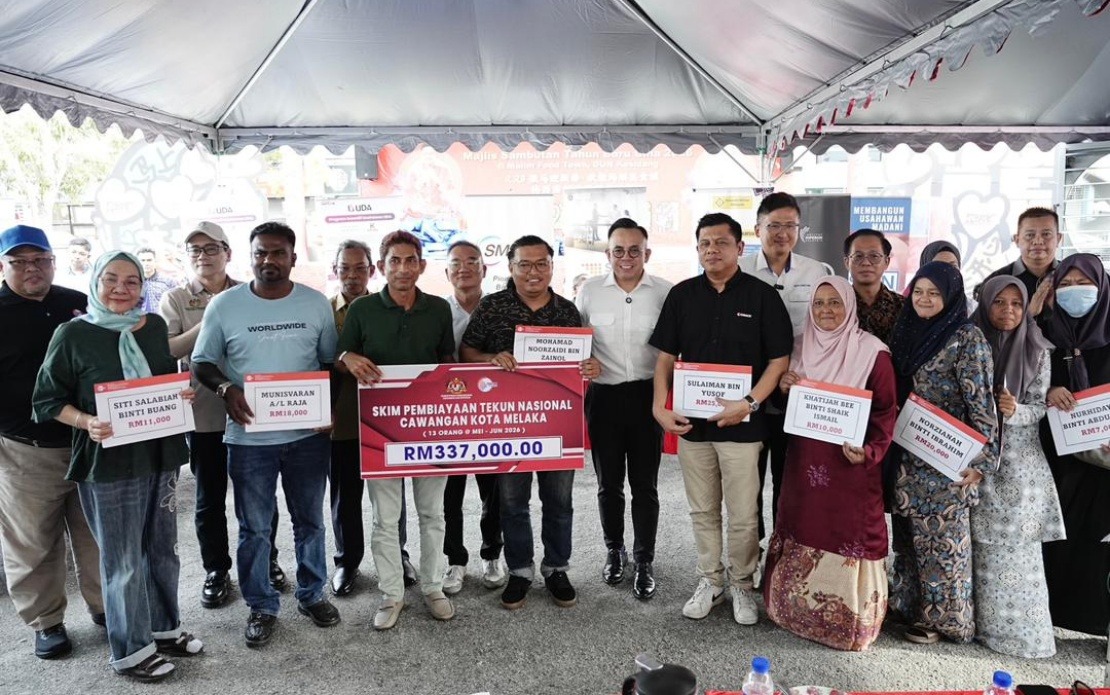
A particularly notable event during Sim's Melaka engagement was a large-scale meet-and-greet session with TEKUN entrepreneurs at Malim Food Town, bringing together approximately 50 local business operators. During this gathering, the minister presented nearly RM1 million in fresh financing commitments to 18 selected entrepreneurs through TEKUN Nasional and SME Corp Malaysia, the latter a statutory body responsible for MSME development strategy. The recipients represented considerable sectoral diversity—food and beverage operations, wholesale distribution, professional services, construction contracting, retail outlets, e-commerce businesses, automotive enterprises, and miscellaneous service providers. This breadth reflects the ministry's inclusive approach to entrepreneurship support, avoiding sector-specific bias and instead concentrating on opportunity identification and financial readiness across the entire business landscape.
The national financing picture reveals an even more expansive deployment of capital. Throughout the initial five months of 2024, KUSKOP had approved RM5 billion in financing allocations benefiting nearly 180,000 entrepreneurs nationwide. These figures contextualise the Melaka achievement within a larger fiscal commitment that spans all thirteen Malaysian states and federal territories. The scale of deployment suggests serious institutional capacity dedicated to processing financing applications, conducting creditworthiness assessments, and administering disbursements across geographically dispersed applicant populations—a considerable operational undertaking that demands robust administrative systems.
Looking ahead, the ministry has articulated an ambitious target through its PowerUp10K initiative, which aims to channel RM15 billion in total financing to MSMEs throughout Malaysia during the current calendar year. If achieved, this represents an acceleration in capital deployment rates and reflects confidence in both entrepreneurial demand and institutional capacity to process applications at scale. The magnitude of this commitment signals that MSME financing has transitioned from peripheral support activity to core national economic policy, comparable in political priority to large infrastructure projects or industrial development zones.
Minister Sim has emphasised that Malaysia's multicultural composition—encompassing diverse racial, linguistic, and cultural communities—constitutes a competitive asset in the knowledge economy and talent market. This perspective recasts demographic diversity from a potential governance challenge into a strategic economic advantage, particularly as businesses seek to expand across national borders or access international supply chains. Malaysian entrepreneurs draw on multilingual capabilities, cross-cultural understanding, and networks spanning several regional business communities, creating natural bridging capacity that foreign investors and regional traders increasingly value. By channelling capital toward this diverse entrepreneurial base, the government amplifies these comparative advantages and positions Malaysian businesses as particularly suited to regional integration initiatives such as ASEAN economic frameworks.
The financing approvals carry implications for Malaysian and Southeast Asian macroeconomic dynamics beyond their immediate beneficiaries. When thousands of MSMEs simultaneously receive capital injections, the cumulative effect influences regional credit conditions, employment growth trajectories, and foreign exchange flows. Increased MSME profitability strengthens domestic demand for intermediate goods and services, creating upward pressure on regional trade volumes. Enhanced employment opportunities reduce pressure on government social safety net systems while expanding the tax base available for public investment. From a Southeast Asian perspective, stronger Malaysian MSME performance improves the region's overall economic resilience by diversifying growth engines beyond larger multinational enterprises or government-linked companies.
The walkabout conducted by Minister Sim and Melaka's Entrepreneur Development, Cooperatives and Consumer Affairs Committee chairman Seah Soo Chin through Malim Food Town represented an important administrative practice: direct observation of financing programme impact in functioning commercial environments. Rather than relying solely on application processing statistics or financial reporting, such field visits enable policymakers to assess whether approved financing has genuinely catalysed business expansion, job creation, and commercial vitality. This feedback mechanism helps identify implementation gaps, unintended consequences, or emerging challenges that may require policy recalibration, ensuring that financing instruments remain responsive to entrepreneurial realities as they evolve across different state economies and business sectors.

