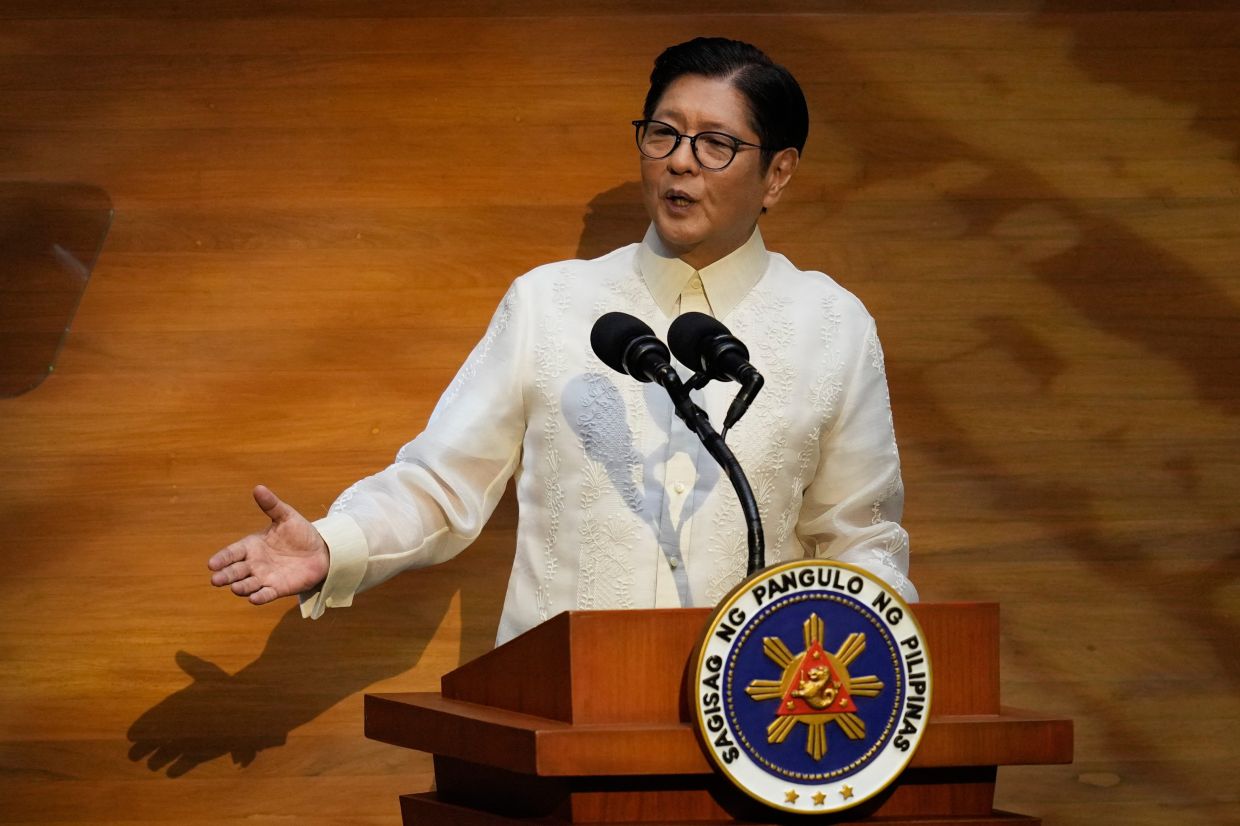
Philippine President Ferdinand Marcos Jr. delivered a carefully calibrated rebuke to China during his state of the nation speech on Monday, pledging that his administration would defend the 2016 arbitration ruling that invalidated Beijing's sweeping territorial claims in the South China Sea. Without naming China directly, Marcos asserted that Filipinos "do not yield" to outsiders, a declaration that drew thunderous applause from the legislative chamber. The speech marked an escalation in rhetoric following inflammatory content disseminated by Chinese state media that depicted Filipinos in deeply offensive terms.
The catalyst for Marcos's pointed remarks stemmed from recent provocations by China Daily, a state-owned Chinese publication, which had distributed AI-generated images and cartoon animations portraying Filipinos as primates. These materials centred on Beijing's rejection of the 2016 tribunal decision that struck down China's expansive "nine-dash line" claims covering much of the South China Sea. The Philippine government formally condemned the imagery as "racist and dehumanizing" and demanded immediate removal. Marcos subsequently summoned Chinese Ambassador Jing Quan to his office in Manila to lodge diplomatic protests over the incident.
Beijing's official response came through Foreign Ministry spokesperson Lin Jian, who distanced the government from the offensive content while simultaneously reinforcing China's rejection of the arbitration process itself. Lin characterised the 2016 ruling as "a political farce disguised as a legal proceeding" and reiterated that the award was "illegal, null and void and has no binding force." This calculated distinction—rejecting responsibility for the media outcry whilst maintaining China's fundamental position on the disputed waters—exemplifies Beijing's broader strategy of plausible deniability coupled with uncompromising territorial assertions.
Marcos framed the 2016 arbitration award as a "definitive benchmark" for interpreting and applying the 1982 United Nations Convention on the Law of the Sea, the legal foundation upon which the tribunal based its decision. The Philippines initiated the arbitration proceedings in 2013 following a tense maritime confrontation involving Chinese and Philippine vessels near Scarborough Shoal, a strategically significant feature in disputed waters. Despite China's refusal to participate in the proceedings and its subsequent dismissal of the tribunal's findings, Marcos declared the ruling final and binding, establishing it as the Philippines' legal touchstone for all future maritime activities in the region.
Marcos pledged that his government would employ "every peaceful and legal means available" to uphold the arbitration award against any attempts—whether foreign or domestic—to erode its standing. This formulation carefully emphasised lawful methods whilst signalling resolve to defend the ruling through diplomatic, legal, and potentially military frameworks. For Southeast Asian observers, particularly those in Vietnam and other claimant states, Marcos's explicit commitment carries broader implications for regional stability and the collective defence of international legal mechanisms against great-power unilateralism.
The South China Sea dispute extends far beyond bilateral Philippine-Chinese tensions. Confrontations involving Chinese, Philippine, and Vietnamese forces have intensified in recent years, with fishing fleets increasingly becoming flashpoints for maritime incidents. The strategic waterway remains among the world's most critical trade corridors, handling trillions of dollars in annual commerce. Malaysia, Brunei, and Taiwan maintain overlapping claims with competing jurisdictions, creating a complex tapestry of territorial assertions that defy simple bilateral resolution. The region's geopolitical fragility means that Philippine firmness or capitulation reverberates across the entire Indo-Pacific calculus.
In domestic developments, Marcos signalled that his administration would pursue corruption charges against Martin Romualdez, his cousin and previously influential House Speaker, though the president conspicuously avoided naming him directly. Marcos stated that "this is painful to me, but we have to do the right thing," and emphasised that his presidential loyalty transcends family and personal relationships. A special anti-graft prosecutor would soon file formal charges against Romualdez in connection with a sprawling scandal involving massive kickbacks siphoned from flood control infrastructure projects, according to Marcos's announcement.
Romualdez has faced accusations alongside numerous congressional members and senators of extracting substantial illicit payments from government-funded engineering and construction contracts. Though he resigned as House Speaker the previous year, he retained his congressional seat. In a written statement, Romualdez maintained his legal innocence and pledged readiness to defend himself against forthcoming charges. To date, despite the scandal's breadth, Romualdez had escaped formal prosecution, distinguishing him from several other implicated figures including a sitting senator, a former senator, and a former public works secretary who served under Marcos.
The government's anti-corruption enforcement has already yielded substantial recoveries from other suspects implicated in the scheme. Authorities have recovered or frozen approximately 25 billion pesos—equivalent to some $410 million—in cash and property belonging to various suspects, with portions already restored to the national treasury. This recovery effort demonstrates the scale of the alleged corruption and the financial resources mobilised by Marcos's anti-graft apparatus. The formal charges against Romualdez would represent a significant moment for presidential accountability, testing whether Marcos's commitment to institutional integrity extends to his innermost political circle.
The dual thrusts of Marcos's address—external firmness on maritime sovereignty and internal resolve against elite corruption—reflect an administration attempting to position itself as both a capable regional actor and a serious reformer. However, the credibility of both messages depends on sustained follow-through. Philippine leadership on the South China Sea requires consistency and allied support, whilst the anti-corruption campaign demands impartial enforcement that does not appear selective or performative. For Malaysia and other Southeast Asian states monitoring Philippine behaviour, these commitments will serve as bellwethers for regional cooperation and institutional development.

