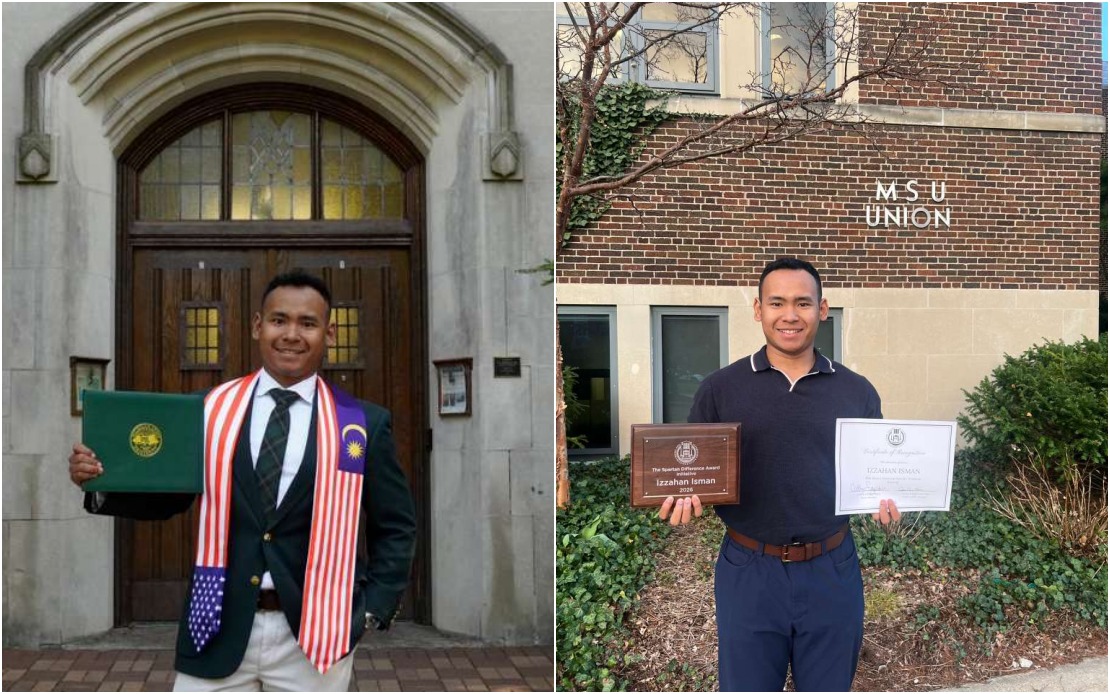
Muhammad Izzahan Isman's trajectory from a tahfiz boarding school in Malaysia to earning honours from a prestigious American university illustrates a growing trend among Southeast Asian scholars: the cognitive benefits of Quranic memorisation extending far beyond religious studies into secular academic disciplines. The 22-year-old, who recently completed his Bachelor of Arts in Economics at Michigan State University under the Majlis Amanah Rakyat (MARA) Young Talent Development Programme (YTP), has emerged as a compelling case study for how Islamic educational practices can serve as a foundation for excellence in competitive international academic environments.
Izzahan's perspective on his educational journey offers insight into the underexplored intersection of Islamic pedagogy and secular achievement. He emphasises that Quranic memorisation functions as rigorous mental training, demanding not merely rote learning but genuine comprehension of complex material—a duality that conditions the brain for adaptive thinking and enhanced retention across diverse fields. This characterisation distinguishes tahfiz education from superficial memorisation; instead, it represents a systematic cognitive discipline that mirrors principles employed in advanced academic study. When transplanted to university-level economics, these mental frameworks proved remarkably transferable, enabling him to approach numerical analysis, theoretical concepts, and empirical research with the same methodical rigour cultivated through years of Quranic study.
His achievements at Michigan State extended well beyond the classroom. Graduating with a CGPA of 3.72 whilst navigating the complexities of international student life reflects substantial personal discipline. Equally notable were his extracurricular accomplishments, which demonstrated that his analytical capabilities could translate into practical workplace innovation. While working part-time as a management assistant, Izzahan identified a recurring operational inefficiency: the departure of trained student employees upon graduation left supervisory staff perpetually retraining replacement workers. Rather than accepting this institutional friction as inevitable, he engineered a comprehensive training manual that systematised the onboarding process, thereby reducing time-to-productivity and enhancing overall operational performance.
The recognition afforded to this initiative—the Spartan Difference Award and the Green Cranium Award—signals institutional appreciation for problem-solving initiative that extends beyond expected job duties. Additionally, his maintenance of a GPA above 3.5 secured him the Reserve Officers' Training Corps (ROTC) Academic Ribbon, a credential reflecting sustained academic excellence across his tenure. For Malaysian observers, these accolades underscore that Malaysian students, when properly prepared, can compete effectively with their international peers in elite American institutions and simultaneously demonstrate leadership qualities valued by employers.
Maintaining equilibrium whilst studying abroad presents psychological and social challenges that extend beyond academic pressure. Izzahan attributes his stability to deliberate mental discipline rooted in long-term vision. By consciously anchoring himself to defined objectives and the future he envisioned building, he constructed psychological defences against the temptations and distractions that frequently destabilise young people residing independently in foreign countries for the first time. This capacity for self-regulation—arguably nurtured through years of disciplined religious practice—enabled him to make intentional choices that protected his relationships, physical health, behavioural patterns, and personal values. His approach offers a model for other Malaysian students navigating similar transitions.
The significance of Izzahan's narrative for Malaysia's broader development agenda merits closer examination. The nation has invested substantially in human capital development through schemes like the MARA YTP, premised on the conviction that strategically educated Malaysians will return to strengthen the country's competitive position. Izzahan's articulated commitment to contributing to Malaysia's financial sector aligns directly with national objectives to establish the country as a leading regional financial hub. His intention to pursue advanced qualifications following his bachelor's degree suggests commitment to developing expertise at the highest levels—precisely the calibre of talent upon which Malaysia's aspiration to regional financial leadership depends.
From an educational policy perspective, Izzahan's success raises instructive questions about the pedagogical value of integrating Islamic educational traditions with contemporary professional preparation. His background at Sekolah Berasrama Penuh Integrasi (SBPI) Rawang positioned him within Malaysia's integrated residential school system, which deliberately combines conventional academic curricula with Islamic religious instruction. The apparent effectiveness of this model—at least in his case—suggests that rather than viewing religious and secular education as competing domains, policymakers might productively explore how principles derived from classical Islamic learning can enhance cognitive flexibility and disciplinary habits applicable across knowledge domains.
The Malaysian educational establishment has long debated how to cultivate both technical expertise and moral grounding in its graduates. Izzahan's experience implies that this dichotomy may be partly illusory. The rigorous mental discipline required for tahfiz education—maintaining focus under challenging conditions, internalising complex material, and applying abstract principles to novel situations—constitutes precisely the metacognitive toolkit that contemporary employers and universities value. When students possess both technical knowledge and the deeper cognitive infrastructure to apply that knowledge creatively, they become adaptable professionals capable of addressing unforeseen challenges, as Izzahan demonstrated through his workplace innovation.
The attention Izzahan garnered on social media prior to his graduation reflected public interest in narratives that transcend conventional categories. He represents neither the stereotypical secular academic achiever nor the traditional religious scholar, but rather someone who has synthesised elements from both traditions into a distinctive trajectory. This hybrid identity resonates particularly with younger Malaysians navigating plural cultural and educational environments, seeking models that demonstrate compatibility between religious commitment and worldly success rather than perceiving these as mutually exclusive pathways.
Looking forward, the trajectory of scholars like Izzahan will partially determine whether Malaysia can sustain competitive advantage in attracting talent to the financial services sector. The nation competes internationally for both domestic graduates choosing among career options and foreign talent considering relocation to Malaysian institutions. Demonstrating that MARA scholars educated in integrated Islamic-secular environments can achieve distinction at leading international universities and subsequently contribute sophisticated expertise to Malaysian firms strengthens the nation's proposition to such talent pools. Izzahan's commitment to serving Malaysia's financial sector represents a return on the nation's investment in his education—provided he is afforded career opportunities and institutional support commensurate with his qualifications upon returning home.