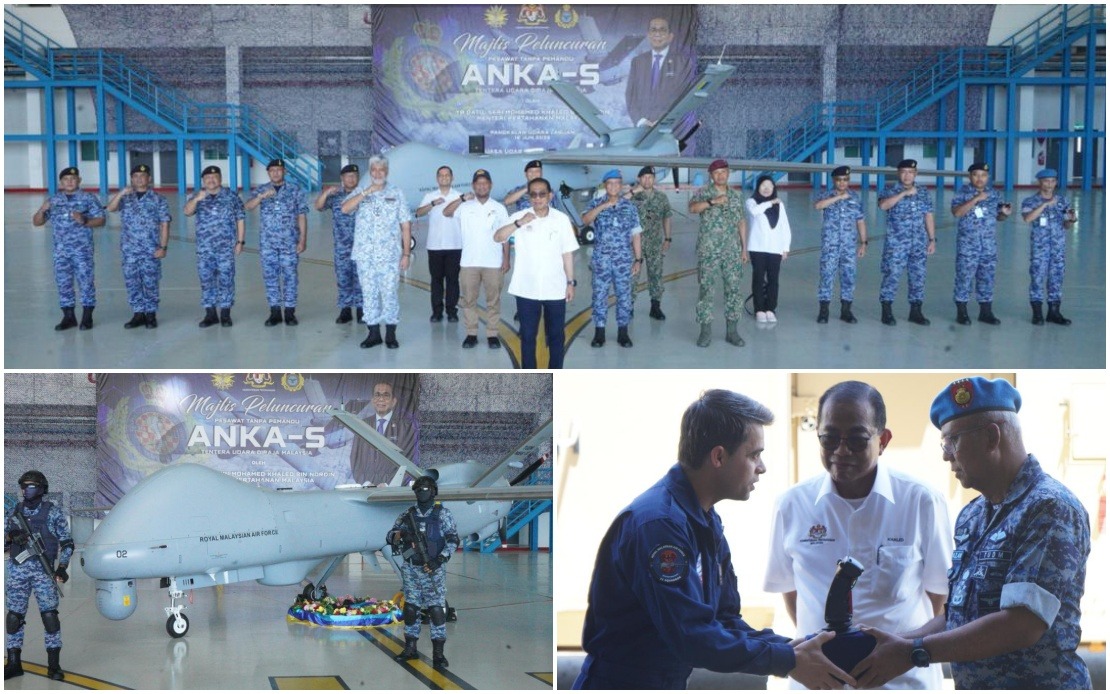
Malaysia has taken a significant step in modernizing its maritime defence infrastructure with the operational deployment of the ANKA-S Unmanned Aircraft System (UAS) at the Royal Malaysian Air Force base in Labuan. Defence Minister Datuk Seri Mohamed Khaled Nordin framed the launch as a watershed moment for the nation's security posture, particularly concerning surveillance and intelligence gathering in one of the world's most strategically important and contested maritime zones: the South China Sea.
The ANKA-S represents a fundamental shift in how Malaysia approaches maritime domain awareness. Rather than relying on conventional manned aircraft or surface vessels for continuous monitoring—approaches that demand sustained operational costs and can leave critical gaps in coverage—the unmanned platform offers persistent surveillance capabilities that were previously unavailable to the country. Operating at altitudes reaching 30,000 feet, the system can remain airborne for more than 24 hours, providing uninterrupted observation of vast ocean expanses where competing territorial claims and increasing maritime traffic demand constant vigilance.
Malaysia's acquisition of three ANKA-S aircraft at a total cost of RM423.8 million—including ground control stations and two years of comprehensive personnel training—reflects a deliberate investment in modernization. The decision to base these systems at Labuan, situated strategically off Sabah's northern coast, positions them optimally for monitoring Malaysia's maritime claims and protecting critical sea lanes that carry substantial regional and global commerce. The geographic positioning of this asset addresses a longstanding operational gap in the nation's ability to maintain what Defence Minister Mohamed Khaled termed "the nation's eyes and ears."
The technical specifications of the ANKA-S platform offer tangible advantages beyond raw surveillance duration. The system's capacity to accurately identify and classify vessel profiles—distinguishing between merchant traffic, fishing vessels, naval ships, and other maritime objects—enables Malaysian security forces to respond intelligently rather than react blindly. This intelligence advantage translates directly into more efficient deployment of limited naval and air assets. Rather than conducting generalized patrols across vast maritime zones, Malaysian forces can now concentrate resources on confirmed intrusions or suspicious activities, substantially reducing operational expenses while improving response effectiveness.
The economic dimension of this acquisition carries particular significance for Southeast Asian defence planners watching Malaysia's modernization trajectory. Continuous deployment of manned fighter aircraft or large naval vessels for surveillance purposes represents an extraordinarily expensive proposition, consuming fuel, maintenance budgets, and personnel hours that could be allocated elsewhere. By transitioning to unmanned persistent surveillance, Malaysia demonstrates a pragmatic approach to defence economics—achieving greater coverage at substantially reduced marginal cost. This model has relevance across the region, where multiple nations face similar fiscal constraints while confronting expanding maritime security challenges.
Perhaps most intriguingly, Defence Minister Mohamed Khaled emphasized that the ANKA-S has deliberately not been weaponized, despite possessing the technical capability to carry armaments. This decision carries geopolitical weight. By publicly choosing to operate these advanced surveillance platforms in a non-lethal configuration, Malaysia signals that its security posture remains fundamentally defensive rather than offensive—a message directed at both neighbouring nations and the international community. In a region where arms races and escalatory dynamics loom as genuine concerns, this restraint provides reassurance even as Malaysia simultaneously strengthens its monitoring and intelligence capabilities.
The presence of top military leadership at the Labuan launch—including Chief of Navy Admiral Tan Sri Dr Zulhelmy Ithnain, Chief of Air Force Gen Tan Sri Muhamad Norazlan Aris, and Joint Forces Commander Lt Gen Datuk Tengku Muhammad Fauzi Tengku Ibrahim—underscores institutional buy-in across Malaysia's armed forces. This unified support suggests that the ANKA-S initiative enjoys broad backing throughout the defence establishment, enhancing prospects for successful integration into operational doctrine and sustained commitment to the program's objectives.
The strategic implications extend beyond Malaysia's immediate maritime concerns. As tensions simmer in the South China Sea over contested island territories and overlapping maritime claims, enhanced surveillance capabilities provide objective information that can inform diplomatic discourse and support Malaysia's positions in bilateral and multilateral forums. Better intelligence about maritime activities reduces reliance on assumption and rumour, grounding policy discussions in verifiable facts. For a nation maintaining careful diplomatic balance between major powers while protecting legitimate interests, this informational advantage carries considerable value.
Looking ahead, Defence Minister Mohamed Khaled indicated that the government is actively considering acquisition of three additional ANKA-S platforms under a second phase expansion. This proposal would effectively double Malaysia's unmanned maritime surveillance capacity and is slated for submission within the current national development planning framework. Should this expansion proceed, Malaysia would possess one of Southeast Asia's most capable unmanned surveillance fleets, reflecting sustained commitment to modernization and intelligence-led defence operations.
The ANKA-S deployment also signals Malaysia's broader pivot toward technology-enabled force development. Rather than pursuing expensive capital-intensive platforms that serve multiple roles imperfectly, Malaysia is investing in specialized systems optimized for specific security challenges. This approach aligns with contemporary global defence trends where unmanned systems handle persistent monitoring tasks while manned assets concentrate on higher-level operational requirements. The precedent established by successful ANKA-S integration may accelerate similar transitions across Malaysia's armed forces in coming years.
For Malaysia's regional standing, the ANKA-S program demonstrates technological competence and sustained commitment to professional military development. The system's deployment sends implicit messages about Malaysia's seriousness in safeguarding its maritime claims and maintaining effective surveillance of approaching threats. In a strategic environment where capability and resolve are carefully monitored, this visible modernization effort carries weight disproportionate to any single acquisition.
The broader context of this deployment involves Malaysia's navigation of complex great power dynamics in Southeast Asia. While the country remains committed to ASEAN centrality and inclusive regional cooperation frameworks, it simultaneously must protect national interests in one of the world's most strategically contested zones. The ANKA-S offers a path toward fulfilling both objectives—strengthening security capabilities while maintaining a demonstrably non-threatening posture. This balance, more than the technical specifications of any single platform, may ultimately prove the system's most valuable contribution to Malaysian security strategy.