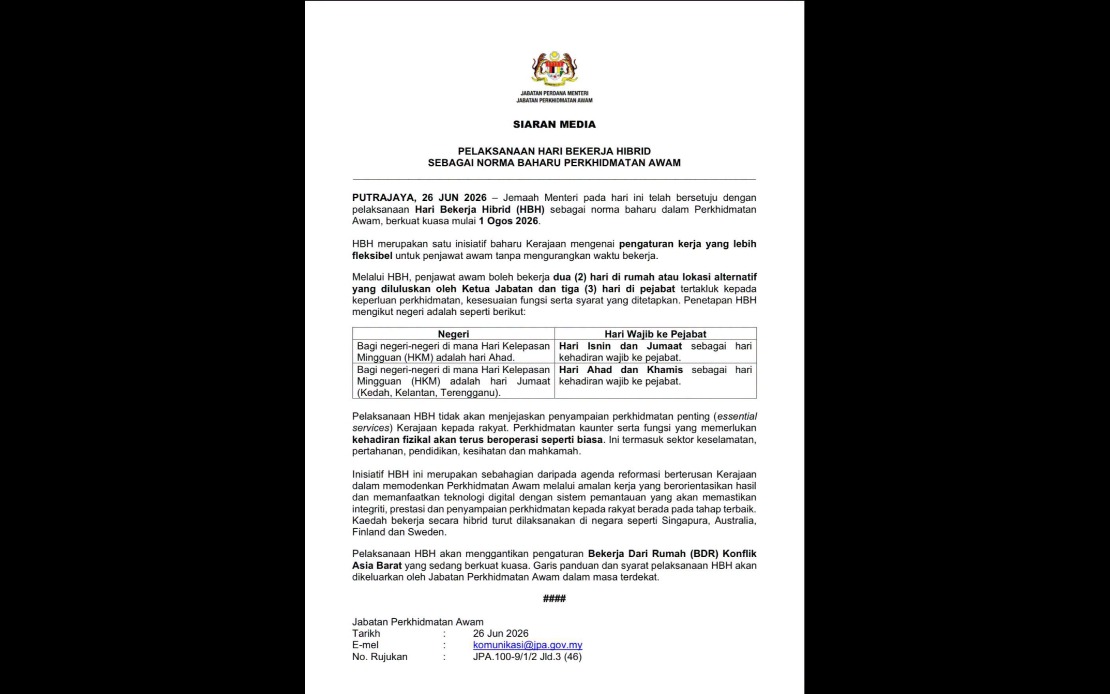
Malaysia's public service is entering a new chapter in workplace flexibility as the Cabinet has officially endorsed a hybrid work arrangement set to commence on August 1. The Public Service Department announced the decision, signalling a departure from the pandemic-era work-from-home model towards a more structured blend of remote and in-office operations. This transition represents a deliberate policy shift aimed at balancing employee flexibility with the operational demands of government service delivery.
Under the Hybrid Work Day framework, civil servants across the country will have the option to work remotely or from an alternative approved location for two days each week, with the remaining three working days conducted at their respective offices. The arrangement comes with built-in flexibility, allowing department heads to adjust schedules based on specific service requirements, job functionality, and departmental conditions. This tiered approach acknowledges that not all government functions can operate effectively with the same remote work ratio, particularly those involving direct public interaction or sensitive operations.
The implementation methodology reflects careful consideration of Malaysia's religious and regional diversity. For states that observe Sunday as their weekly rest day, Monday and Friday have been designated as mandatory office attendance days. This ensures consistency in public service availability during the standard business week. Conversely, states including Kedah, Kelantan, and Terengganu, where Friday serves as the weekly holiday, will have Sunday and Thursday as compulsory in-office days. This tailored approach prevents service gaps and maintains the government's capacity to serve citizens across different regions simultaneously.
Critical sectors including security, defence, education, healthcare, and the judiciary have been explicitly exempted from potential disruptions. Counter services requiring direct public engagement will continue operating normally without interruption. The Public Service Department has provided firm assurances that the hybrid model will not compromise the delivery of essential government functions. This protective measure acknowledges the reality that certain public services cannot be effectively delivered remotely and require consistent physical presence and immediate responsiveness.
The hybrid work initiative forms part of a broader modernisation agenda within Malaysia's public sector reform programme. By shifting towards results-based work practices and leveraging digital technology infrastructure, the government aims to enhance productivity while offering employees greater control over their working environment. This reflects a global trend where outcome-focused management has replaced traditional presence-based accountability metrics. Malaysian policymakers appear to recognise that remote work, when properly managed, can drive efficiency gains rather than diminish them.
The Public Service Department will establish a monitoring mechanism to oversee the implementation and ensure that performance standards and service delivery quality remain uncompromised. This supervisory framework demonstrates that flexibility need not equate to reduced accountability. Instead, the government plans to track outcomes and results rather than physical presence, representing a philosophically different approach to workforce management. Clear performance metrics and integrity standards will guide how departments implement and adapt the hybrid model.
Malaysia's approach aligns with international precedents set by developed nations. Singapore, Australia, Finland, and Sweden have all adopted similar hybrid arrangements, and Malaysia is essentially importing and adapting proven models. These countries have demonstrated that hybrid work can coexist with high service standards and operational efficiency. By referencing these global examples, Malaysian authorities are signalling that this shift reflects not an experimental policy but rather a validated international best practice increasingly recognised as the modern norm.
The transition away from the previous work-from-home arrangement towards a more structured hybrid model addresses concerns that emerged during extended remote work periods. While remote work provided flexibility during lockdowns and restrictions, many government departments struggled with coordination, training, and institutional knowledge transfer. The hybrid model attempts to preserve the benefits of flexible work arrangements while rebuilding the collaborative and mentoring aspects that benefit from in-office interaction. This balance recognises that government work often requires knowledge sharing and decision-making that benefits from spontaneous office collaboration.
Implementation will proceed in phases, with detailed guidelines and specific conditions to be released by the Public Service Department in coming weeks. Department heads have been granted discretion to establish protocols aligned with their operational needs, provided they comply with the overarching framework. This delegation of authority suggests a trust-based approach where central government sets parameters but allows operational flexibility at the departmental level. Effective implementation will depend significantly on how individual government agencies interpret and apply these guidelines.
For Malaysian workers, this development represents a meaningful shift in employment culture. The hybrid model offers relief from daily commuting burdens, particularly significant in congested urban centres like Kuala Lumpur and Selangor, while maintaining the structured accountability that government employment traditionally demands. Employees gain predictability—knowing which days they must report to the office—while retaining two days of remote work flexibility for focused individual work and reduced transportation costs.
The initiative also carries implications for Malaysia's broader productivity and competitiveness discourse. As the nation pursues higher value-added economic activities and digital transformation, workforce flexibility becomes increasingly important for talent attraction and retention. By modernising work arrangements, the government positions the public service as a competitive employer capable of matching private sector flexibility. This matters particularly for attracting younger, digitally-native professionals who increasingly view flexible working as a baseline expectation rather than a privilege.
From a property and infrastructure perspective, the hybrid model also influences facility planning. Rather than requiring office spaces designed for full daily occupancy, government departments can optimise buildings for intermittent use, potentially reducing facility costs and supporting sustainability objectives. Fewer daily commuters translates to reduced traffic congestion and lower carbon emissions, aligning with Malaysia's environmental commitments. The policy thus extends beyond human resources into urban planning and environmental dimensions.

