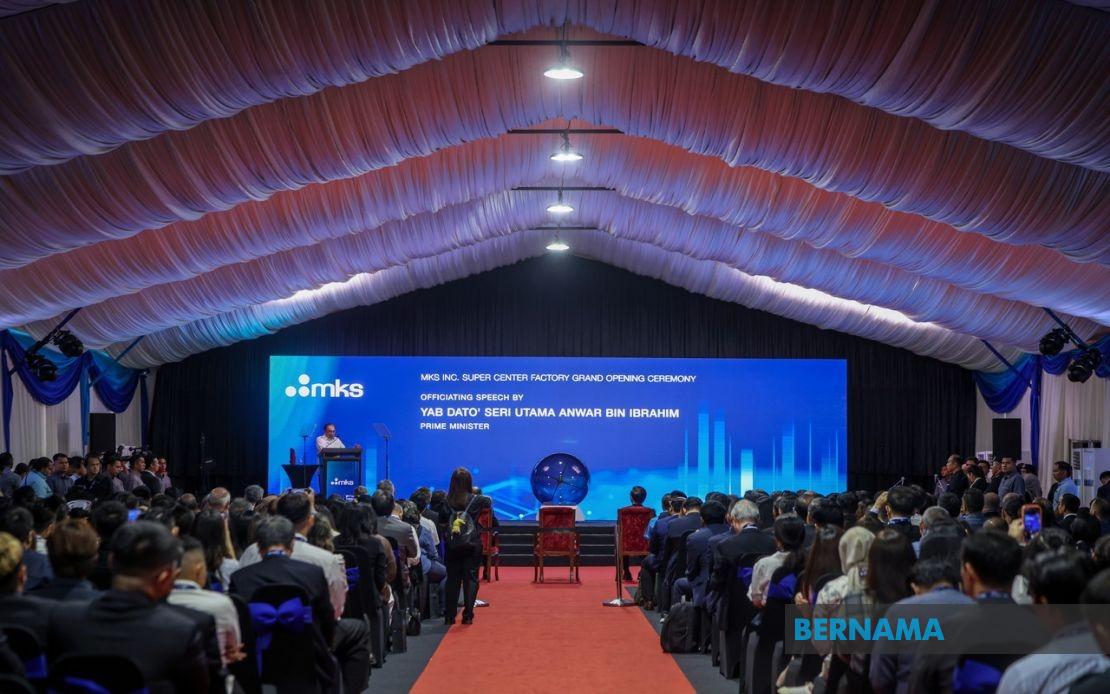
Prime Minister Datuk Seri Anwar Ibrahim believes Malaysia's deliberate approach of engaging with major powers while preserving its political independence is positioning the nation as an attractive investment destination and reliable international partner. Speaking at a factory opening in Bandar Cassia Technology Park in Penang on June 20, Anwar outlined how this strategic balance has translated into concrete economic gains and strengthened Malaysia's standing on the global stage.
The government's willingness to maintain relations across ideologically distinct blocs—spanning the United States, China, India, and Russia—demonstrates Malaysia's commitment to pragmatic rather than ideological foreign policy. Anwar highlighted that this approach is not merely diplomatic posturing but reflects a genuine effort to leverage Malaysia's geographic position and diplomatic credibility. By refusing to align exclusively with any single power, Malaysia preserves decision-making autonomy and avoids being drawn into disputes that could undermine its economic interests or regional stability.
Concrete evidence of this strategy's success emerged through Petronas's recent commercial agreement in Turkmenistan, which the Prime Minister cited as a tangible example of how balanced engagement translates into business wins. Energy sector investments from international partnerships demonstrate that global companies and governments view Malaysia as a stable, neutral intermediary rather than a contested territory. Such confidence attracts major infrastructure projects, resource partnerships, and technology transfers that would otherwise bypass the nation.
Anwar's reference to President Donald Trump's visit and subsequent engagements with Beijing and Moscow illustrates Malaysia's ability to host world leaders without triggering regional tensions. While some nations struggle to manage relationships across competing geopolitical camps, Malaysia has cultivated a reputation for even-handedness. This positioning is particularly valuable in Southeast Asia, where smaller nations often face pressure to choose sides in great-power rivalry. Malaysia's example demonstrates that genuine neutrality, rather than forced alignment, can be a source of strength.
The Prime Minister also emphasized that maintaining independence does not mean remaining silent on international issues. Malaysia actively expresses its position on contentious global matters while simultaneously welcoming constructive participation from all nations. This nuance is crucial: the government seeks to be heard on issues affecting global stability and Malaysian interests without allowing those positions to damage bilateral relationships with major powers. Such calibration requires diplomatic skill and consistent messaging, qualities that have increasingly defined Anwar's tenure.
For Malaysian businesses and investors, the implications are substantial. A nation perceived as neutral and reliable attracts not only governmental partnerships but also corporate investment from companies seeking political stability. Multinational corporations factor geopolitical risk into location decisions, and Malaysia's refusal to become entangled in external conflicts reduces that risk premium. This advantage becomes more pronounced as global tensions rise and companies increasingly prioritize jurisdictional stability alongside cost considerations.
The Penang event underscored this advantage through MKS's factory expansion, suggesting that technology and manufacturing sectors view Malaysia favorably relative to polarized alternatives. The presence of Penang Chief Minister Chow Kon Yeow and Deputy Minister Sim Tze Tzin highlighted how federal and state governments align on promoting investor confidence through consistent policy messaging. Such coordination matters to businesses making multi-year commitments in manufacturing and logistics.
Anwar's framing also addresses domestic political considerations. By articulating Malaysia's neutral stance as a deliberate national strategy rather than passive fence-sitting, the government rejects criticism from those who might view non-alignment as weakness. Instead, the narrative positions Malaysia as strategically sophisticated—capable of engaging Trump, Xi, Modi, and Putin without compromising core interests or sovereignty. This messaging appeals to a Malaysian electorate concerned about maintaining peace and prosperity amid global turmoil.
Regional implications extend beyond Malaysia alone. As the world's largest economy pursues more assertive policies and other powers respond competitively, Southeast Asian nations face mounting pressure to declare alignments. Malaysia's sustained neutrality offers a countermodel: nations can accommodate great-power interests while preserving independence and generating economic benefits through strategic positioning. Other ASEAN members facing similar pressures monitor how successfully Malaysia executes this balancing act.
Looking ahead, maintaining this equilibrium will grow increasingly complex. Economic partnerships with China deepen even as security partnerships with the United States expand; energy needs draw Malaysia toward Russia and the Middle East while Western markets remain critical for exports and technology. Anwar's challenge involves constantly recalibrating without appearing inconsistent or unreliable to any partner. The government's repeated public articulation of this strategy suggests awareness that such balancing requires sustained political communication and consistent implementation.
The economic payoff depends ultimately on whether Malaysia can convert diplomatic credibility into sustained investment flows and technological advancement. Petronas agreements alone do not guarantee prosperity if manufacturing remains low-value or if technology transfer stalls. Yet the foundation that Anwar describes—a nation perceived as stable, neutral, and strategically important—creates conditions where such advancement becomes possible. For Malaysia's long-term competitiveness in an uncertain world, that foundation may prove more valuable than any single contract.

