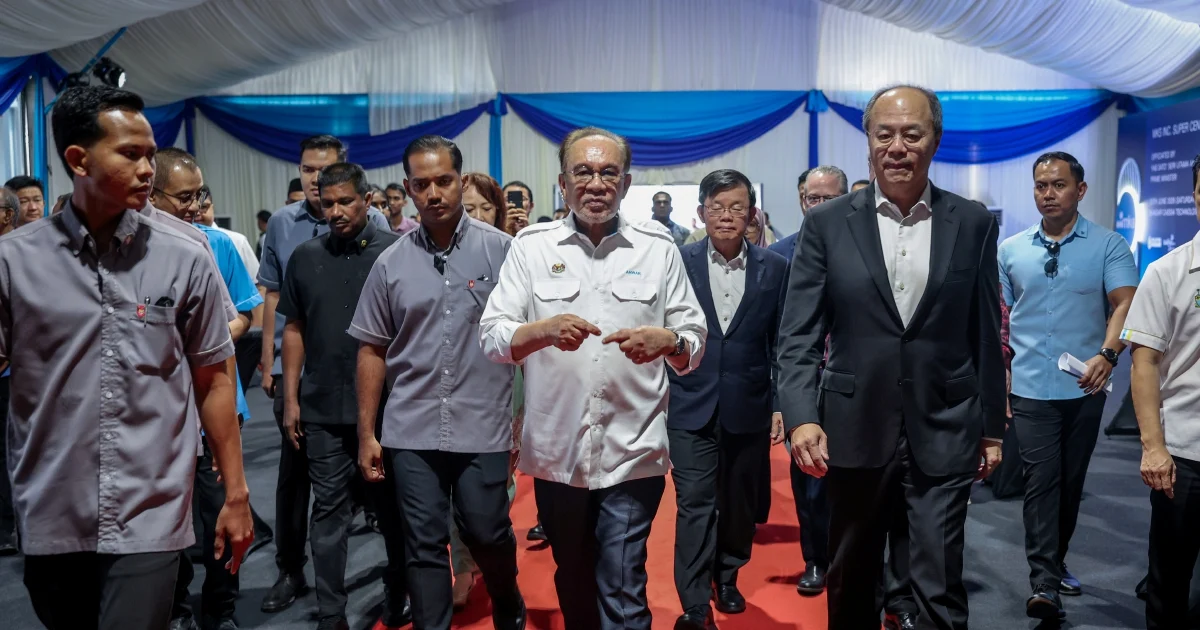
Prime Minister Datuk Seri Anwar Ibrahim has underscored the strategic advantage Malaysia gains from its balanced approach to international relations, arguing that the nation's willingness to engage constructively with all powers whilst remaining independent is a key factor underpinning stronger investor sentiment and sustained economic momentum.
Spoken at an engagement in Batu Kawan, the Prime Minister's remarks reflect a broader narrative about Malaysia's positioning in an increasingly fractious geopolitical landscape. As tensions between major powers—particularly the United States and China—continue to shape regional dynamics, Malaysia's refusal to align rigidly with either camp has become a selling point for attracting foreign direct investment. Investors, wary of supply chain disruptions and political unpredictability, appear increasingly drawn to nations that maintain pragmatic relations across ideological and strategic divides.
For Malaysia, this non-aligned philosophy is hardly novel. The country has historically steered a middle course, leveraging its strategic location on one of the world's busiest shipping lanes and its position in Southeast Asia to maintain commercial ties with multiple powers. However, Anwar's emphasis on this stance carries particular weight as Malaysia navigates recovery from the economic impacts of the pandemic and grapples with slower global growth forecasts. By articulating Malaysia's neutrality as an asset rather than a constraint, the government is attempting to reposition the nation as a stable, predictable destination for capital seeking to hedge against regional volatility.
The connection between diplomatic flexibility and investor confidence is not coincidental. Multinational corporations evaluating expansion or relocation decisions increasingly factor in geopolitical risk. A country that maintains stable relations with both Washington and Beijing, for instance, reduces the likelihood of becoming collateral damage in great power competition. Malaysia's openness to participating in regional frameworks—from ASEAN to bilateral agreements—whilst resisting pressure to choose sides demonstrates this pragmatism.
Anwar's framing also resonates within ASEAN, where consensus-building and non-interference remain foundational principles. As the bloc wrestles with maintaining unity amid member states with differing strategic alignments, Malaysia's advocacy for inclusive engagement serves as a template. This positioning could strengthen Malaysia's hand in regional negotiations and potentially attract businesses seeking a gateway into Southeast Asia that operates according to established diplomatic norms rather than volatile great power alignments.
The economic implications extend beyond investor psychology. A neutral Malaysia can host supply chains that source from or serve multiple regions without triggering sanctions or discriminatory trade measures. Companies manufacturing for both Western and Asian markets find fewer obstacles to operations in a country that doesn't face restrictions or tariffs rooted in geopolitical disputes. This operational flexibility translates into lower business risk and potentially higher margins, making Malaysia comparatively attractive compared to nations perceived as closer to either Washington or Beijing.
Yet Anwar's emphasis on this strategy also underscores mounting pressure on Malaysia to articulate its value proposition clearly. With the regional economy increasingly segmented along technological and supply chain lines—semiconductors and electronics manufacturing, for example, face distinct rules depending on whether they serve American or Chinese end-markets—a genuinely neutral position becomes harder to sustain. Malaysia's growing technology manufacturing base, particularly in semiconductors and renewable energy components, means the government will face increasing pressure to choose sides on critical issues like export controls and intellectual property standards.
The Prime Minister's remarks also implicitly address domestic concerns about Malaysia's economic trajectory. With growth forecasts moderating and regional competitors ramping up investment in infrastructure and technology, Malaysia must compete harder for capital. By portraying neutrality not as weakness but as strategic strength, Anwar is signalling to investors that Malaysia offers stability and access without the baggage of entanglement in external conflicts.
Investor confidence, however, depends on more than diplomatic posture. Implementation matters. Regulatory predictability, rule of law, infrastructure quality, and skilled workforce availability remain critical. Anwar's government has initiated reforms on these fronts, but execution risks persist. If Malaysia's institutions falter or political instability resurfaces, the most deftly maintained neutrality will struggle to offset other liabilities attracting foreign capital.
Moreover, maintaining genuine neutrality requires constant calibration. China is Malaysia's largest trading partner, whilst the United States remains a significant investor and technology provider. The European Union increasingly imposes sustainability standards that affect manufacturing. Any signal that Malaysia is tilting toward one power risks alienating others, creating a delicate balancing act for policymakers.
Looking ahead, Malaysia's neutral engagement strategy will likely remain central to its economic messaging, particularly as global uncertainty persists. The success of this approach, however, will ultimately depend on whether Malaysia can translate diplomatic flexibility into tangible benefits—job creation, technology transfer, infrastructure improvements—that demonstrate genuine value to ordinary Malaysians and reassure investors that the country's balanced position reflects strategic clarity rather than strategic confusion.

