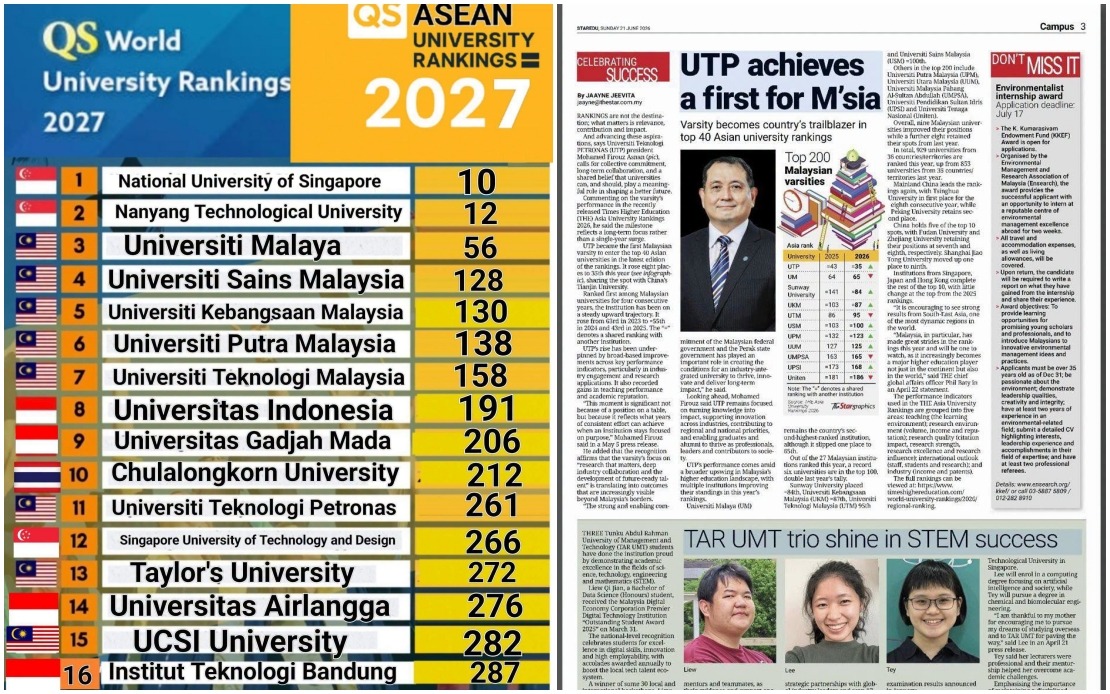
Malaysia's higher education institutions have demonstrated their growing competitive strength on the regional stage, with a record-breaking showing in the latest Times Higher Education Asia University Rankings 2026. The performance represents a significant milestone for a nation working to position itself as Southeast Asia's premier education destination, and Higher Education Minister Datuk Seri Dr Zambry Abd Kadir has characterised the results as validation of the country's broader aspirations to become a globally recognised hub for excellence in teaching, research and innovation.
Universiti Teknologi Petronas (UTP) emerged as the standout performer among Malaysia's institutions, achieving a historic breakthrough by becoming the first Malaysian university to crack Asia's top 40, securing 35th position in the rankings. This represents a notable climb from its 43rd ranking in the previous year, demonstrating the trajectory of improvement that some Malaysian universities are achieving through sustained investment and institutional focus. UTP's ascent is particularly significant as it signals that Malaysian universities can compete effectively with regional peers and international counterparts, even in highly specialised fields where the institution has built particular strength.
The broader Malaysian showing revealed encouraging depth across the higher education system. Twenty-seven Malaysian institutions were included in this year's rankings, with six universities reaching the prestigious top 100 tier in Asia and a further eleven positioned within the top 200. These figures indicate that excellence is not confined to a single flagship institution but is being cultivated across multiple universities, both in the public and private sectors. The distribution of ranked institutions suggests a maturing ecosystem where quality benchmarks are being applied and met across diverse institutional types and missions.
Zambry's statement reflected the government's perspective that while international rankings should not become an obsession for universities, they remain a meaningful measure of institutional quality, reputation and competitive positioning in an increasingly globalised education marketplace. The minister's emphasis on rankings as one indicator rather than the ultimate objective represents a balanced approach to performance measurement, acknowledging that universities must pursue multiple objectives including community engagement, social responsibility and local impact alongside international recognition. This nuance matters for Malaysian policymakers seeking to balance global aspirations with the nation's specific development needs.
The achievements attributed to Malaysian universities reflect the accumulated contributions of multiple stakeholders within and beyond institutional walls. Academics and researchers working across disciplines have conducted work that meets international standards and contributes to global knowledge. Students have engaged in rigorous study and research experiences that position them competitively alongside their regional peers. Administrative staff and support personnel have created operational environments enabling quality instruction and research. Alumni have built careers that enhance institutional reputations. Industry partners have collaborated on research initiatives and provided practical context for academic work. This ecosystem perspective suggests that Malaysia's ranking improvements result from systemic strengthening rather than isolated pockets of excellence.
The list of congratulated institutions provides a snapshot of Malaysia's higher education diversity. Universiti Malaya (UM) maintains its position as a leading research-intensive institution. Sunway University represents the strong contributions of private higher education to Malaysia's sector. Public universities including Universiti Kebangsaan Malaysia (UKM), Universiti Teknologi Malaysia (UTM), Universiti Sains Malaysia (USM), Universiti Putra Malaysia (UPM) and Universiti Utara Malaysia (UUM) continue reinforcing their respective research and teaching missions. Newer institutions such as Universiti Malaysia Pahang Al-Sultan Abdullah (UMPSA) and Universiti Tenaga Nasional (UNITEN) have established sufficient quality standards to achieve recognition. Universiti Pendidikan Sultan Idris (UPSI) represents the teacher education sector, often overlooked in international rankings but crucial to national development.
For Malaysia's regional positioning, these ranking results carry strategic implications. As the nation competes with Singapore, Thailand, Indonesia and Vietnam for regional education market share, demonstrating multiple strong institutions creates a compelling narrative for international students considering higher education options in Asia. The improvement trajectory visible in UTP's movement from 43rd to 35th position signals momentum that may attract prospective students, faculty and research collaborators. Countries across Southeast Asia are investing heavily in becoming education hubs, and Malaysia's showing suggests it remains a credible player in this competitive landscape.
The significance of achieving six universities in Asia's top 100 extends beyond prestige. These institutions become natural magnets for research funding, international collaborations, and high-calibre faculty recruitment. When universities achieve such recognition, they typically experience virtuous cycles where improved rankings attract better students, which enhances research output, which further strengthens rankings. For Malaysia, this means that the current improvements may well compound over coming years if institutions maintain their investment trajectories and strategic focus.
Looking forward, the momentum identified by Zambry will require sustained commitment. International university rankings are increasingly competitive as institutions across Asia invest in research infrastructure, international recruitment and quality assurance frameworks. Malaysia cannot assume that current improvements will be automatically sustained without continued effort. The challenge for Malaysian universities involves balancing the imperatives of international rankings with other pressing needs, including affordability and accessibility for Malaysian students, research alignment with national development priorities, and engagement with local communities and industries. The most successful Malaysian universities will likely be those that pursue international excellence while remaining deeply anchored to Malaysia's specific context and requirements.

