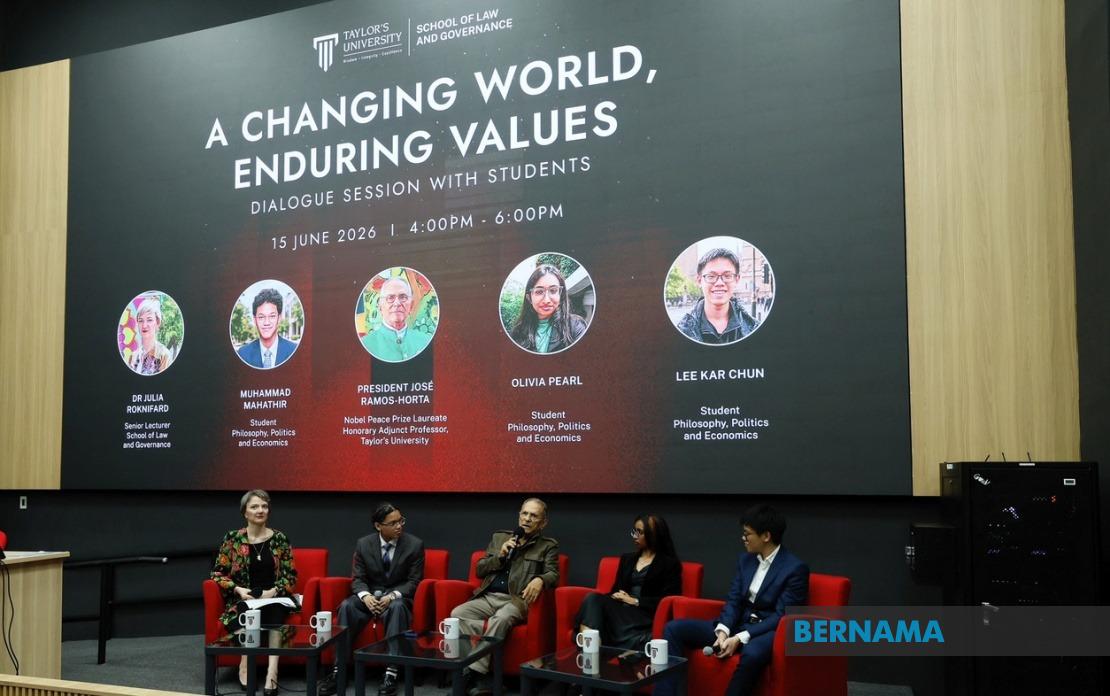
Timor-Leste President Jose Ramos-Horta has characterised diplomatic relations between his nation and Malaysia as exceptionally robust, while commending the country's standing internationally across security, democratic governance and personal freedoms. The Nobel laureate, speaking during a five-day official visit that runs until Wednesday, highlighted Malaysia's instrumental role in supporting Timor-Leste's development trajectory stretching back decades—well before Timor-Leste achieved independence in 2002.
Ramos-Horta's remarks underscore a bilateral relationship that has deepened considerably in recent years. He pointed to Malaysia's contribution to peacekeeping operations in 1999 as a foundational moment in the partnership, representing a commitment to Timor-Leste's sovereignty during a critical juncture. Speaking with reporters at Taylor's University in Petaling Jaya following a dialogue session with students, the former journalist reflected on Malaysia's four-decade trajectory of development and stability. He specifically noted how Prime Minister Datuk Seri Anwar Ibrahim's leadership has reinvigorated Malaysia's economic standing and expanded its international influence and diplomatic reach.
The visit carries particular symbolic weight for Southeast Asian regional dynamics. Ramos-Horta used the occasion to address Malaysia's journalist community ahead of National Journalists' Day (HAWANA) celebrations scheduled for Petaling Jaya this Saturday. His message emphasised the critical role of an informed citizenry in sustaining cohesion, advancing national unity and navigating contemporary challenges. By congratulating Malaysian journalists on their professional efforts, he acknowledged the profession's broader contribution to democratic accountability and public discourse—themes that resonate across the region as nations grapple with misinformation and social fragmentation.
A centrepiece of Ramos-Horta's visit involves showcasing Timor-Leste's readiness to assume the ASEAN chairmanship in 2029. During a university dialogue titled "A Changing World, Enduring Values," he expressed confidence that infrastructure and institutional preparations will be completed within the timeframe. The declaration reflects optimism tempered with acknowledgment of the logistical challenge involved in hosting the bloc's annual summits and associated ministerial meetings.
Timor-Leste's trajectory within ASEAN represents a watershed moment for the regional bloc. The nation officially joined as ASEAN's 11th member on October 26, 2025—the organisation's first expansion in 26 years—ending a multi-decade pursuit of membership. Malaysia played a decisive diplomatic role in facilitating this accession during its 2024 ASEAN chairmanship, a contribution Ramos-Horta explicitly acknowledged. This milestone reflects not only Timor-Leste's geopolitical significance in the maritime Southeast Asian context but also the bloc's commitment to inclusive regionalism and conflict resolution through institutional engagement.
The timing of Ramos-Horta's visit carries implications for Malaysia's broader regional positioning. By hosting the Timorese president and securing his public approbation, Kuala Lumpur reinforces its standing as a stabilising force within ASEAN and demonstrates capacity for effective multilateral diplomacy. For Malaysian policymakers and observers, the visit signals continued opportunities for deepening cooperation across development, defence and institutional frameworks—areas where both nations have complementary interests.
Ramos-Horta's emphasis on infrastructure readiness for the 2029 chairmanship reveals underlying challenges facing Timor-Leste's development agenda. The nation, having emerged from conflict and instability relatively recently, faces considerable capacity constraints in staging a major regional event. Malaysia's experience hosting ASEAN forums and bilateral investment in Timor-Leste's development could prove invaluable as preparations accelerate. The implicit acknowledgment that external support remains necessary underscores the interdependencies characterising the broader region.
From a Southeast Asian perspective, strengthening Malaysia-Timor-Leste ties serves broader strategic interests. Both nations sit astride critical maritime corridors and share interests in maritime security, counterterrorism and economic cooperation. Timor-Leste's ASEAN membership enhances regional cohesion and institutional capacity for addressing transnational challenges from piracy to environmental degradation. Malaysia's investments in this relationship—diplomatic, economic and security-related—position it favourably for the coming decade as competition for influence in Southeast Asia intensifies.
Ramos-Horta's visit also reflects generational shifts in regional leadership. As a Nobel laureate whose career spans journalism, diplomacy and statecraft, he embodies intellectual engagement with complex regional challenges. His framing of Malaysia's development as exemplary and his emphasis on informed citizenry suggest sophisticated engagement with issues beyond traditional security considerations. This intellectual dimension adds texture to what might otherwise appear as routine diplomatic courtesy.
The convergence of themes—democratic resilience, development partnership, regional institution-building—outlined during Ramos-Horta's remarks points toward an emerging agenda for Malaysia-Timor-Leste cooperation. Malaysian support for infrastructure development, technical capacity-building and institutional strengthening will likely increase as 2029 approaches. Such engagement benefits both parties: Timor-Leste gains crucial expertise and resources, while Malaysia enhances its regional standing and secures longer-term partnerships with a strategically located neighbour.
Looking forward, the relationship trajectory suggests deepening integration across multiple domains. Economic cooperation, particularly in energy and fisheries, offers practical avenues for mutual benefit. Defence partnerships and maritime cooperation address shared security concerns. Educational and cultural exchanges, highlighted during Ramos-Horta's university engagement, build people-to-people connections that sustain diplomatic relationships across political cycles. The visit thus represents not conclusion but inflection point in a developing partnership with considerable potential for regional significance.

