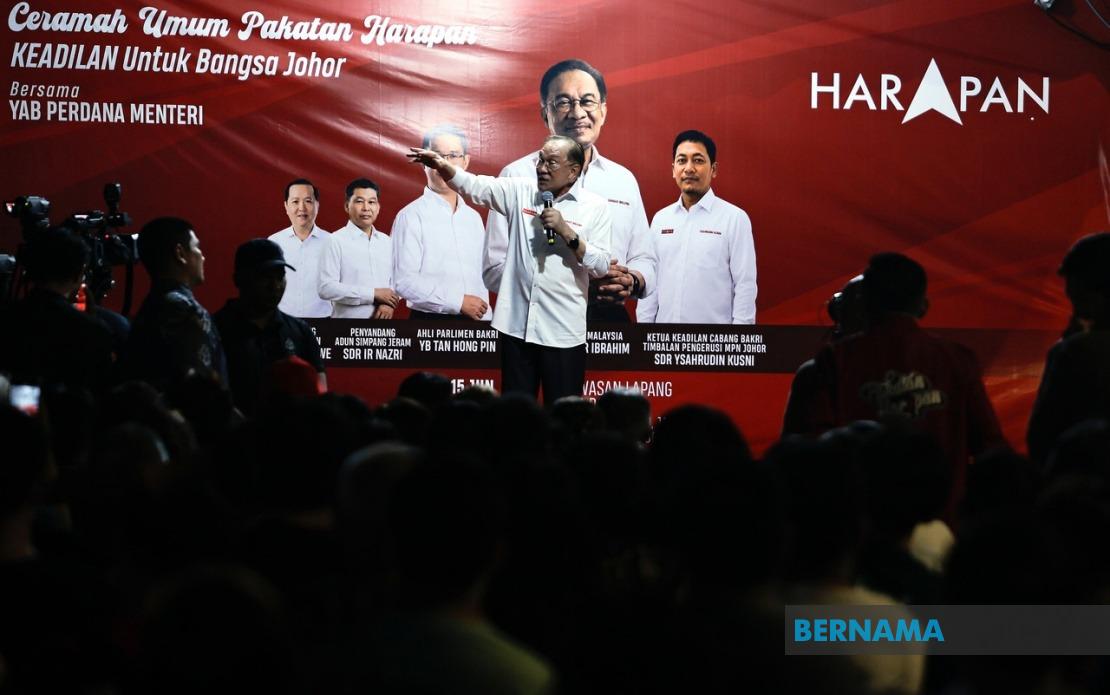
Prime Minister Datuk Seri Anwar Ibrahim has issued a stark reminder to the nation that technological advancement and economic development must supersede the endless cycle of political squabbling that has long characterised Malaysian public discourse. Speaking at a Pakatan Harapan grand rally in Muar, Johor, Anwar underscored the urgency of redirecting national attention toward artificial intelligence and quantum computing—technologies he views as fundamental to Malaysia's prosperity and relevance in the global economy. His message was unambiguous: the country cannot afford to be distracted by divisive rhetoric when competing nations are racing ahead in innovation and digital transformation.
The Prime Minister's call to action comes amid his government's tangible efforts to position Malaysia as a regional hub for technological investment and development. Recent visits to Japan, where discussions focused on quantum computing prospects, have formed part of a broader strategy to attract multinational corporations and establish data centres within Malaysian territory. These initiatives represent more than symbolic gestures; they constitute a deliberate pivot toward sectors that economists recognise as decisive for twenty-first-century competitiveness. By highlighting these concrete steps, Anwar sought to demonstrate that his administration is actively translating rhetoric into policy, a distinction that carries weight with investors evaluating emerging markets for deployment of capital and expertise.
The Prime Minister's exhortation carried particular weight given the persistent fault lines in Malaysian society. His reference to ceaseless disputes over religious sites, ethnicity, and cultural matters reflected frustration with how political actors routinely weaponise identity-based grievances to mobilise support. Anwar's framing suggested that such conflicts, while significant, ought not consume governmental bandwidth and national focus to the degree they currently do. Instead, he articulated a vision wherein technological prowess and economic dynamism serve as unifying objectives that transcend the traditional ethnic and religious divisions that have historically structured Malaysian politics. This reorientation, if successful, could gradually shift public discourse toward pragmatic discussion of measurable outcomes rather than symbolic battles.
The audience for this message extended beyond attendees at the Muar rally. Anwar's remarks, delivered in his capacity as both Prime Minister and Pakatan Harapan Chairman, signalled to international investors and technology firms that Malaysia presents a stable, forward-thinking governance environment despite periodic political turbulence. Investors evaluating markets for artificial intelligence and quantum computing facilities require assurance that policy frameworks remain consistent and that governmental priorities remain anchored in economic fundamentals rather than consumed by internal political combat. By publicly committing the administration to this technological agenda, Anwar effectively communicated predictability and seriousness of purpose to global capital markets.
The presence of PKR Vice-President Datuk Seri Dr. Zaliha Mustafa and Johor PH Chairman Aminolhuda Hassan underscored the coalition's unified stance on this approach. Their attendance lent institutional weight to the Prime Minister's vision and suggested consensus within the governing alliance regarding technological investment as a priority. This display of unity carries significance in a Malaysian political context where internal coalition disagreements frequently become public spectacles that undermine governmental effectiveness and foreign confidence. By presenting a consolidated front, the coalition attempted to signal that inter-party tensions would not impede implementation of technology-focused policies.
Anwar's invocation of Malaysia's emerging international reputation as a destination for investment added another dimension to his argument. His observation that global investors are now approaching Malaysia rather than Malaysia pursuing them reflects genuine shifts in foreign direct investment patterns, particularly in technology sectors. This positive momentum, he implied, risks dissipation should political elites revert to habitual identity-based confrontations that repel international companies seeking stable, merit-focused operating environments. The implicit warning was clear: the window for establishing Malaysia as a genuine technology hub remains open, but only if political leadership exercises strategic restraint.
The emphasis on intergenerational responsibility further strengthened Anwar's rhetorical positioning. By framing AI and quantum computing as the inheritance Malaysian children deserve, he elevated the discussion beyond immediate political advantage to longer-term national interest. This generational language resonates particularly with younger voters who increasingly prioritise economic opportunity and global competitiveness over the historical grievances that shaped their parents' political consciousness. Such messaging aims to gradually reorient Malaysian politics toward demographic cohorts less invested in perpetuating divisive identity frameworks and more focused on access to high-quality employment in innovation-driven sectors.
The Prime Minister's appeal for cross-ethnic collaboration explicitly rejected zero-sum competition among Malay, Chinese, and Indian communities in favour of collaborative nation-building. This framing sought to redefine national interest as a shared endeavour rather than a contested resource to be distributed along ethnic lines. While such appeals have longstanding precedent in Malaysian political discourse, their reiteration by an incumbent Prime Minister with executive authority carries greater credibility than similar statements from opposition figures or civil society advocates. However, the gap between rhetorical appeal and institutional change in Malaysian politics remains substantial, and genuine reorientation toward technology-centric priorities would require sustained commitment across multiple government agencies and political cycles.
The timing of these remarks in Johor carries subnational significance. As the largest state by population and a crucial electoral battleground, Johor's political orientation influences national outcomes substantially. By directing this message to Johor audiences, Anwar signalled that the coalition intends to contest elections on the basis of developmental track records and technological progress rather than traditional identity-based appeals. This represents an implicit challenge to opposition parties that have historically relied heavily on such mobilisation strategies. Whether Malaysian voters, particularly in Johor, prove responsive to this reorientation toward technocratic governance rather than identity politics remains an open question that will likely shape electoral dynamics in coming years.
The broader context of Anwar's remarks reflects genuine international trends in competitive advantage. Nations that have successfully transitioned to AI and quantum computing leadership—whether South Korea, Singapore, or increasingly Vietnam—have recognised that sustainable development requires institutional capacity to nurture technological innovation. Malaysia's historical reliance on commodity exports and conventional manufacturing increasingly appears inadequate for maintaining middle-income status in a global economy where technological sophistication drives wealth creation. Anwar's insistence on reorienting Malaysian governance toward these imperatives aligns with economic reality, even as it challenges deeply embedded patterns of political mobilisation.
Yet implementation presents formidable challenges. Creating genuine technological ecosystem capacity requires not merely government proclamations but sustained investment in education, research infrastructure, and regulatory frameworks conducive to innovation. Political support for such unglamorous institutional development often proves difficult to sustain when competing constituencies demand immediate resource allocation to healthcare, education, and welfare provision. Furthermore, senior civil servants and political appointees accustomed to traditional patronage networks may resist transition toward meritocratic technological sectors. Anwar's rhetorical commitment to this agenda, therefore, must be matched by organisational changes within government that actually prioritise technology investment and insulate such projects from patronage pressures.
The fundamental question underpinning Anwar's remarks concerns whether Malaysian political culture can genuinely shift toward the technocratic, development-focused paradigm he advocates. His call for unity on technological advancement rather than divisive politics represents an implicit critique of Malaysian political practice across multiple decades. Whether this critique produces meaningful behavioural change among political elites remains to be demonstrated. What remains clear is that the Prime Minister has positioned technological development as the primary metric by which his administration should be evaluated, thereby creating a measurable standard against which political accountability can be assessed. This clarity of purpose may itself constitute a significant contribution to redirecting Malaysian political discourse, regardless of ultimate success in transforming institutional practices.

