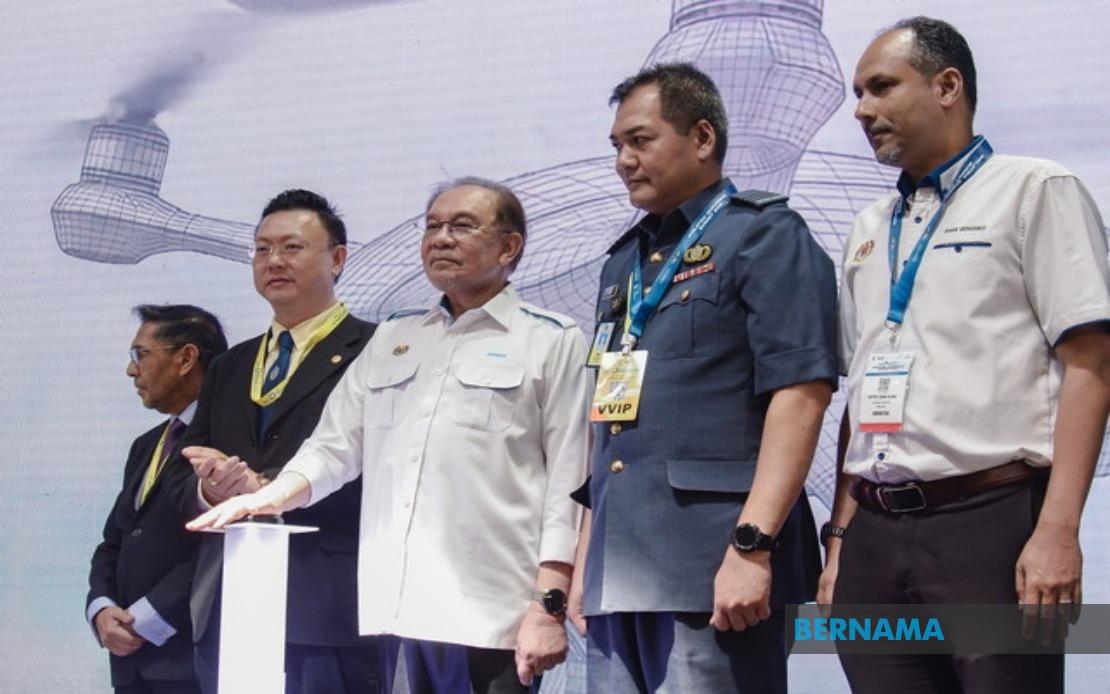
Prime Minister Datuk Seri Anwar Ibrahim has stressed the critical importance of Malaysia moving swiftly to develop and adopt unmanned aerial vehicle technology, positioning the emerging sector as essential to the country's long-term economic competitiveness and prosperity. Delivering remarks at the MyDrone Expo 2026 closing ceremony in Sepang, Anwar articulated a vision in which drone technologies serve as a cornerstone of national industrial advancement, linked inextricably to broader trends in artificial intelligence and digital transformation shaping global economies.
The drone sector represents far more than a niche industrial segment, according to the Prime Minister's assessment. Rather, it functions as a convergence point where multiple technological frontiers—from autonomous systems and data analytics to advanced materials and sensor integration—intersect to create multiplier effects across numerous economic domains. By positioning Malaysia within this ecosystem, the government aims to capture downstream opportunities that extend well beyond manufacturing, into services, infrastructure inspection, precision agriculture, and logistics optimisation.
Market projections underscore the magnitude of opportunity at stake. The global unmanned aerial vehicle market is anticipated to surpass USD55 billion in value by 2030, a trajectory reflecting sustained institutional and commercial investment worldwide. Concurrently, economists and technology analysts increasingly recognise the low-altitude economy—encompassing operations conducted at heights below traditional aviation corridors—as an emerging and strategically significant investment category. For a Southeast Asian nation seeking to transition towards higher-value economic activities, the timing of entry and depth of commitment in this space carries substantial implications for future competitiveness.
Anwar has instructed Cabinet ministers, regulatory authorities, scientific research institutions, and relevant government agencies to mobilise comprehensive support for the drone industry ecosystem. This directive extends across multiple dimensions: policy formulation, regulatory streamlining, financial resource allocation, and institutional coordination. The government's commitment encompasses not merely defence and aerospace applications, which traditionally dominated unmanned systems discourse, but equally emphasises civil-sector deployment across agriculture, plantation management, urban planning, environmental monitoring, and emergency response operations.
Regulatory modernisation forms a critical pillar of the government's strategy. Malaysia's existing aviation and technology regulatory frameworks, developed during periods when drone technologies remained nascent, require recalibration to accommodate rapid innovation cycles and diverse operational scenarios that contemporary unmanned systems enable. The government has committed to expedited development of certification standards, testing protocols, and airspace management procedures that balance innovation encouragement with public safety and security considerations—a delicate equilibrium that successful drone economies must achieve.
Research funding and institutional capacity building represent equally important components. Malaysia currently possesses several academic and research institutions with emerging competencies in robotics, autonomous systems, and related domains. However, systematic expansion of research funding dedicated to unmanned aerial systems, establishment of dedicated testing facilities, and creation of innovation hubs modelled on successful international precedents could substantially accelerate domestic capability development. Such institutional investments typically generate spillover benefits throughout adjacent technology sectors.
The MyDrone Expo 2026, which concluded with the Prime Minister's address, demonstrated the sector's emerging maturity and international engagement profile. The three-day event exceeded organisers' expectations, attracting more than 100 exhibition booths and thousands of industry professionals and policy stakeholders representing 46 countries. This international participation reflects growing recognition that Malaysia possesses geographic, regulatory, and human capital advantages potentially rendering it an attractive hub for drone research, development, and commercialisation within the Asian region.
Collaboration between private enterprises, government research institutions, and universities emerges as foundational to Malaysia's drone industry development strategy. The Prime Minister specifically emphasised the necessity of constructing robust talent pipelines through educational partnerships analogous to existing university programmes in artificial intelligence and quantum computing. This approach—deliberately cultivating specialised human capital through coordinated academic and industry engagement—has proven effective in positioning leading technology economies at the frontier of emerging sectors.
For Malaysian stakeholders across agriculture, logistics, telecommunications, and environmental management sectors, accelerated drone technology adoption and localised manufacturing capabilities could unlock productivity improvements and cost reductions. Precision agriculture applications particularly resonate within Malaysia's plantation economy, where drone-based crop monitoring, targeted pesticide application, and yield prediction systems could substantially enhance operational efficiency. Similarly, telecommunications infrastructure inspection across Malaysia's geographically dispersed regions could benefit considerably from autonomous aerial survey capabilities.
The geopolitical and economic context surrounding this initiative merits consideration. Regional competitors including Singapore, Thailand, and Indonesia simultaneously pursue drone technology development strategies, creating implicit competitive pressure. Malaysia's success in establishing itself as a Southeast Asian drone innovation centre depends substantially on execution speed and the coherence of government support mechanisms. Bureaucratic delays, regulatory uncertainty, or insufficient research investment could cede emerging market opportunities to regional rivals possessing clearer strategic focus.
Anwar's emphasis on balanced regulatory frameworks addresses a genuine tension within technology-driven economic development. Overly restrictive regulations stifle innovation and drive investment elsewhere; insufficiently developed safeguards create public safety and security risks that ultimately undermine public and political support for sector development. Malaysia's regulatory architecture must navigate this terrain carefully, learning from international precedents while accommodating local circumstances.
The convergence of drone technology with artificial intelligence and digital transformation initiatives already receiving government attention suggests a coherent long-term strategy. Rather than treating drone development as an isolated industrial project, the government appears to recognise its position within a broader digital economy transition. This integrated perspective enhances the probability of sustained political commitment and coordinated resource allocation across multiple government entities and timeframes.

