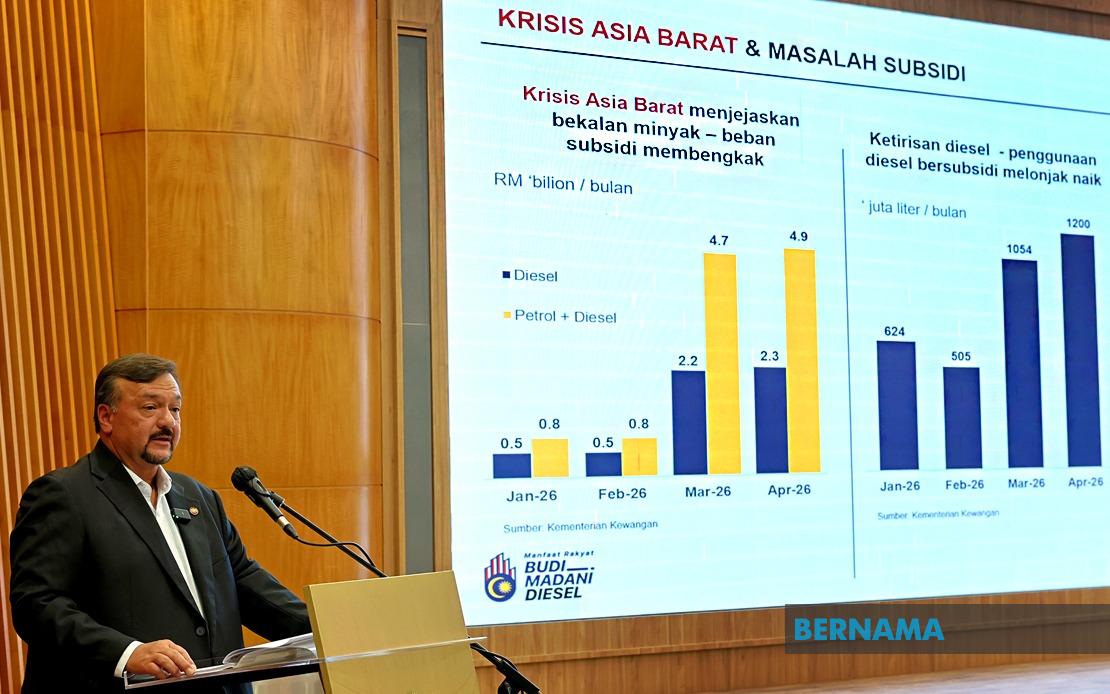
The Malaysian government has decided to keep the monthly BUDI MADANI RON95 subsidy quota at its current level of 200 litres, declining for now to restore it to the previous 300-litre threshold. The decision reflects Putrajaya's cautious approach to fuel subsidies amid volatile geopolitical developments in the Middle East that continue to influence global petroleum markets. Finance Minister II Datuk Seri Amir Hamzah Azizan explained that the government requires additional time to assess the stability and effectiveness of recent diplomatic breakthroughs before committing to increased fuel support spending.
The backdrop to this policy stance is the recently announced ceasefire agreement between the United States and Iran, which introduces considerable uncertainty into global energy markets. The preliminary accord, formally signed last Friday, includes a 14-point framework aimed at de-escalating tensions in the West Asia region. However, the agreement is contingent on further negotiations, with both sides granted a 60-day window to reach a comprehensive settlement. This extended negotiation period means the ultimate trajectory of oil prices remains unpredictable, making it imprudent for Malaysia to expand subsidy commitments without clearer visibility on market conditions.
Amir Hamzah emphasized that the government's primary objective remains protecting Malaysian households from fuel price volatility while maintaining fiscal sustainability. He noted that the reduction from 300 to 200 litres, implemented earlier as a precautionary measure, has manageable consequences for households and businesses. The Finance Minister highlighted data showing that approximately 80 per cent of BUDI95 beneficiaries consume less than 200 litres of petrol monthly, suggesting the current quota adequately serves the majority of eligible users without significant hardship.
The BUDI95 subsidy programme represents a cornerstone of Malaysia's approach to controlling cost-of-living pressures for middle and lower-income citizens. By restricting the monthly quota, the government aims to target assistance toward regular commuters and essential transport users rather than high-volume consumers. This approach reflects a shift toward means-tested subsidies rather than universal fuel price controls, a strategy increasingly adopted across Southeast Asia as nations grapple with balancing welfare objectives against fiscal constraints.
Prime Minister Datuk Seri Anwar Ibrahim had previously signalled optimism regarding the US-Iran preliminary agreement, viewing the diplomatic breakthrough as a potential pathway to sustained regional stability and lower oil prices. His cautious confidence suggested that a successful resolution could ultimately benefit Malaysia through reduced petroleum costs and improved predictability in global energy markets. However, the conditional nature of the agreement—requiring final settlement within 60 days—means premature policy commitments could prove counterproductive if negotiations falter.
The government's monitoring approach reflects lessons learned from previous commodity price shocks and geopolitical disruptions. West Asia remains a critical region for global energy supplies, and any escalation in tensions can trigger sudden oil price spikes that rapidly erode government budgets dedicated to fuel subsidies. By maintaining a flexible stance and gathering additional intelligence on both diplomatic developments and market responses, Malaysian policymakers preserve the option to adjust subsidies in real time should conditions warrant.
For Malaysian consumers, the continuation of the 200-litre quota means household budgets face continued constraints, though the government emphasises this remains manageable for the vast majority. The Finance Minister encouraged citizens to adopt efficiency measures such as remote working arrangements and prudent fuel consumption habits to reduce the cumulative burden on household spending. These recommendations implicitly acknowledge that targeted subsidies alone cannot solve broader transportation affordability challenges without complementary behavioural and workplace adjustments.
The subsidy reduction also carries implications for Malaysia's fiscal position amid competing spending pressures. Government revenues remain sensitive to global commodity prices, and fuel subsidies represent a substantial recurring expense. By exercising restraint in expanding subsidy commitments, the administration preserves budgetary room for investments in healthcare, education, and infrastructure—priorities essential for long-term economic competitiveness.
Regional observers will monitor whether the US-Iran negotiations progress as scheduled or encounter obstacles. Any deterioration in talks or resurgence of geopolitical tensions could prompt rapid oil price movements, forcing Malaysia to revisit its subsidy calculations. Conversely, a successful comprehensive agreement could create conditions for the government to reconsider the 300-litre quota restoration. The government's decision to maintain the current quota while keeping options open reflects pragmatic uncertainty management in an inherently unpredictable environment.
The BUDI95 framework also serves as a case study in how developing economies balance social welfare objectives against fiscal prudence. Malaysia's phased approach—maintaining a subsidy rather than eliminating it entirely, while restricting its scope—contrasts with more dramatic liberalisation schemes adopted by some regional neighbours. This middle path aims to cushion vulnerable populations while signalling to markets that the government recognises budget constraints and commits to fiscal discipline.
Looking ahead, the government's wait-and-see posture extends beyond the 60-day US-Iran negotiation window. Even if a comprehensive agreement is reached, assessing its durability and real-world impact on oil markets will require additional observation. This suggests the 200-litre quota may persist for several months beyond the current diplomatic timeline, providing consumers with visibility for household budget planning while giving policymakers space to make informed decisions about future adjustments.

