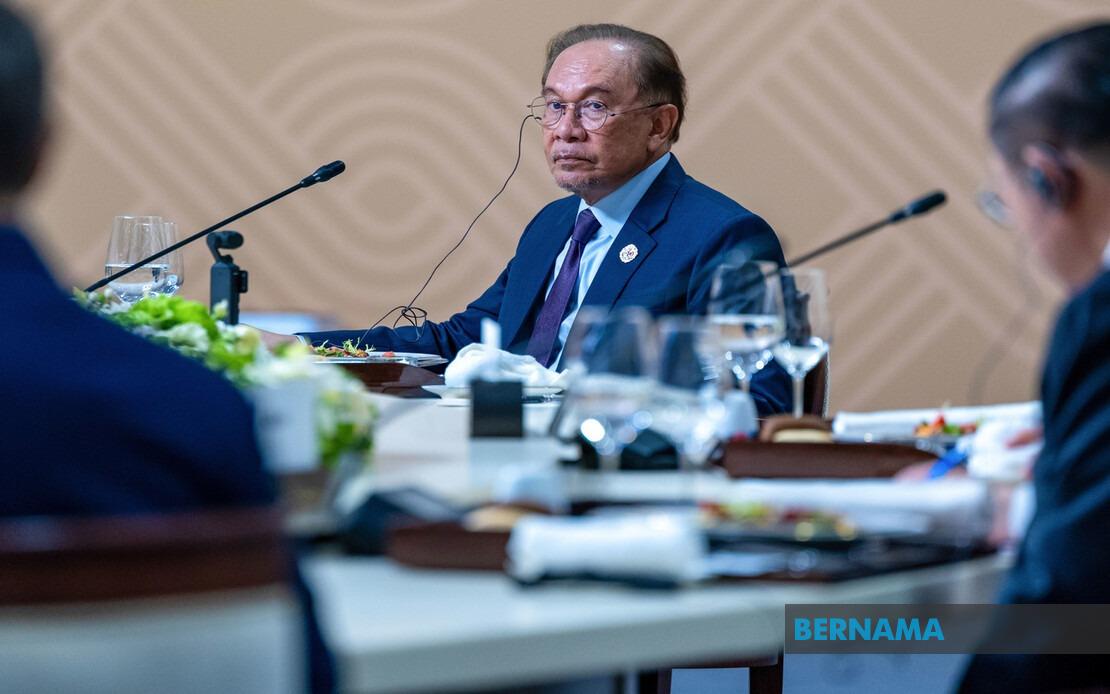
Prime Minister Datuk Seri Anwar Ibrahim's whirlwind four-day visit to Tashkent, Kazan, and Ashgabat represents far more than a routine diplomatic tour. The journey encapsulates Malaysia's deliberate pivot towards building economic relationships across a wider geographic and strategic spectrum, a necessary recalibration as the international order undergoes one of its most significant transformations since the Cold War's conclusion. What makes this initiative particularly consequential is its timing, arriving at a moment when major powers are employing trade restrictions, sanctions, and export controls as standard instruments of statecraft, reshaping the landscape in which smaller economies must navigate.
Malaysia faces a fundamentally altered operating environment compared to the relatively predictable period of globalisation that characterised the early twenty-first century. Today's multipolar world presents both opportunities and vulnerabilities for trading nations dependent on openness and international connectivity. The strategic competition among major powers is intensifying in ways that create new trade barriers and fragment previously integrated supply chains. For a country like Malaysia, which has built prosperity on its ability to connect diverse markets and serve as a regional hub, this fragmentation threatens established prosperity models while simultaneously opening doors to new partnerships in regions previously outside Malaysia's primary commercial orbit.
The stopover in Tashkent, initially planned as a courtesy meeting with President Shavkat Mirziyoyev, transformed into a substantive working visit addressing multiple areas of economic cooperation initiated during a previous official engagement in 2024. This evolution from protocol to productive negotiation reveals how personal diplomatic relationships can create momentum for deeper engagement. The discussions signalled Malaysia's intention to treat Central Asia not as a peripheral region but as part of an expanded strategic architecture offering genuine commercial and developmental possibilities.
Kazan's significance extends beyond the bilateral Malaysia-Russia relationship. The city hosted the ASEAN-Russia Commemorative Summit, which provided a platform for Malaysia to engage with political and business leaders from across the broader Eurasian region. While Russia itself remains a relatively modest trade partner for ASEAN compared to established economic powers, both sides recognise substantial untapped potential in sectors spanning energy, agriculture, advanced manufacturing, digital technologies, and food security. The ASEAN-Russia Strategic Programme on Trade and Investment Cooperation 2026-2035 formalises this recognition, establishing a framework for engagement that acknowledges how future competitiveness increasingly hinges on innovation and technological capability.
Particularly noteworthy were discussions between Malaysian officials and leaders from the Republic of Tatarstan, often overshadowed globally by Moscow's prominence yet representing one of Russia's most dynamic industrial and technological hubs. Conversations ranged across biotechnology, halal industries, maritime capabilities, Islamic finance, and industrial cooperation. These engagements illustrate a crucial but frequently overlooked dimension of modern economic diplomacy: national governments no longer serve as exclusive gateways to international economic cooperation. Regions, provinces, cities, and specialised innovation clusters have become significant actors in their own right within international economic networks. Building direct relationships with these subnational entities can generate practical opportunities that complement and sometimes exceed what traditional state-to-state diplomacy achieves.
The final component of the visit, focused on Turkmenistan, highlighted energy diplomacy's continuing centrality to Malaysia's strategic interests. Petronas' three-decade presence in the country has evolved far beyond that of a simple foreign investor. Over this extended engagement, Petronas has contributed meaningfully to infrastructure development, technological transfer, skills advancement, and human capital cultivation. The scale of this commitment, estimated at nearly USD12 billion, demonstrates a partnership built through patient accumulation over decades rather than recent opportunistic positioning. The landmark agreements concluded during the recent visit, characterised by President Serdar Berdimuhamedov as marking entry into a "new critical phase," effectively position Petronas with expanded stakes in one of the world's largest gas fields, encompassing enhanced production-sharing arrangements and broadened exploration activities.
This energy engagement transcends purely commercial calculation. Recent geopolitical upheavals have starkly demonstrated how disruptions in one geographic location can rapidly cascade through global energy markets, transportation networks, and production costs elsewhere. In such circumstances, diversified energy partnerships become absolutely essential components of economic resilience and strategic flexibility. For Malaysia, securing long-term access to energy supplies from multiple sources reduces vulnerability to supply shocks originating from any single region or chokepoint.
The broader strategic rationale underlying these three-city tour reveals Malaysia's recognition that economic resilience for middle powers increasingly depends on breadth and diversity of external relationships rather than concentration with a narrow set of partners. This diversification does not represent displacement of existing partnerships but rather expansion of Malaysia's overall option set in an increasingly complicated global environment. For a nation whose wealth creation fundamentally depends on openness and cross-border connectivity, resilience emerges from a wider network of mutually beneficial ties spanning multiple regions and sectors.
The principle of ASEAN centrality, frequently emphasised in the Kazan discussions, captures this philosophy at the regional level. Rather than viewing regional affairs through exclusive blocs or binary choices imposed by competing powers, ASEAN consistently works to maintain open engagement channels across competing centres of influence. This balancing act, while occasionally constraining in the immediate term, provides the regional grouping with strategic flexibility that comes from not being locked into any single great power alignment. Malaysia's bilateral efforts extend this principle beyond Southeast Asia, building relationships with diverse partners that allow the country to preserve autonomy while maximising economic opportunities.
Crucially, contemporary economic diplomacy operates across multiple domains simultaneously, a reality that emerged throughout the visit's discussions. Food security intersects with technology transfer. Energy cooperation overlaps with industrial development and infrastructure investment. Digitalisation creates innovation opportunities while raising legitimate concerns about governance standards and technological dependence. The consolidation of trust-based relationships has become integral to economic statecraft, with soft power wielded through leadership personalities playing an indispensable role in clinching substantive agreements.
This multidimensional approach explains why discussions in all three cities extended well beyond narrow commercial metrics. Collaboration in education and research, the halal ecosystem, and financial services featured prominently in bilateral agendas. These areas have become recognised as foundational to long-term economic partnership, creating institutional depth and people-to-people connections that sustain relationships through inevitable ups and downs in political relationships and market cycles.
For Malaysian policymakers and businesses, the clear message emerging from this diplomatic surge is that the era of treating economic engagement as primarily transactional—limited to bilateral trade volumes and investment flows—has fundamentally shifted. Successful middle powers now cultivate relationships that encompass technological cooperation, standards development, supply chain integration, and institutional learning. Malaysia's expanded outreach to Central Asia and the Caucasus region positions the country to participate in emerging economic networks that may offer advantages as global economic arrangements continue their multipolar evolution.

