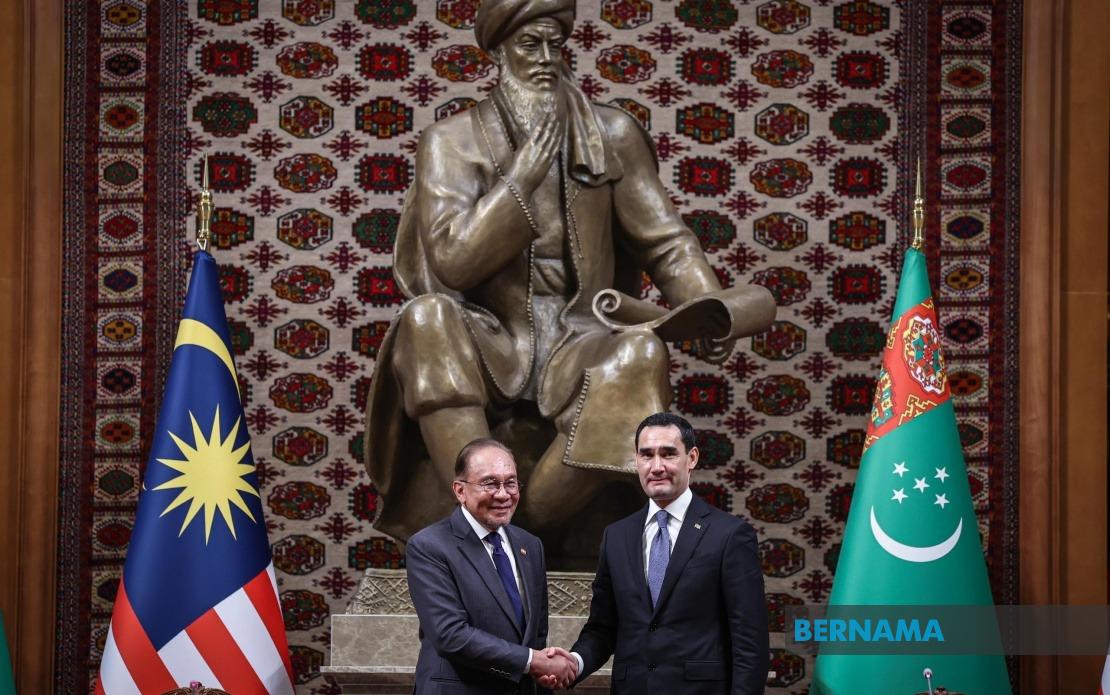
Malaysia and Turkmenistan have committed to building a more structured and progressive bilateral relationship that prioritises strategic mutual interests and long-term benefits for both populations, according to Prime Minister Datuk Seri Anwar Ibrahim. The declaration emerged from high-level talks in Ashgabat on June 19, where Anwar met with Turkmenistan President Serdar Berdimuhamedov at the Presidential Palace following a series of substantive discussions on cooperation frameworks.
The depth of the partnership commitment was underscored by the formal exchange of multiple agreements and memoranda of understanding, which Anwar described as catalysts for accelerating strategic cooperation across priority sectors. Both governments have pledged to implement all agreed initiatives with discipline, transparency and operational effectiveness, signalling a shift towards institutionalised rather than ad-hoc engagement. This approach reflects Malaysia's broader diplomatic strategy of building relationships anchored in clear governance structures and measurable outcomes.
The bilateral agenda covered an expansive portfolio of sectors that reveals both nations' economic complementarities. Energy cooperation stands as a foundational element, given Turkmenistan's significant hydrocarbon reserves and Malaysia's regional market access. Trade and investment avenues were also prioritised, offering Malaysian companies potential entry points into Central Asian markets whilst facilitating Turkmen economic diversification. The halal industry and Islamic banking dimensions are particularly significant for Malaysia, positioning it as a global standard-setter in these growing sectors whilst offering Turkmenistan the opportunity to tap into Islamic finance networks.
Education, research and technological advancement featured prominently in the discussion portfolio, reflecting both nations' aspirations to enhance human capital development and innovation capacity. The inclusion of science and technology cooperation suggests Malaysia may serve as a conduit for advanced knowledge transfer and research collaboration, areas where the country has developed particular expertise. Tourism cooperation was also flagged, opening possibilities for enhanced people-to-people connectivity and cultural exchange between the two nations.
Air connectivity emerged as a critical practical enabler of the broader partnership. The Air Services Agreement between the two governments will facilitate direct aviation links, reducing travel friction and supporting both business activity and tourism flows. This infrastructural dimension often proves decisive in translating diplomatic commitments into tangible commercial and cultural exchanges. Enhanced connectivity typically stimulates subsequent partnership development across multiple sectors.
The formal documentation exchanged during the visit included an Air Services Agreement establishing direct aviation pathways, alongside an accord between Malaysia's Institute of Diplomacy and Foreign Relations and Turkmenistan's Institute of International Relations. The latter arrangement promises enhanced diplomatic coordination and people-to-people understanding at official level. Additional memoranda connected Malaysia's Ministry of Transport with Turkmenistan's State Service, and linked both nations' Academies of Sciences, creating institutional channels for sustained technical collaboration.
Anwar, attending in his concurrent role as Finance Minister, jointly signed a comprehensive statement with President Berdimuhamedov formalising the visit outcomes. The prime minister's dual portfolio demonstrates the integrative nature of the partnership, encompassing both diplomatic and economic dimensions. His delegation included Minister of Investment, Trade and Industry Datuk Seri Johari Abdul Ghani and Minister of Economy Akmal Nasrullah Mohd Nasir, underscoring the business development focus alongside political engagement.
The timing holds particular significance as this marks Anwar's inaugural official visit to Turkmenistan since assuming the prime ministership in November 2022, reflecting a deliberate effort to broaden Malaysia's diplomatic footprint in Central Asia. The visit occurred at Turkmen invitation, suggesting receptivity from the Ashgabat government to deepening engagement. For Malaysia, establishing stronger ties with energy-rich Central Asian nations aligns with broader economic diversification strategies and regional influence expansion.
The partnership development carries implications for Malaysia's positioning within broader regional dynamics. Central Asia's geopolitical significance has increased markedly, with multiple global powers competing for influence and resources. By establishing structured partnerships with nations like Turkmenistan, Malaysia can expand its diplomatic leverage whilst creating business opportunities for Malaysian enterprises. The emphasis on transparent, disciplined implementation distinguishes this approach from transactional diplomacy, suggesting genuine commitment to sustained institutional development.
For Turkmenistan, collaboration with Malaysia offers access to Southeast Asian markets and Islamic finance mechanisms whilst enhancing its international economic integration. The Academy of Sciences linkage promises scientific collaboration on mutually beneficial research priorities. These arrangements typically involve technical staff exchanges, joint publications and collaborative research initiatives that strengthen both nations' research ecosystems.
The halal industry cooperation deserves particular attention given Malaysia's global leadership position in halal certification, standards-setting and market development. Turkmenistan's Muslim-majority population and strategic location make it a logical partner for halal industry expansion into Central Asian markets. This vertical could become increasingly lucrative as global halal market growth accelerates, creating substantial business opportunities for Malaysian enterprises whilst supporting Turkmen economic development.
Looking forward, implementation mechanisms will prove critical to translating these commitments into sustained engagement. The emphasis on transparency and discipline suggests both governments recognise that institutional capacity building and consistent follow-through separate aspirational partnerships from operationally meaningful relationships. Regular high-level visits, technical working groups and progress monitoring will determine whether this initiative evolves into substantive economic partnership or remains primarily symbolic.
The Malaysia-Turkmenistan partnership expansion reflects Malaysia's strategic pivot toward diversifying diplomatic and economic relationships beyond traditional Southeast Asian and European partners. As global competition intensifies for access to Central Asian resources and markets, Malaysia's early establishment of structured frameworks positions it favourably for capturing emerging opportunities whilst contributing to regional stability and prosperity.

