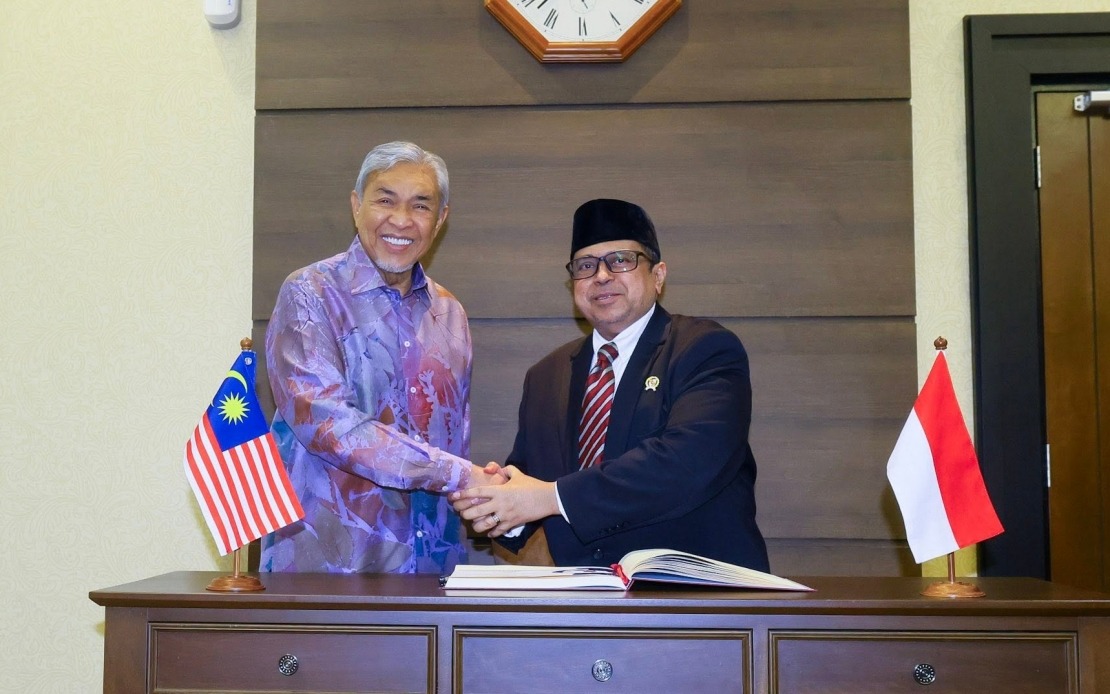
Malaysia and Indonesia are positioning themselves to forge a more integrated halal ecosystem by establishing coordinated governance structures and trade frameworks that could reshape regional standards-setting for the global Islamic commerce sector. Deputy Prime Minister Datuk Seri Dr Ahmad Zahid Hamidi outlined the bilateral agenda following discussions at Parliament with Indonesia's Ambassador to Malaysia Raden Datuk Mohammad Iman Hascarya Kusumo and Dr Ahmad Haikal Hassan, head of Indonesia's Halal Product Assurance Organising Body (BPJPH). The breadth of proposed initiatives signals ambitions extending far beyond bilateral trade to encompass regional and international influence in halal certification and product development.
Central to the strategic vision is the proposed Malaysia-Indonesia Halal Council (MIHC), conceived as an institutional mechanism to align policies and practices between Southeast Asia's two largest Muslim-majority economies. This bilateral platform would serve as a foundation for addressing technical harmonisation challenges that currently fragment the region's halal supply chains. Both nations have developed sophisticated domestic halal certification systems, yet divergences in standards, testing methodologies, and approval timelines create friction for manufacturers and exporters seeking simultaneous market access. The council structure would enable regular high-level dialogue on resolving such inconsistencies while building mutual recognition frameworks that reduce duplication and accelerate time-to-market for compliant products.
The proposed ASEAN Halal Council represents an even more ambitious expansion, extending coordination mechanisms across the broader Southeast Asian community. Such a body would position the region as a unified voice in halal standards development, collectively shaping global benchmarks rather than adapting to frameworks developed elsewhere. Given that ASEAN nations collectively represent a significant portion of global Muslim consumer purchasing power and halal product manufacturing capacity, a coordinated regional approach could amplify their leverage in international bodies responsible for halal certification guidelines. The move also reflects growing recognition that halal commerce encompasses not merely food and beverages but extends to pharmaceuticals, cosmetics, financial services, and logistics, requiring complex multi-sectoral coordination.
Equally significant is the proposed World Halal Development Council, which suggests aspirations for Malaysia and Indonesia to co-lead global halal governance architecture. This institutional ambition reflects both nations' established positions as halal industry pioneers, with Malaysia having invested decades in building its certification ecosystem and Indonesia commanding enormous manufacturing capacity and domestic consumption. A world council platform would formalise their roles in shaping halal standards beyond regional spheres, potentially positioning them as arbiters in disputes over halal compliance claims and expanding their soft power in Islamic commerce governance. For Malaysia in particular, which has cultivated halal as a key economic and diplomatic asset, such arrangements represent validation of its strategic positioning.
Ahmad Zahid, speaking in his capacity as chairman of the Malaysia Halal Industry Development Council, emphasised that cooperation spans multiple development domains beyond halal certification alone. Trade facilitation, rural economic development, and workforce capacity-building form an interconnected strategy recognising that halal sector growth requires enabling infrastructure across production, logistics, retail, and consumer awareness. Rural development cooperation proves particularly relevant given that agricultural production forms the foundation of the halal supply chain, and both nations contain significant rural populations whose livelihoods depend on commodity exports. Enhanced cooperation in rural productivity could strengthen smallholder participation in halal value chains, distributing growth benefits beyond major urban centres and manufacturing hubs.
Human capital development initiatives carry strategic importance for scaling halal industry operations. Both nations face challenges in developing specialised workforces capable of managing increasingly complex halal supply chains, from blockchain-enabled traceability systems to advanced laboratory testing for contaminant detection. Training and certification programmes developed through bilateral cooperation could establish regional standards for halal professional credentials, creating career pathways and mobility across borders. This dimension also addresses skills shortages in emerging halal sectors such as digital certification and risk management, where expertise remains concentrated in developed markets.
The historical relationship between Malaysia and Indonesia provides institutional foundation and diplomatic trust necessary for ambitious cooperative frameworks. Both nations share Islamic heritage, cultural affinities, and experience with halal industry development, though each has charted distinct paths reflecting different market structures and policy priorities. This proximity enables them to move faster on institutional arrangements than would be feasible with more distant partners. Their combined market size and manufacturing capacity also mean that joint standards harmonisation carries automatic weight internationally, as suppliers seeking to serve both markets will adopt unified compliance frameworks.
For Malaysian businesses, particularly those in food manufacturing, logistics, and pharmaceuticals, the cooperation framework promises reduced compliance burdens and expanded market access. Companies currently managing separate certification processes for Malaysian and Indonesian markets could operate under unified standards, lowering administrative costs and accelerating expansion timelines. The ripple effects extend to supporting industries such as testing laboratories, certification auditors, and supply chain management providers, which would benefit from larger, integrated market opportunities. Export-oriented companies gain particular advantage as they position themselves within a coherent regional bloc recognised internationally for halal compliance credibility.
The initiative also reflects competitive positioning within global halal commerce, where other actors—including Middle Eastern countries, non-Muslim majority nations with significant Muslim populations, and international certification bodies—are expanding their roles. Malaysia and Indonesia moving decisively to establish governance frameworks and set standards demonstrates intent to maintain leadership rather than cede influence to external actors. This defensive dimension accompanies the cooperative aspiration, ensuring that regional interests shape halal sector development rather than having standards imposed from outside.
Implementing these proposed councils presents practical challenges requiring sustained commitment and resource allocation. Negotiating consensus across multiple jurisdictions on standards and procedures demands technical expertise, diplomatic skill, and political will to subordinate domestic preferences to collective outcomes. Past regional cooperation initiatives have encountered difficulties translating ambitious institutional frameworks into operational effectiveness. Success depends on establishing credible governance processes, transparent decision-making mechanisms, and genuine commitment to mutual benefit rather than zero-sum competition.
Looking forward, the cooperation framework positions Malaysia and Indonesia to shape halal commerce architecture during a period of significant industry expansion. Global halal market projections suggest robust growth driven by rising Muslim consumer populations, increasing awareness among non-Muslim consumers, and expanding product categories entering halal value chains. Establishing coordinated governance early positions both nations to capture disproportionate benefits from this expansion while establishing themselves as authoritative standard-setters. For Malaysian policymakers particularly, the arrangement validates decades of investment in halal infrastructure and positions the nation within a larger, more influential regional bloc capable of shaping international commerce standards.

