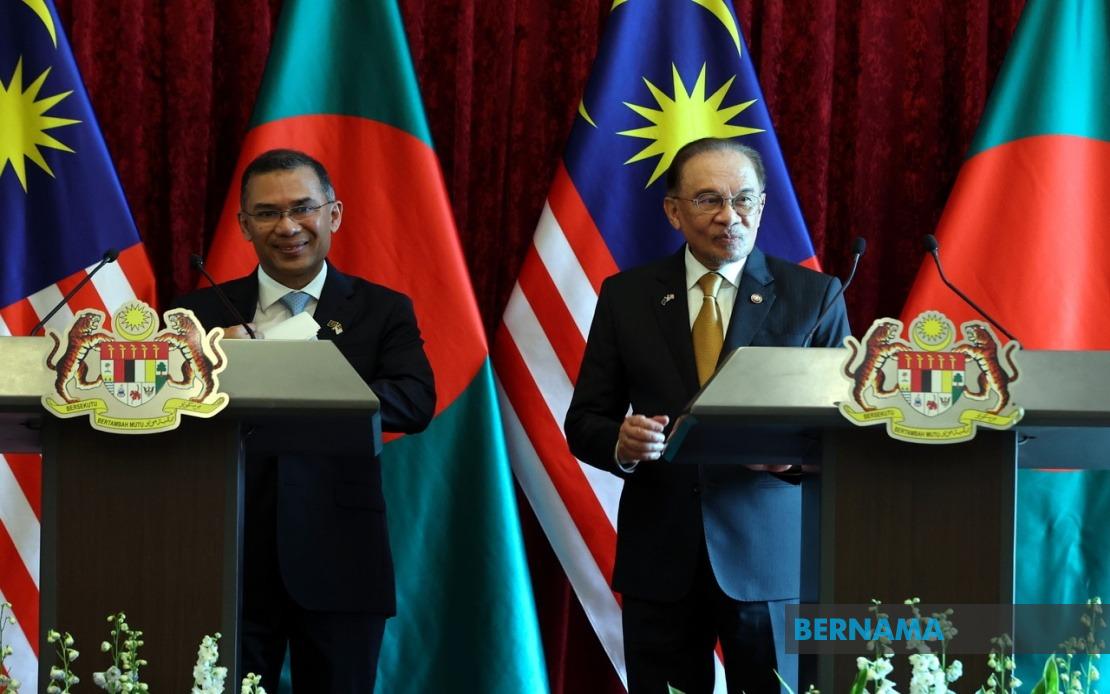
Prime Minister Datuk Seri Anwar Ibrahim has underscored Malaysia and Bangladesh's convergence on several critical international affairs, pledging that both nations will work collaboratively with global partners to advance peace across contested regions. Speaking during a joint press conference in Putrajaya with Bangladesh Prime Minister Tarique Rahman on Monday, Anwar highlighted the two countries' shared commitment to addressing the Palestinian cause, the humanitarian crisis affecting Gaza's population, and broader stability concerns in the Gulf and Iran.
The Malaysian premier characterised the alignment as reflective of deeper strategic partnership, emphasising that Malaysia and Bangladesh remain in sync regarding their positions on what he termed the "atrocities inflicted" by what he referred to as the "Zionist Israeli regime." This rhetorical consistency demonstrates how both South and Southeast Asian nations frame their Middle East concerns within a broader anti-colonial and pro-sovereignty narrative that resonates across their respective political constituencies. The statement carries particular weight given Malaysia's historical advocacy within the Non-Aligned Movement and Organisation of Islamic Cooperation, platforms where Bangladesh similarly maintains significant influence.
Rahman's visit to Malaysia, which commenced on Sunday, represents his first official foreign engagement since assuming office in February this year, a diplomatic choice that underscores Bangladesh's priority in strengthening ties with Southeast Asian neighbours. The timing and destination signal Bangladesh's strategic reorientation following its recent political transition, suggesting that regional partnerships with established ASEAN members remain central to Dhaka's foreign policy calculations. For Malaysia, receiving the Bangladesh leader as the inaugural overseas visit demonstrates Kuala Lumpur's commitment to nurturing relations with one of South Asia's most populous and economically significant nations.
Beyond rhetorical alignment, the visit encompasses efforts to deepen bilateral cooperation across sectors of mutual interest, though specific economic or security arrangements were not detailed in immediate statements. The emphasis on strengthening ties reflects recognisable patterns in Malaysian diplomacy, whereby solidarity declarations on global issues often accompany substantive discussions on trade, defence cooperation, and people-to-people exchange. Bangladesh, as a major manufacturing economy and Bangladesh garment sector participant in regional supply chains, holds particular relevance for Malaysian businesses and policymakers focused on diversifying economic relationships beyond traditional partners.
Anwar's characterisation of the relationship as familial—referring to Rahman as "part of an enlarged family" and emphasising "brotherly relations"—employs diplomatic language common in intra-Muslim and developing-nation engagements. This framing transcends formal state relations, invoking shared cultural, religious, and developmental experiences that distinguish Malaysia-Bangladesh ties from relationships with distant powers. Such language also carries domestic political implications, appealing to Malaysian constituencies sensitive to Islamic solidarity and South-South cooperation narratives.
The joint focus on Gulf regional stability and Iran represents a nuanced diplomatic position. Both Malaysia and Bangladesh maintain pragmatic engagement with Iran despite international sanctions, viewing Tehran as an important regional actor and market for their products. Simultaneously, both nations navigate complex relationships with Gulf Cooperation Council states, critical sources of investment, employment, and energy security. By emphasising their shared commitment to "lasting peace" in these regions rather than aligning with any particular bloc, Malaysia and Bangladesh preserve diplomatic flexibility and avoid antagonising key economic partners.
The Palestinian cause occupies a particularly symbolic position in both nations' foreign policy lexicons, serving as a touchstone for Islamic solidarity and anti-imperialist positioning. Malaysian leadership, across political divides, has consistently maintained strong rhetorical support for Palestinian rights, a stance that enjoys broad public backing domestically. Bangladesh similarly maintains this position, though its engagement with the issue has historically been tempered by its focus on immediate South Asian regional challenges and its economic dependence on various international partners. The joint reaffirmation signals renewed emphasis on this shared commitment at governmental level.
For Southeast Asian observers, the Malaysia-Bangladesh meeting reflects broader patterns of South-South cooperation gaining prominence as traditional Western-centric international arrangements face contestation. ASEAN nations increasingly recognise the strategic value of deepening ties with significant South Asian democracies, particularly as geopolitical competition intensifies in the Indo-Pacific. Bangladesh's population exceeding 170 million and its role in global manufacturing supply chains make it a natural partner for regional integration initiatives and cooperative frameworks extending beyond traditional geographical blocs.
The visit also occurs within a context of Malaysian domestic political stabilisation under Anwar's leadership, a period during which the government has sought to project confidence through active regional diplomacy and hosting of high-profile international visitors. Successfully receiving foreign leaders and securing joint statements affirming shared positions on contentious global issues demonstrates governmental capacity and diplomatic prowess to domestic audiences. For Rahman, reciprocal engagement with a stable ASEAN neighbour offers similar domestic legitimacy benefits following Bangladesh's recent political transitions.
Moving forward, observers should watch for concrete outcomes from this bilateral engagement, including potential frameworks for enhanced trade, defence cooperation, or coordinated positions within multilateral forums. The rhetorical alignment on Palestine, Iran, and Gulf peace issues provides foundation for deeper strategic partnership, though translating such statements into substantive policy coordination remains contingent upon both governments' prioritisation and institutional capacity. The relationship exemplifies how middle-power diplomacy navigates complex international terrain through principled positioning combined with pragmatic economic engagement.

