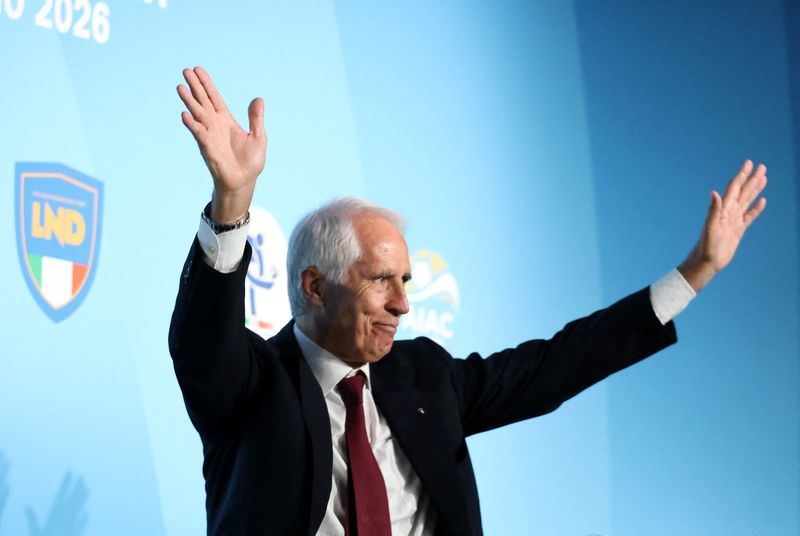
Giovanni Malago has assumed leadership of Italian football at a moment of profound crisis, winning election as president of the Italian Football Federation (FIGC) on Monday with a decisive 68.58% mandate. The 67-year-old entrepreneur inherits responsibility for reviving a four-time World Cup champion whose standing in global sport has eroded dramatically, following the team's failure to qualify for a third successive World Cup tournament. His election comes as the federation attempts to navigate the deepest institutional turmoil in four decades, a period that has seen the country's football system questioned at every level from elite coaching structures to youth academy development.
Malago's appointment represents a significant departure from the recent leadership of Gabriele Gravina, who tendered his resignation in April following Italy's shocking playoff defeat to Bosnia & Herzegovina. That World Cup elimination triggered a wave of public fury and political condemnation across Italy, with supporters and lawmakers demanding wholesale changes to the federation's management. The controversy intensified when Italian clubs subsequently crashed out of European competitions, compounding what many observers characterised as the sport's darkest chapter in the country's modern footballing history. Gravina, who led the federation since 2018, acknowledged during the assembly meeting that he should have departed earlier, offering a candid admission of his inability to reverse the organisation's downward trajectory.
The incoming FIGC president arrives at the role following recent prominence as head of the organising committee for the Milano Cortina Winter Olympics in February, where his management credentials received significant acclaim. International observers praised the execution of those Games, suggesting Malago possesses the logistical competence necessary to oversee complex sporting operations. His background also includes a tenure leading the Italian National Olympic Committee, alongside experience as a futsal player, providing him with embedded understanding of Italian sport's institutional structures. However, football represents a distinct challenge, one requiring not merely administrative capability but strategic vision and the political acumen to navigate competing interests within Italian clubs and among the federation's constituent bodies.
Malago confronts an immediately pressing agenda that demands decisive action. Appointing a new men's national team coach stands as the most urgent priority, with the federation requiring stability in the dugout after Gennaro Gattuso's departure following the World Cup failure. Beyond that, the federation must undertake a comprehensive overhaul of youth development systems, an area where previous officials including legendary former goalkeeper Gianluigi Buffon, who stepped down as national team delegation head, had highlighted chronic deficiencies. The incoming president has articulated an intent to accelerate preparations for the 2032 European Championship, which Italy will co-host with Turkey, positioning that tournament as both a test of his stewardship and a potential redemption narrative for Italian football's international standing.
The new president has signalled that his philosophy diverges substantially from administrative incrementalism. In remarks preceding the vote, Malago asserted that the federation must transcend mere bureaucratic function and become an institution of inspiration and vision. He characterised Italian football as the nation's largest social institution, extending far beyond statistical measures of participation, thereby elevating the FIGC's responsibilities to encompass broader cultural significance. This framing suggests Malago intends to reposition the federation within Italian society as a vehicle for collective identity and aspiration, a strategic repositioning that acknowledges widespread public disappointment and seeks to rebuild fractured relationships between the sport's governing body and the nation's supporters.
The recovery of Italian youth development systems represents one of the most substantive challenges before the new administration. Prominent figures in Italian football, notably former striker Roberto Baggio, had previously warned that the country's existing structures for nurturing young talent had become obsolete and incapable of competing with modern methodologies employed elsewhere in Europe. This systemic critique suggests that superficial administrative changes will prove insufficient, requiring instead fundamental reconstruction of academies, coaching education, and talent identification mechanisms. Malago's task involves convincing Italian clubs, many of whom operate powerful academies generating revenue from player development and sales, that collective investment in improved youth pathways serves their long-term interests alongside the national team's competitive aspirations.
Malago's election victory over Giancarlo Abete, secured through the FIGC assembly in Rome, reflected broader appetite within Italian football's institutional structures for significant change. The voting margin, while decisive, nonetheless conceals underlying tensions within Italian football regarding the appropriate direction for the sport's reconstruction. Different factions within Italian clubs harbour competing visions regarding investment priorities, with some advocating for immediate national team rebuilding whilst others emphasise domestic league competitiveness. Malago's success in uniting these disparate interests during his electoral campaign will require continuation throughout his presidency, a task he acknowledged by emphasising that meaningful progress demands collective cooperation across the federation's membership.
The international context surrounding Italian football's reconstruction merits consideration when evaluating the magnitude of Malago's challenge. European football's landscape has shifted considerably, with nations such as Spain, France, and Germany developing comprehensive talent pipelines that produce consistent international competitiveness. Italy's three consecutive World Cup qualification failures represent not merely temporary setbacks but evidence of structural decline relative to competing nations. Malago must therefore operate simultaneously across multiple temporal horizons: addressing immediate concerns surrounding the national team's competitive standing whilst implementing longer-term systemic reforms that will require years to demonstrate measurable improvement. This balancing act typically proves politically fraught, as frustrated stakeholders demanding rapid results clash with the necessary patience required for substantive institutional transformation.
Malago's remarks following his election demonstrated awareness of the psychological dimension inherent in Italian football's recovery. His invocation of the federation's historical legacy whilst simultaneously insisting that past glories must not become burdensome nostalgia reflects understanding that Italian football requires both continuity and rupture with recent practice. The new president explicitly rejected framing Italian football's proud history as a constraint, instead positioning it as foundation for renewed ambition. This rhetorical approach carries practical significance, as supporters and administrators alike must transcend the paralysing effect of repeated disappointment and recommit to the demanding work of systematic improvement. Such psychological reorientation, though intangible, often determines whether institutional reform initiatives succeed or devolve into cosmetic adjustments failing to address underlying dysfunction.
For Malaysian and Southeast Asian football observers, Italy's tribulations offer instructive perspective on the consequences of allowing systematic decline in talent development and competitive infrastructure. The Italian experience demonstrates that even nations with rich footballing traditions and substantial resources can deteriorate rapidly when institutional governance fails and youth development systems become outdated. Southeast Asian federations, many operating with more constrained resources than their Italian counterparts, must therefore prioritise continuous adaptation and investment in coaching education, academy modernisation, and knowledge transfer from international best practice. Malago's appointment signals that even the world's established football powers recognise necessity for fundamental reform when excellence falters, a lesson applicable across the football world regardless of a nation's current competitive standing.
The timeline for assessing Malago's leadership remains uncertain, though the 2024 European Championship qualifiers and the 2026 World Cup qualification campaign will provide concrete measures of progress. These competitions will reveal whether the new administration's strategic decisions regarding coaching appointments, youth development prioritisation, and federation reform have begun translating into improved on-field performance. Expectations within Italy remain extraordinarily high, with the football-obsessed public demanding both immediate competitive restoration and evidence of systematic reconstruction. Malago's success will ultimately depend not merely on administrative competence but on his capacity to build consensus among competing institutional interests, attract elite coaching talent, and communicate a compelling narrative of Italian football's renaissance to supporters weary after years of disappointment.

