Across Malaysia on June 17, communities gathered to observe Maal Hijrah 1448H, the Islamic New Year, in a series of nationwide commemorations that placed renewed emphasis on personal transformation, ethical governance, and collective strengthening of the Muslim ummah. The celebrations, held under the overarching theme "MADANI Dihayati, Ummah Diberkati" (MADANI Practised, Ummah Blessed), reflected broader aspirations to harness the spiritual significance of hijrah—the Prophet Muhammad's migration from Mecca to Medina—as a framework for contemporary social progress and national cohesion.
The concept of hijrah has traditionally symbolised a profound turning point, a moment of deliberate departure from the old towards a purposeful new beginning. This year's observances translated that historical narrative into modern Malaysian context, positioning hijrah as a metaphor for positive institutional change, the cultivation of principled leadership, and the forging of stronger bonds within Muslim communities. Religious programmes formed the backbone of the celebrations, featuring extended Quran recitations, scholarly discourses on Islamic principles, and formal award ceremonies that recognised individuals and institutions embodying these ideals.
The main gathering in Kuala Lumpur drew approximately 5,000 attendees and attracted prominent government representation. Deputy Prime Minister Datuk Seri Fadillah Yusof and Minister in the Prime Minister's Department (Religious Affairs) Dr Zulkifli Hasan both graced the occasion, underscoring the federal government's commitment to positioning Islamic observances within the broader framework of national development and social stability. Their presence signalled official recognition that religious and civic advancement are interconnected pursuits, particularly in a multicultural democracy like Malaysia where interfaith understanding and the responsible exercise of religious leadership carry considerable national significance.
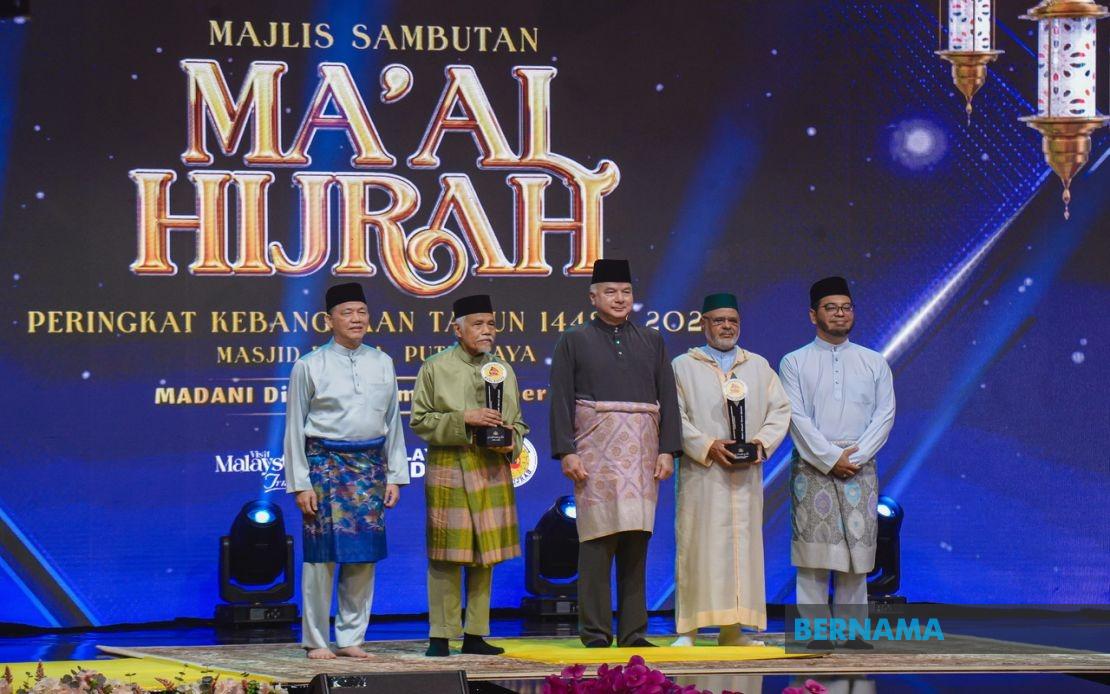
The conferring of awards represented a deliberate strategy to highlight exemplary figures whose contributions embodied the year's thematic focus. Sultan Nazrin of Perak, in his ceremonial capacity, presented the National Tokoh Maal Hijrah Award to Prof Emeritus Datuk Dr Osman Bakar, rector of the International Islamic University Malaysia (IIUM). The selection of IIUM's leadership underscored the importance placed on academic excellence and institutional integrity in advancing Islamic knowledge within Malaysia's higher education landscape. Simultaneously, the International Tokoh Maal Hijrah Award went to Dr Ahmad Al-Raysuni, a distinguished Moroccan Islamic jurisprudence scholar, reflecting Malaysia's engagement with broader Islamic intellectual traditions and cross-continental scholarly networks.
Parallel celebrations in Sabah drew approximately 1,000 participants to a separate ceremony where Tun Musa and Toh Puan Faridah Tussin were received by Chief Minister Datuk Seri Hajiji Noor and organising committee chairman Datuk Dr Mohd Arifin Mohd Arif, who also holds the Sabah Housing and Local Government portfolio. The Sabah-specific recognition of awardees highlighted how the national theme resonated across diverse regional contexts. Community activist Datuk Ag Sharin Alimin, drawing on his background as former director of the Sabah Islamic Religious Affairs Department, received the male category Tokoh Maal Hijrah Award, whilst former Sabah deputy state secretary Datuk Masnah Matsalleh was honoured in the female category, demonstrating deliberate gender representation in recognising leadership.
In a touching moment that connected contemporary celebrations to historical Islamic pedagogy, Ahmad Samsuri presented the Tokoh Maal Hijrah Award to 95-year-old Quran teacher Jusoh @ Muda Ismail during the Sabah ceremonies. Jusoh's distinction as the adopted son and student of the revered Quranic scholar Tuan Guru Haji Mat Lintar created a tangible link between Malaysia's Islamic educational heritage and present-day observances. His recognition honoured not merely individual achievement but an entire lineage of knowledge transmission and spiritual mentorship that has sustained Islamic learning across generations in East Malaysia.
The thematic emphasis on quality leadership across all ceremonies reflected an implicit acknowledgment that genuine social transformation requires institutional maturity and ethical governance. Rather than treating hijrah as merely a historical commemoration, organisers positioned it as an active invitation for contemporary leaders—whether in government, academia, religious affairs, or community service—to examine their stewardship and recommit themselves to principles of public welfare and moral integrity. This interpretive framework transforms a religious observance into a moment of national introspection regarding governance standards.
For Malaysian readers, particularly in an era of heightened political scrutiny and ongoing conversations about institutional accountability, the 2026 Maal Hijrah celebrations signal that religious leadership and state leadership are mutually reinforcing domains. The gathering of senior government figures alongside Islamic scholars and community leaders creates a symbolic statement: societal progress depends upon coordinated efforts across religious, educational, and governmental spheres, each institution holding itself to standards of excellence and ethical conduct.
The nationwide scope of celebrations also emphasises religious unity across different regional contexts. While Kuala Lumpur hosted the centrepiece gathering, simultaneous events in Sabah and implicitly elsewhere demonstrated that Maal Hijrah observance transcends peninsular boundaries, binding East and West Malaysia within shared spiritual and civic commitments. This geographic inclusivity carries particular resonance given Malaysia's federal structure and the importance of maintaining national cohesion across diverse regions.
Looking forward, the 1448H celebration establishes a baseline for measuring how effectively the themes of transformation, ethical leadership, and ummah unity translate into tangible institutional and community outcomes. Whether through improved governance standards, enhanced Islamic education quality, or strengthened interfaith cooperation, the frameworks articulated during these ceremonies will provide benchmarks against which future progress can be assessed. For a nation navigating complex questions about religious governance, educational standards, and social harmony, Maal Hijrah observances serve as periodic opportunities to collectively reaffirm foundational values and recommit to their implementation.