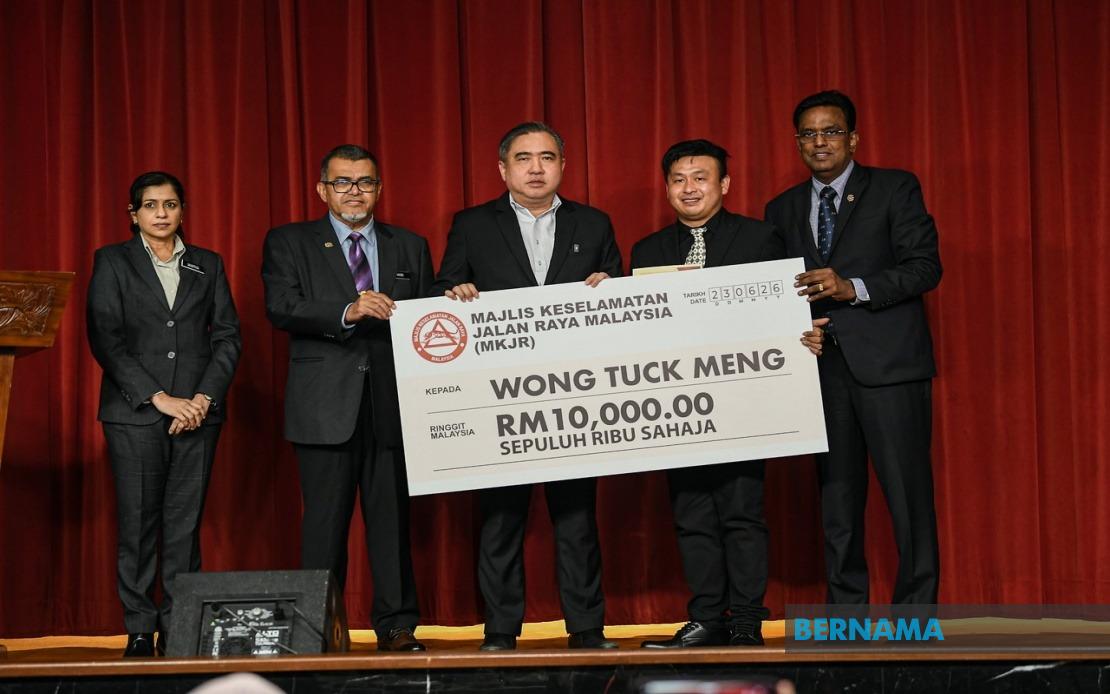
Wong Tak Ming, a lorry driver whose split-second decision prevented what could have been a devastating accident, was formally recognised by the Malaysian government on June 23 at a special ceremony held in Parliament. The Transport Minister Anthony Loke presented Wong with a Special Certificate of Appreciation and RM10,000, funded by the Malaysian Road Safety Council, honouring his extraordinary actions during an incident on June 15 near the Menora Tunnel in Perak that saved the lives of 21 passengers aboard an express bus.
The recognition ceremony at the Parliament building underscored the gravity of Wong's contribution to public safety. Loke described the lorry driver as a true hero whose composure and quick thinking in the face of immediate danger prevented a potential tragedy. The Transport Minister emphasised that Wong's actions transcended ordinary civic duty, as he put his own safety at considerable risk to protect others on the road. Speaking to the assembled audience, Loke noted that Wong's intervention during those critical moments transformed what appeared to be an unfolding disaster into a controlled outcome.
The incident itself had unfolded with alarming speed. An express bus travelling from Kedah to Kuala Lumpur encountered a mechanical failure while descending a slope approaching the Menora Tunnel. Unable to maintain control on the downhill stretch, the bus began to veer dangerously out of its lane. At this critical juncture, Wong's presence of mind became the decisive factor. Rather than attempt to avoid the oncoming vehicle, Wong manoeuvred his lorry to make contact with the rear of the bus, using the weight and stability of his vehicle to help decelerate the rapidly moving passenger coach.
Wong then continued his intervention by steering his lorry closer to the guardrail, positioning both vehicles in a way that brought them safely to a halt before either could collide with other traffic or barriers. The entire sequence of events required instantaneous decision-making and exceptional vehicle handling skills under extreme pressure. A video recording of the incident subsequently circulated widely across social media platforms, generating substantial public recognition of Wong's bravery and prompting widespread admiration for his actions.
When asked about his conduct during the emergency, Wong demonstrated the humility characteristic of those who act instinctively in crisis situations. He explained that his overriding concern at the moment of impact was not his own welfare but rather preventing fatalities among the bus passengers and protecting other motorists on the road. Wong noted that because he had detected a gap between his lorry and the approaching bus, he retained precious seconds in which to respond. He utilised those moments to activate his horn repeatedly, attempting to warn drivers ahead of the danger so they could increase distance and move out of the potential collision zone.
The broader significance of Wong's recognition extends beyond individual commendation. The Deputy Speaker of the Dewan Rakyat, Datuk Dr Ramli Mohd Nor, formally conveyed Parliament's gratitude to Wong during proceedings related to the Road Transport (Amendment) Bill 2025, which Loke tabled for its second reading. This parliamentary acknowledgment elevates Wong's actions from a personal achievement to a matter of national importance, signalling government commitment to recognising and encouraging lifesaving public interventions.
For Malaysian road users and transport operators, Wong's incident illuminates both the vulnerabilities in vehicle safety systems and the critical importance of driver alertness. Express buses carrying substantial passenger loads operate under demanding schedules across Malaysia's diverse terrain, including challenging downhill sections where mechanical failure poses acute risks. Wong's quick response demonstrates that secondary safety measures—human vigilance and swift action by other road users—can serve as essential backup when primary systems fail.
The financial award and official certificate represent tangible acknowledgment of a deed that cannot be adequately compensated through money alone. Yet the recognition carries practical value as well, potentially encouraging other drivers to remain alert and prepared to assist in emergencies rather than simply passing by. In a region where road safety challenges remain significant, instances where individual responsibility supersedes self-interest deserve prominent visibility.
The Menora Tunnel incident underscores an ongoing reality on Malaysian highways: the narrow margin between routine journeys and catastrophic outcomes. Technical malfunctions, whether in brakes, steering, or engine systems, can strike suddenly and dramatically. When they do, the response capacity of alert and skilled drivers nearby often determines whether accidents remain minor or escalate into mass casualties. Wong's actions on June 15 exemplified this principle in its most vivid form.
As Malaysia continues developing its road safety infrastructure and regulatory frameworks, the stories of individuals like Wong should prompt reflection on how to foster cultures of mutual responsibility among road users. Driver training programmes, vehicle maintenance standards, and emergency response protocols all contribute to safety, but they exist within a human context where personal character, training, and presence of mind ultimately determine outcomes in split-second emergencies.
The Parliamentary recognition of Wong Tak Ming sends a clear message that the nation values and celebrates those who demonstrate exceptional courage and skill in protecting others. His RM10,000 award and certificate serve as permanent reminders that ordinary individuals, through vigilance and decisive action, can prevent tragedies and save lives on the roads. For other drivers navigating Malaysia's highways daily, Wong's story offers both inspiration and a sobering reminder of the responsibilities shared by everyone using these vital transport corridors.

