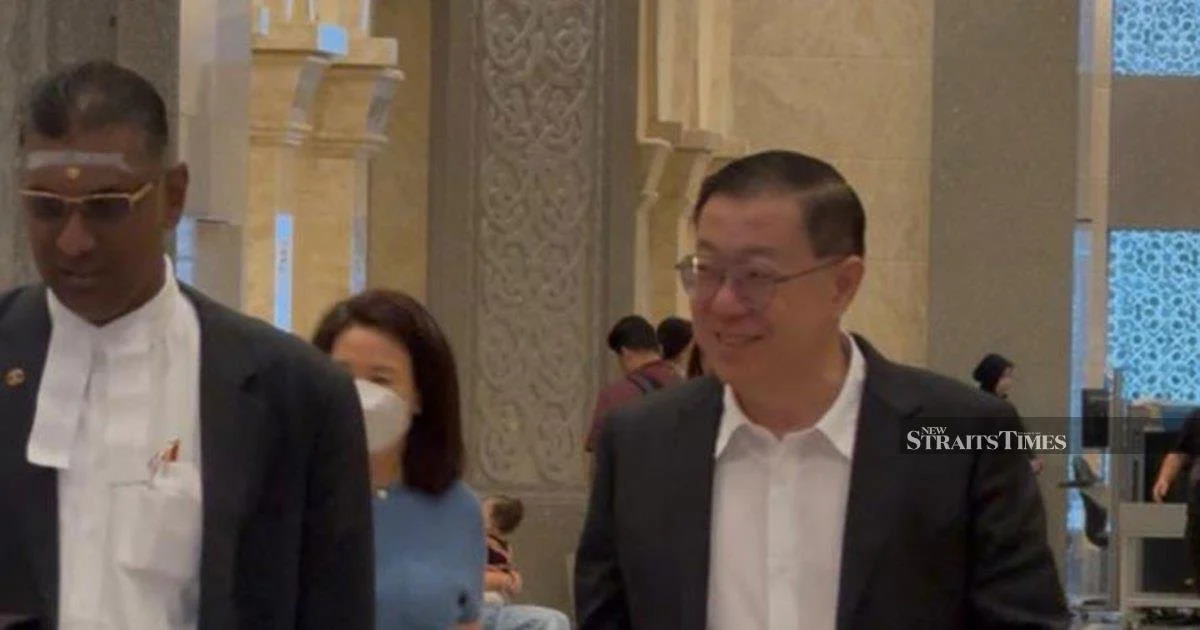
The Palace of Justice in Putrajaya became the focal point of Malaysia's political establishment on a pivotal day, as DAP adviser Lim Guan Eng, his wife Betty Chew, and businesswoman Phang Li Koon appeared before the Court of Appeal to hear a decision on their application to strike out corruption-related charges stemming from an RM11.6 million case. The three arrived at the courthouse where proceedings were scheduled to determine whether the lower court's charges would stand or be dismissed, marking a significant moment in a legal battle that has drawn sustained public attention since the charges were first filed.
Lim Guan Eng, who served as Finance Minister under the Pakatan Harapan administration and later as Chief Minister of Penang, has consistently maintained his innocence throughout the legal proceedings. His appearance at the Palace of Justice underscored the gravity of the matter, which carries implications not only for his political future but also for the broader narrative surrounding governance and accountability in Malaysian politics. The case has persisted across several years, with various legal motions and arguments presented by both the prosecution and the defence team.
The charges in question relate to an allegation involving improper financial transactions and abuse of power. Specifically, the case centres on claims that Lim Guan Eng, along with his wife and the businesswoman, were involved in activities that violated anti-corruption legislation. The RM11.6 million figure represents the scale of the alleged impropriety, making this one of the more substantial corruption cases involving high-profile political figures in recent Malaysian history.
Betty Chew's involvement as a co-accused alongside her husband has been a particularly contentious aspect of the case, raising questions about whether family members should face charges when the alleged impropriety is tied to political office. Her presence in court reflected the personal toll that such protracted legal proceedings can exact on families, regardless of the eventual outcome. The couple has maintained a united stance throughout, with their legal representatives arguing that the charges lack sufficient merit to proceed to trial.
Phang Li Koon, the third party implicated in the case, represents a different dimension of the allegation, as the charges suggest a nexus between political office, business interests, and financial impropriety. Her involvement adds complexity to the narrative, as it illustrates how corruption investigations often extend beyond individual office-holders to encompass business associates and financial intermediaries who may have been part of the alleged scheme.
The application to strike out the charges is a legal mechanism available to defendants when their counsel argues that the prosecution has failed to establish a prima facie case or that the charges are fundamentally flawed in their formulation. A successful strike-out application would result in the dismissal of charges without the matter proceeding to full trial, representing a major victory for the defence. Conversely, if the Court of Appeal upholds the lower court's decision to maintain the charges, the case would advance toward trial, prolonging the legal process and extending the period of uncertainty for all parties involved.
For the DAP and its political coalition partners, this case has remained a source of tension and debate. While the party has consistently defended Lim Guan Eng's integrity and portrayed the legal action as politically motivated persecution, critics argue that no public official should be exempted from proper investigation when circumstances warrant scrutiny. The political dynamics surrounding the case have evolved significantly, particularly as Malaysia's political landscape has shifted through successive electoral cycles and coalition realignments.
The timing of major legal decisions often carries political significance in Malaysia, given the country's history of using legal instruments within broader political contests. Observers have noted that key rulings in high-profile political cases can reshape narratives and influence public perception of both the individuals involved and the institutions delivering justice. The anticipation surrounding the Court of Appeal's decision reflected this broader awareness that legal outcomes can reverberate across political and public spheres.
From a Southeast Asian perspective, the Lim Guan Eng case contributes to ongoing conversations about corruption, judicial independence, and the treatment of political figures accused of financial impropriety across the region. As other countries grapple with similar issues of accountability for public officials, Malaysia's approach—reflected in how courts handle such cases—attracts regional attention and shapes international perceptions of Malaysian governance standards.
The appearance of all three parties at the Palace of Justice signalled their commitment to engaging with the legal process, despite the personal and political costs involved. Whether the Court of Appeal would side with the defence's arguments or permit the charges to proceed remained the critical question facing the court, with implications extending far beyond the immediate legal outcome into the realm of political confidence, institutional credibility, and the principle that public officials remain subject to the law.
As Malaysia continues to navigate post-electoral politics and questions of accountability, decisions in cases such as this one carry weight beyond their immediate legal implications, reflecting broader societal debates about justice, power, and the rule of law in a complex, evolving democracy.

