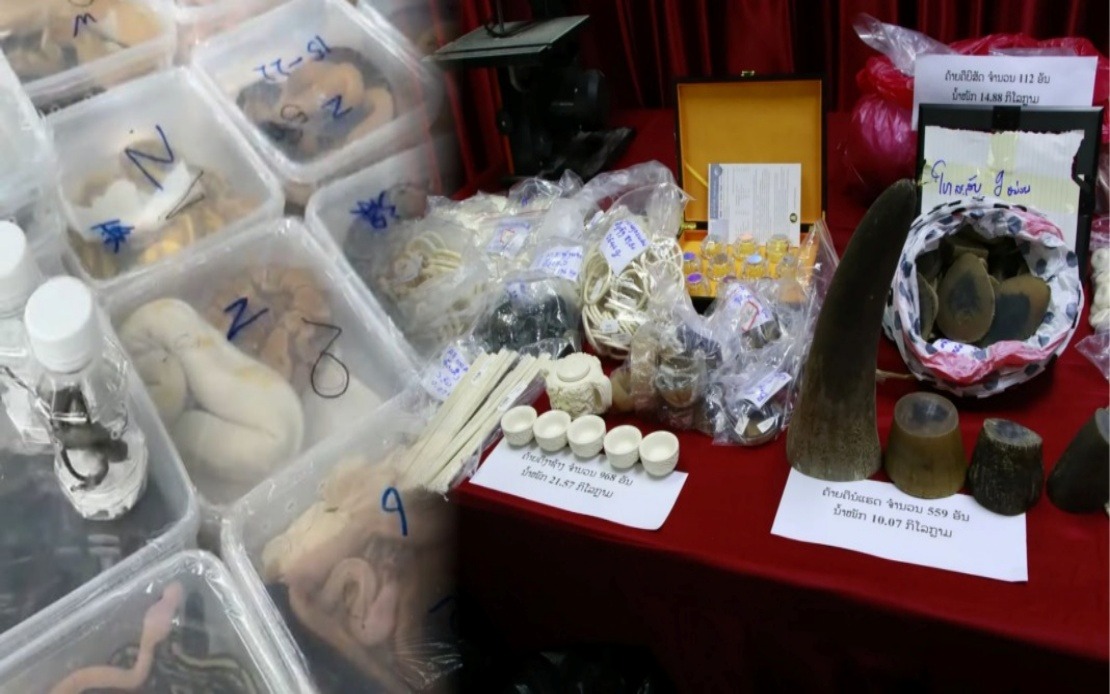
Coordinated law enforcement operations across Laos have dismantled a major animal trafficking network, rescuing nearly 300 live creatures and confiscating vast quantities of illegal wildlife merchandise. The series of busts, centred on the Lao-Thai border region, underscores the mounting pressure on Southeast Asia's endangered fauna and the sophisticated networks moving them across international lines. For Malaysia and other regional nations grappling with similar smuggling problems, the Laos case illuminates both the scale of the challenge and the potential impact of unified enforcement action.
The initial breakthrough came when Laotian Wildlife Enforcement Network personnel discovered 60 kilograms of suspected contraband in Luang Prabang, the country's cultural heartland and a major tourist hub. Officers uncovered ivory-like objects, animal gallbladders, pangolin scale materials, and rhino horns—commodities that command premium prices in underground markets across Asia. Additional seizures in the same location yielded elephant skin powder, bear gallbladder, hornbill head specimens, and tubes of herbal remedies suspected to contain illegal wildlife ingredients. The diversity of seizures suggests a sophisticated operation catering to multiple demand streams: traditional medicine practitioners, collectors, and souvenir merchants all represent lucrative market segments for traffickers.
Four days after the Luang Prabang operation, authorities achieved an even more dramatic result at the Vang Tao International Checkpoint in Champasak Province, which straddles the border with Thailand's Ubon Ratchathani Province. Wildlife rangers intercepted 294 live animals destined for international markets, including turtles, pythons, green snakes, gold-ringed cat snakes, and various lizard species. The sheer volume of creatures recovered in a single operation indicates that traffickers operate with industrial-scale logistics, employing standard passenger transport and commercial routes to move contraband. This integration into regular commercial networks makes detection difficult and demonstrates why border authorities require constant vigilance and sophisticated intelligence gathering.
The timing and geographic clustering of these seizures suggest that international enforcement coordination may be yielding results. Just weeks before the Laos operations, Thai authorities arrested a woman operating a traditional medicine and souvenirs shop in Nakhon Phanom, the northeastern Thai province nearest to Laos, after investigators discovered more than 100 protected wildlife remains they believed had been smuggled from across the border. Earlier in May, officials thwarted another smuggling attempt along the Thai-Lao frontier, confiscating 130 kilograms of cut elephant ivory and animal carcasses. These consecutive successes indicate that regional law enforcement agencies are improving their ability to detect and intercept shipments, whether through enhanced training, better intelligence sharing, or strengthened checkpoint protocols.
Laos's position as a trafficking epicentre stems from its unique geographical vulnerability. The country shares lengthy borders with Cambodia, China, Myanmar, Thailand, and Vietnam—five nations with varying enforcement capacities and market demand for illegal wildlife products. This convergence of porous boundaries and high regional demand creates what wildlife experts describe as a perfect storm for smuggling operations. Unlike maritime nations where shipping containers can be more systematically screened, Laos's land borders involve hundreds of crossing points, many in remote areas with limited monitoring infrastructure. Additionally, Laos itself lacks substantial domestic markets for these products, positioning it primarily as a transit nation rather than a final destination—a role that makes it simultaneously critical to disrupt trafficking chains and challenging to combat, since smugglers can move contraband through quickly without establishing visible commercial operations.
The global dimensions of this problem dwarf regional concerns. The United Nations Office on Drugs and Crime's World Wildlife Crime Report 2024 places illegal wildlife trafficking within a broader criminal ecosystem worth approximately US$10 billion annually—a valuation that places it alongside human trafficking, narcotics smuggling, and the arms trade as one of the world's most lucrative criminal enterprises. This economic calculation is crucial for understanding why enforcement efforts, while symbolically important and ethically necessary, struggle to stem trafficking flows. As long as demand exists in consumer markets and profit margins remain astronomical, criminal networks will find ways to circumvent even well-resourced law enforcement operations.
Corruption represents perhaps the most insidious factor enabling these networks. The UNODC report explicitly identifies graft as a key facilitator of wildlife smuggling, and this observation carries particular weight in Southeast Asia, where enforcement salaries often lag far behind the sums traffickers can offer as bribes. A border official confronted with a payment equivalent to several months of wages faces intense pressure to look the other way, and criminal syndicates operating on multi-million-dollar turnovers can easily absorb such costs. This structural vulnerability means that even the most dedicated enforcement personnel operate within systems that may contain compromised actors, making inter-agency cooperation and international pressure essential counterweights.
For Malaysia, the Laos case provides instructive lessons about both effective enforcement and the limits of localized action. Malaysia has long struggled with wildlife trafficking, particularly involving elephants, pangolins, and birds destined for regional and international markets. The Laos operations demonstrate that coordinated border enforcement, media attention, and international cooperation can yield tangible results—the nearly 300 animals rescued represent actual lives preserved and genetic diversity protected. Simultaneously, the recurrent nature of major seizures suggests that traffickers quickly adapt to enforcement pressure by adjusting routes, timing, and concealment methods rather than ceasing operations. Malaysian authorities might benefit from the Laos precedent by strengthening bilateral cooperation with neighbouring countries, enhancing intelligence sharing about trafficking patterns, and supporting capacity-building in less-resourced enforcement agencies.
The use of international passenger buses as smuggling conveyances, as noted in the Laos seizures, highlights a critical vulnerability in Southeast Asia's transport infrastructure. These vehicles cross borders regularly and legitimately, making them relatively inconspicuous compared to dedicated cargo shipments. Trafficking networks exploit the massive volume of passenger traffic to hide contraband among checked luggage and cargo compartments. Addressing this vulnerability requires not just traditional border security measures but also cooperation with transport operators, passenger screening technologies, and international protocols for coordinating interdiction efforts across borders. Thailand's recent arrests of a traditional medicine shop operator suggest that enforcement is increasingly following trafficking chains backward from retail points to source, a more sustainable approach than simply interdicting shipments.
The species composition of the seized animals—turtles, snakes, and lizards—reflects an often-overlooked dimension of wildlife trafficking. While megafauna like elephants and tigers capture public imagination and media attention, reptile trafficking represents an enormous and rapidly growing criminal sector. These animals are easier to conceal, require less sophisticated logistics than mammals, and command strong prices in international pet markets, particularly in Europe and North America. The rescue of 294 such creatures barely registers internationally compared to the seizure of a single elephant, yet the cumulative impact of reptile trafficking on wild populations can be devastating. Southeast Asian nations including Malaysia, which are biodiversity hotspots with unique reptile species, should recognize that protecting lesser-known fauna requires comparable enforcement resources.
The international dimensions of traditional medicine markets cannot be overlooked. Substances like bear gallbladder, pangolin scales, and rhino horn persist in traditional medicine formulations despite decades of conservation advocacy and legal prohibitions. Demand emanates not only from Laos but from China, Vietnam, and other regional markets where these products command prices that incentivize smuggling networks. Addressing trafficking at source requires simultaneously attacking demand through public health campaigns, promoting synthetic or plant-based alternatives, and enforcing strict penalties on retailers and consumers. Malaysia's role as a regional leader in conservation advocacy positions it to promote demand-reduction campaigns alongside enforcement operations.
Looking forward, the Laos enforcement successes highlight the critical importance of sustained, coordinated action across borders. A single major operation capturing 294 animals is impressive but represents a moment in time; maintaining momentum requires consistent funding, personnel, training, and political commitment. The involvement of multiple agencies—local wildlife rangers, international enforcement networks, and potentially Interpol—suggests that this particular operation benefited from coordination and resources that may not persist without institutional support. For Southeast Asia broadly and Malaysia specifically, the Laos precedent demonstrates that animal trafficking can be disrupted when enforcement agencies prioritize it and when regional cooperation strengthens rather than weakens individual national efforts.

