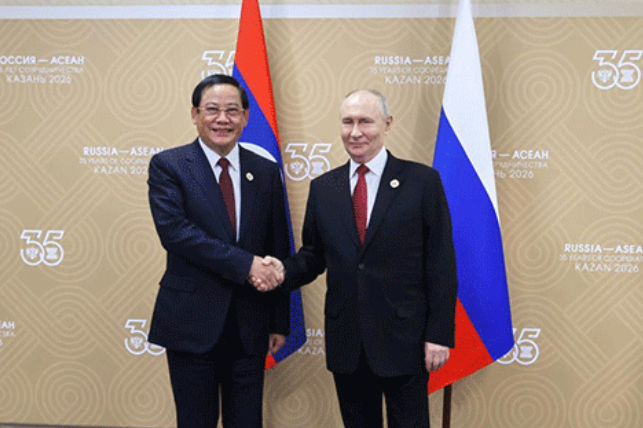
Laos and Russia have moved to reinvigorate their longstanding partnership, with the two nations agreeing to broaden collaboration across multiple economic and technical sectors. The commitment emerged during high-level talks between Prime Minister Sonexay Siphandone and Russian President Vladimir Putin held in the Tatar city of Kazan, where both leaders convened on the margins of the Russia-Association of Southeast Asian Nations Summit. The discussions represent a significant moment in bilateral relations, marking Prime Minister Sonexay's inaugural official visit to Moscow since his recent assumption of office. Travelling at the behest of Russian Prime Minister Mikhail Mishustin during a four-day trip from mid-June, the Lao leader sought to cement economic and strategic bonds that span more than six decades of diplomatic recognition.
The centerpiece of the bilateral engagement centred on Russia's determination to anchor its position within Southeast Asian geopolitical calculations at a time of shifting regional alignments. President Putin underscored Moscow's appreciation for Laos as a reliable partner, emphasising that the relationship has consistently rested on principles of mutual regard and reciprocal respect. His remarks carried particular significance given the diplomatic backdrop: Russia faces considerable Western pressure and sanctions, making Southeast Asian partnerships strategically valuable. The Russian president commended Laos for its backing of expanded Russia-ASEAN dialogue, noting that the bloc and Moscow will mark 35 years of formal relations in 2026, a milestone that both sides intend to commemorate with deepened institutional engagement.
A watershed moment in the talks involved the Kremlin leader's praise for Laos's symbolic support during Russia's major patriotic occasions. He thanked Lao President Thongloun Sisoulith for attending Moscow's Victory Day ceremonies in May and for Laos's dispatch of military personnel to the preceding year's 80th anniversary parade commemorating Soviet triumph in World War II. These gestures, modest in diplomatic terms, carry outsized meaning within Moscow's political framework, where demonstrations of international solidarity carry considerable propaganda weight. For Laos, such participation reflects both historical ties to the Soviet era and contemporary efforts to maintain equidistant relationships with major powers while retaining strategic autonomy.
The two governments inked an intergovernmental accord addressing the peaceful applications of nuclear technology, a development that carries significant long-term implications for Laos's energy infrastructure. Under the agreement's framework, Russia will assist Laos in constructing a compact nuclear power facility utilising Moscow-supplied technology. This initiative positions Laos alongside other developing nations increasingly exploring nuclear energy to address rising electricity demands while reducing carbon emissions. For the region, such arrangements merit careful attention, as they reshape energy security calculations and deepen technological dependencies on Moscow at a moment when many Southeast Asian states seek diversified energy portfolios to hedge geopolitical exposure.
Cooperation targets extend across an expansive range of bilateral interests spanning conventional economic domains. The two sides reviewed ongoing initiatives in petroleum and natural resources extraction, industrial manufacturing, agricultural development, and mineral processing—sectors where Russia possesses technical expertise and Laos possesses abundant raw materials. Beyond these extractive industries, both governments identified the digital economy, financial services, transportation infrastructure, cultural tourism, and personnel training as priority zones for expanded engagement. This comprehensive agenda reflects the intention to move beyond historical reliance on resource trade and construct more sophisticated economic architecture capable of generating employment and technological transfer.
The educational dimension of the partnership warrants particular emphasis within the Malaysian and broader Southeast Asian context, as it illustrates Moscow's enduring commitment to developing human capital across friendly nations. Prime Minister Sonexay expressed gratitude to the Russian government and its people for sustained scholarship programmes and training initiatives benefiting Lao nationals, particularly government administrators requiring advanced professional development. These educational investments function as powerful soft power instruments, cultivating cohorts of specialists with direct exposure to Russian institutions and cultivating long-term diplomatic networks. For neighbouring Malaysia and Thailand, such initiatives highlight the ongoing competition for influence over the Indochinese peninsula's administrative and intellectual elite.
Another collaborative project gaining traction involves the construction of the Laos-Russia Friendship School in Vientiane, which both sides indicated approaches completion. Educational institutions bearing joint nomenclature carry symbolic weight beyond their pedagogical functions, serving as tangible monuments to bilateral goodwill and facilitating cross-cultural understanding among younger generations. The school's establishment reflects Soviet-era patterns of friendship-building that persisted through the post-Cold War transition and continue shaping Russia's regional engagement strategy. For Malaysia's policymakers, such educational infrastructure underscores the necessity of maintaining competitive positioning in Southeast Asian education markets and cultural influence.
Prime Minister Sonexay's expression of appreciation for Russia's stewardship of the regional summit carries geopolitical undertones relevant to Malaysian observers. His commendation of Moscow's active involvement in regional and international affairs implicitly endorses Russia's efforts to maintain a seat at Southeast Asian strategic deliberations despite Western efforts to marginalise Russian influence. For nations navigating the complex geometry of great power competition, such public endorsements carry consequences, signalling alignment patterns and establishing expectations about future voting behaviour in multilateral forums. Laos's consistent emphasis on its commitment to the Russia partnership suggests that Moscow retains sufficient influence to shape policy orientations across the Indochinese states.
Bilateral discussions between Prime Minister Sonexay and Russian Premier Mikhail Mishustin complemented the presidential-level engagement, focusing on institutional mechanisms for expanding trade and investment flows. Both governments signalled satisfaction with the trajectory of their increasingly multifaceted cooperation grounded in mutual confidence and complementary interests. The Lao premier's particular gratitude for human resource development programmes underscores the reality that many developing Southeast Asian administrations lack domestic capacity to train specialised personnel and depend on external partnerships to build institutional competence. This dependency creates pathways through which external powers exercise subtle influence over policy formation and administrative preferences.
The visit's conclusion incorporated a Laos-Russia business forum designed to stimulate commercial engagement between private and state-sector enterprises from both nations. Such platforms function as marketplaces for ideas, investment opportunities, and partnership arrangements while simultaneously signalling governmental endorsement of expanding economic interdependence. For Malaysian business observers, such forums illustrate Russia's determination to overcome sanctions-related isolation through intensified engagement with friendly Southeast Asian economies, potentially creating commercial opportunities and competitive pressures for regional firms.
A particularly ceremonial element involved Prime Minister Sonexay's oversighting of the transfer of two elephants to Kazan Zoo—a gesture celebrating the 65th anniversary of Laos-Russia diplomatic relations and Russia Day on June 12. While apparently anodotal, such animal diplomacy carries historical precedent and reflects Laos's symbolic deployment of its national heritage in international relations. The gift simultaneously honours the relationship's longevity and introduces Lao cultural elements to Russian publics, functioning as a public relations gesture that humanises bilateral relations beyond governmental formalities.
The broader significance of Laos's diplomatic outreach to Russia merits contextualisation within Southeast Asian power dynamics. As a landlocked, economically modest state, Laos navigates challenges in maintaining strategic autonomy whilst benefiting from partnerships with influential external actors. Russia's persistent engagement with the Indochinese states, despite broader regional trends favouring Western-aligned nations, reflects Moscow's determination to preserve spheres of influence and prevent complete Western hegemony across the Asian continent. For Malaysia and other ASEAN members, Laos's cultivation of Russian ties exemplifies the complex balancing acts required to maximise benefits from multiple partnerships whilst avoiding entrapment within exclusive blocs—a delicate equilibrium that increasingly characterises contemporary Southeast Asian statecraft.

