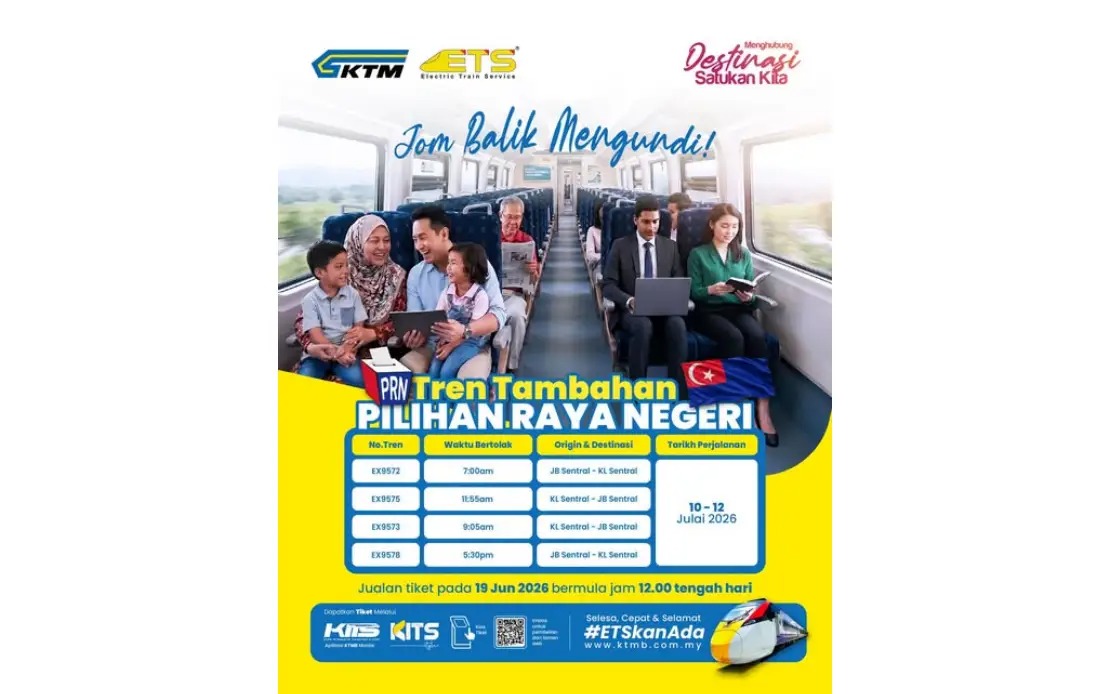
Keretapi Tanah Melayu Berhad (KTMB) has responded to anticipated travel demand by scheduling supplementary ETS train operations southbound in conjunction with the upcoming Johor state election. The move recognises that many eligible voters living and working elsewhere across the country will need to journey home to cast their ballots, a pattern consistently observed during major electoral exercises in Malaysia.
The transport infrastructure operator announced the initiative via its social media channels, signalling readiness to accommodate what is typically a surge in intercity travel during state and federal elections. Such logistical support proves particularly valuable in Johor, which commands a large diaspora workforce drawn to opportunities in Kuala Lumpur, Selangor, and other economic centres. By increasing train capacity during the electoral period, KTMB helps reduce reliance on road transport and eases congestion on major highways, particularly the North-South Expressway which experiences heavy southbound traffic as polling day approaches.
According to KTMB's announcement, the augmented services will operate across a three-day window spanning July 10 through July 12, bracketing the official polling date of July 11. This scheduling allows flexibility for voters planning staggered journeys—some preferring to travel before voting day and return afterward, whilst others may journey home on the morning of July 11 itself. The Election Commission's decision to set July 11 as polling day followed the dissolution of the Johor State Legislative Assembly on June 1, providing the public with a known timeframe for electoral planning.
Ticket procurement processes have been streamlined to maximise accessibility for potential passengers. KTMB announced that ticket sales commenced at noon on June 19, the day of the announcement, enabling early booking by voters seeking to secure preferred departure times. The railway operator has integrated multiple purchase channels to accommodate different customer preferences and technological comfort levels. The KTMB Mobile application caters to digitally-savvy passengers, whilst the KITS Style platform provides an alternative online avenue. For those preferring traditional methods, the official website at online.ktmb.com.my and physical ticket kiosks at various railway stations remain available, ensuring no segment of the travelling public faces barriers to purchasing.
This multi-channel booking strategy reflects evolving consumer expectations in Malaysia's increasingly digital society. Younger voters and urban professionals typically gravitate toward mobile applications, whilst some older voters or those in less digitally connected areas may prefer established booking windows. By maintaining parallel systems, KTMB ensures equitable access across demographic divides, a consideration that takes on heightened significance during electoral periods when maximising voter participation represents a national interest.
The provision of additional train services during elections underscores the interconnected nature of Malaysian infrastructure and democratic participation. Johor's geographic position as the southernmost peninsular state, combined with its significant economic role and substantial population dispersal, makes transport capacity genuinely consequential for electoral logistics. The state's rapid development and urbanisation have drawn talent and labour from across Malaysia, creating voting populations that straddle multiple states. Without coordinated transport initiatives, practical barriers to voting could potentially suppress turnout among these mobile populations.
From an operational perspective, KTMB's decision demonstrates the extent to which public utilities in Malaysia now factor electoral cycles into capacity planning. Railway networks, bus services, and highway operations all experience predictable demand spikes during voting periods, requiring advance coordination. The advance notification by KTMB—providing roughly three weeks' notice before the electoral window—allows adequate time for scheduling adjustments, staff scheduling, and passenger communication.
The emphasis in KTMB's messaging on voting participation—"Let's head home to vote"—reflects a broader societal narrative around electoral engagement. Malaysian electoral authorities and public institutions have increasingly recognised that removing practical obstacles to voting strengthens democratic participation. Transport availability ranks among the most significant such obstacles for voters living away from their constituencies, particularly for those from lower-income backgrounds for whom private vehicle travel represents a substantial expense.
Beyond the immediate Johor context, KTMB's initiative may establish precedent for future state and federal elections. If the additional capacity receives strong uptake and positive feedback, the railway operator may institutionalise similar measures during other electoral exercises. This would align with global best practices in countries where public transport operators view facilitating voter access as a civic responsibility complementary to their commercial operations.
For Johor voters currently residing in other states, the availability of coordinated, affordable train transport likely improves the practical feasibility of participation. Where previously some voters might have weighed the cost and inconvenience of travel against the effort required to vote, expanded ETS services lower this calculus toward participation. This consideration proves particularly relevant for Malaysian citizens in younger age brackets, who exhibit greater geographic mobility for work and study than previous generations but maintain stronger emotional and voting connections to their home constituencies.

