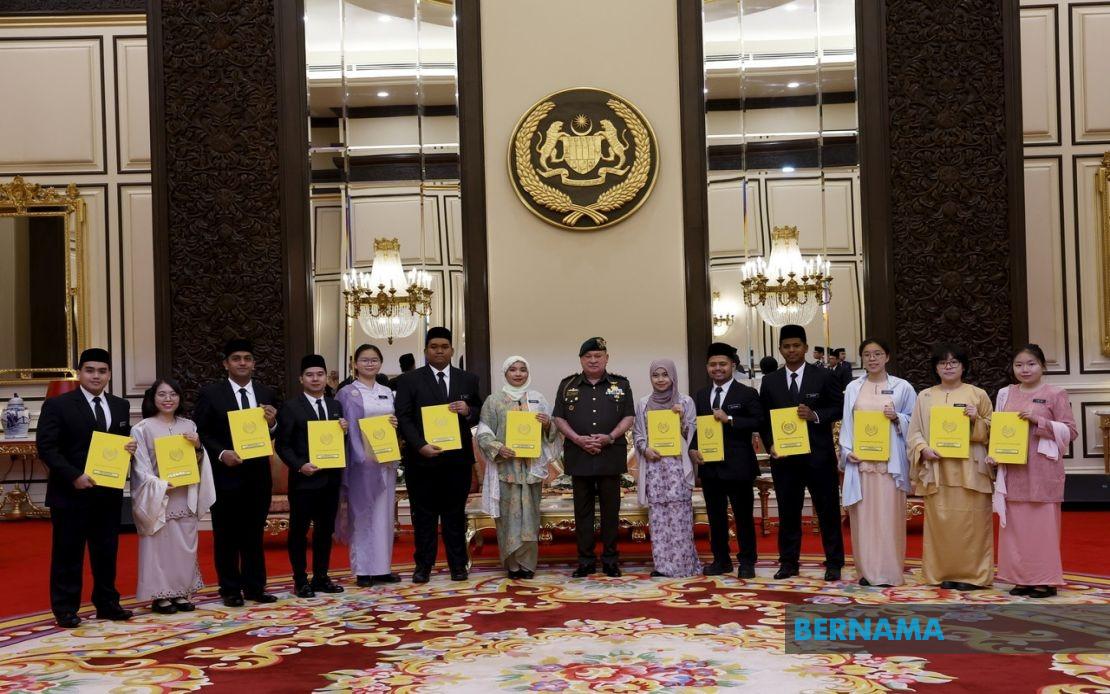
His Majesty Sultan Ibrahim, King of Malaysia, has presented the 2026 Yang di-Pertuan Agong Scholarships (BYDPA) to 14 accomplished scholars during a formal presentation ceremony conducted at Istana Negara in Kuala Lumpur. The occasion underscores the monarchy's commitment to nurturing academic excellence and supporting the nation's research capacity at the highest levels of tertiary education. The recipients represent a cross-section of Malaysia's most promising intellectual talent, having been selected through a rigorous and competitive evaluation process that identifies individuals demonstrating exceptional academic credentials and research potential.
The award allocation reflects a balanced distribution across different levels of postgraduate study. Exactly half of the cohort—seven scholars—will pursue doctoral degrees, positioning them to undertake original research that advances knowledge in their respective fields. The remaining seven recipients have been granted scholarships to pursue Master's-level research programmes, which typically serve as foundational stepping stones toward later doctoral work or specialised professional careers. This structured approach ensures that Malaysia's scholarship investment spans the full spectrum of advanced research training, from early-stage master's candidates through to those preparing for independent doctoral contributions.
The geographic scope of the awards reflects both Malaysia's growing research infrastructure and the continued importance of international academic collaboration. Four of the 14 scholars will conduct their advanced studies at prestigious universities located beyond Malaysia's borders, gaining exposure to global research methodologies, international peer networks, and world-class laboratory and library facilities. Simultaneously, the remaining ten recipients will undertake their programmes at established domestic research universities, indicating confidence in the quality and specialisation available within Malaysia's higher education sector. This balance acknowledges that international experience enriches scholarship and career prospects whilst also building critical mass within local institutions.
The BYDPA scheme itself holds a distinctive position within Malaysia's landscape of government-sponsored education programmes. According to Tan Sri Wan Ahmad Dahlan Abdul Aziz, the Director-General of the Public Service, who commented to reporters following the presentation ceremony, the BYDPA represents the most generous funding envelope available under any government scholarship offering in the country. The distinction matters considerably for aspiring researchers: superior financial support removes barriers to full-time engagement with rigorous academic work, eliminating the need for many recipients to undertake supplementary employment that might otherwise dilute their research productivity or extend their time to completion.
The ceremony itself drew participation from senior figures within Malaysia's administrative and royal establishments, reflecting the institutional significance accorded to the scholarship programme. Tan Sri Dr Azmi Rohani, serving as Comptroller of the Royal Household at Istana Negara, attended alongside Tan Sri Wan Ahmad Dahlan Abdul Aziz. The presence of such figures signals that the BYDPA carries symbolic weight beyond its material benefits—it represents a tangible expression of the monarchy's engagement with questions of national intellectual development and the cultivation of knowledge-based capacity.
For Malaysia's research ecosystem, the implications of such targeted investment merit consideration. By concentrating substantial funding on a limited number of carefully vetted candidates, the BYDPA approach differs from programmes that distribute smaller amounts across larger cohorts. This concentration strategy potentially yields deeper specialisation and more focused research outputs, as scholars operate without the financial pressure that might otherwise compartmentalise their intellectual energy. The existence of such a prestigious scheme also influences Malaysian academia's profile internationally, as recipients often publish results and forge collaborative networks that enhance the country's visibility in global research communities.
The broader context of government scholarship investment in Southeast Asia reveals Malaysia's sustained commitment to postgraduate training despite the region's competitive dynamics. Thailand, Singapore, and Indonesia have similarly expanded their own domestic scholarship offerings in recent years, recognising that advanced human capital correlates strongly with innovation capacity and economic competitiveness. Malaysia's decision to maintain and promote the BYDPA—particularly by publicising its status as the highest-funded government scholarship programme—reflects a deliberate strategy to retain top talent and prevent brain drain toward better-resourced institutions elsewhere in the region or globally.
For the 14 recipients themselves, the scholarship carries implications extending well beyond immediate financial security. Selection for a scheme explicitly endorsed by the reigning monarch confers status that will persist throughout their careers, signalling to future employers, research institutions, and collaborators that the awardee has undergone elite-level vetting. Many scholarship recipients go on to assume leadership roles in academia, research institutions, government agencies, or private sector research divisions, making the BYDPA effectively an investment in the nation's future leadership cohort across knowledge-intensive sectors.
Looking forward, the scheme's sustainability depends on continued government budget allocation despite competing demands on public resources. The Malaysian government's maintenance of such scholarships, particularly during periods of fiscal constraint, reflects a policy preference for long-term human capital development over shorter-term expenditure priorities. As Malaysia navigates its position within the global knowledge economy and seeks to advance from a middle-income to high-income status, such commitments to advanced research training become increasingly critical to competitive positioning.

