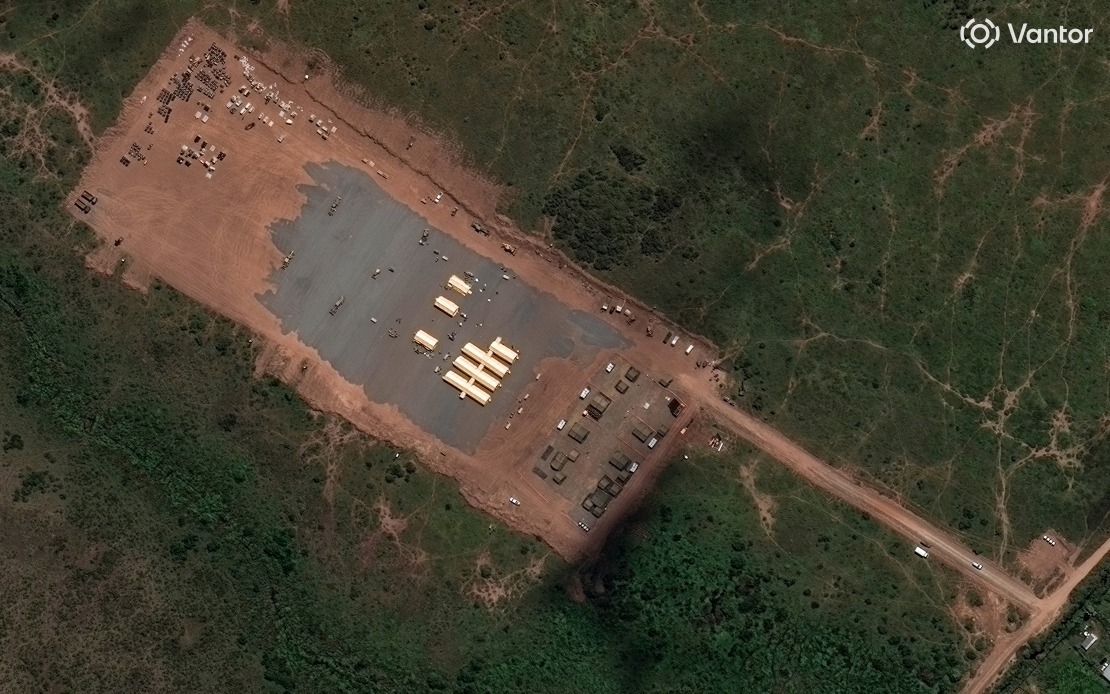
A Kenyan High Court has declared the country's health minister in contempt of court for persisting with construction of a contentious American-backed Ebola quarantine facility despite explicit judicial orders to cease work. Judge Patricia Nyaundi delivered the ruling on Monday against Aden Duale, determining that he had deliberately violated suspension orders issued in late May and reaffirmed in early June, continuing to oversee activities at the site even after the court had formally halted the project. The minister now faces potential sanctions and has been summoned to appear before the bench on Tuesday for mitigation arguments and sentencing.
The disputed installation involves a 50-bed isolation and quarantine complex situated at Laikipia Air Base in Nanyuki, positioned approximately eight kilometres west-northwest of that town and roughly two hundred kilometres north of Nairobi. According to government explanations, the facility would serve as a quarantine centre for American personnel who might have been exposed to Ebola virus during operational responses to outbreaks occurring in the Democratic Republic of the Congo and neighbouring countries experiencing transmission. The infrastructure project represents a component of bilateral health cooperation between Nairobi and Washington, with President William Ruto confirming that he had authorised the initiative following a direct request from President Donald Trump.
What might have been a straightforward public health infrastructure development has instead become one of Kenya's most divisive recent policy matters, generating sustained legal opposition, street demonstrations, and critical commentary from parliamentary opposition figures, grassroots civil society organisations, and regional administrative authorities. The constitutional rights group Katiba Institute launched the original legal challenge, arguing that the project violated multiple constitutional protections and ought not to advance without fulfilling mandatory legal compliance procedures and incorporating genuine public participation in decision-making processes. The High Court's acceptance of these arguments led to the suspension order that Minister Duale subsequently disregarded.
The government's position emphasises Kenya's vulnerability to epidemic disease spillover, citing the nation's significance as a regional transportation node, diplomatic hub, and commercial centre that facilitates movement across East Africa and beyond. Officials maintain that Ebola preparedness capacity strengthens Kenya's ability to respond to future outbreak threats and protects neighbouring populations. The United States Embassy in Nairobi has similarly stressed that the facility represents a legitimate public health asset posing no threat to adjacent communities and contributes to strengthened regional disease surveillance and response infrastructure across East Africa.
Yet public concern has mounted substantially in Laikipia County, where community members have mounted persistent demonstrations questioning both the government's intentions and its apparent disregard for lawful court intervention. Residents worry about undisclosed health and environmental risks, along with transparency deficiencies in how decisions affecting their region have been made. The tension has escalated into violence, with at least three people killed during protests according to police accounts, witness statements, and documentation from human rights monitoring organisations operating in the area.
This controversy illuminates broader tensions within Kenya regarding sovereignty and foreign military or health infrastructure on national soil. By characterising the facility as responsive to direct presidential appeal from Washington, the Ruto administration framed the project as reflecting international diplomatic obligation rather than autonomous national decision-making. This framing itself became contentious, with critics viewing it as evidence of external pressure overriding domestic democratic deliberation and constitutional process. The minister's defiance of judicial orders now escalates the institutional confrontation, pitting executive action against judicial authority in a manner that extends beyond the facility's merits to encompass fundamental questions about constitutional governance.
For regional observers, particularly those in Southeast Asia managing relationships with multiple great powers, Kenya's experience offers relevant lessons about the complexities of accepting foreign-backed health infrastructure proposals. Malaysia and other ASEAN nations have similarly navigated proposals for foreign military medical facilities, quarantine installations, and pandemic response infrastructure from various international partners. The Kenyan case demonstrates that inadequate transparency, insufficient public participation in decision-making, and perceived executive overreach can rapidly transform technical health projects into symbols of sovereignty concerns and democratic deficit, regardless of their epidemiological rationale.
The constitutional dimension remains significant, as Kenya's 2010 constitution emphasised public participation and devolved governance structures. By proceeding without apparent coordination with Laikipia County authorities or meaningful community engagement, the national government arguably violated both procedural and substantive constitutional norms. The court's intervention therefore reflects judicial protection of constitutionalism itself, not merely obstruction of foreign cooperation. The minister's continued disregard for judicial rulings escalates this constitutional dimension, suggesting executive determination to override both popular sentiment and judicial constraint.
Observers anticipate that Tuesday's sentencing hearing may determine whether Kenya's courts possess sufficient institutional independence and enforcement capacity to compel executive compliance with judicial orders. Previous instances of political figures ignoring court directions in Kenya have sometimes proceeded without significant consequences, undermining public confidence in judicial authority. A robust sanction against the health minister would signal genuine judicial independence. Conversely, minimal punishment might suggest that executive power can supersede judicial authority when officials prioritise international relationships or policy objectives over domestic legal obligations, a dynamic with implications far beyond this particular dispute.
The underlying facility question itself may ultimately depend on whether the government can navigate a political resolution that addresses public concerns while maintaining the diplomatic commitment implied by the Trump administration's request. Some observers have suggested that relocation, enhanced transparency measures, or modified operational frameworks might accommodate both security cooperation and democratic legitimacy. However, the minister's apparent determination to proceed despite legal obstacles suggests the administration views capitulation as diplomatically unacceptable, potentially locking Kenya into continued institutional confrontation over what began as a technical public health proposal.

