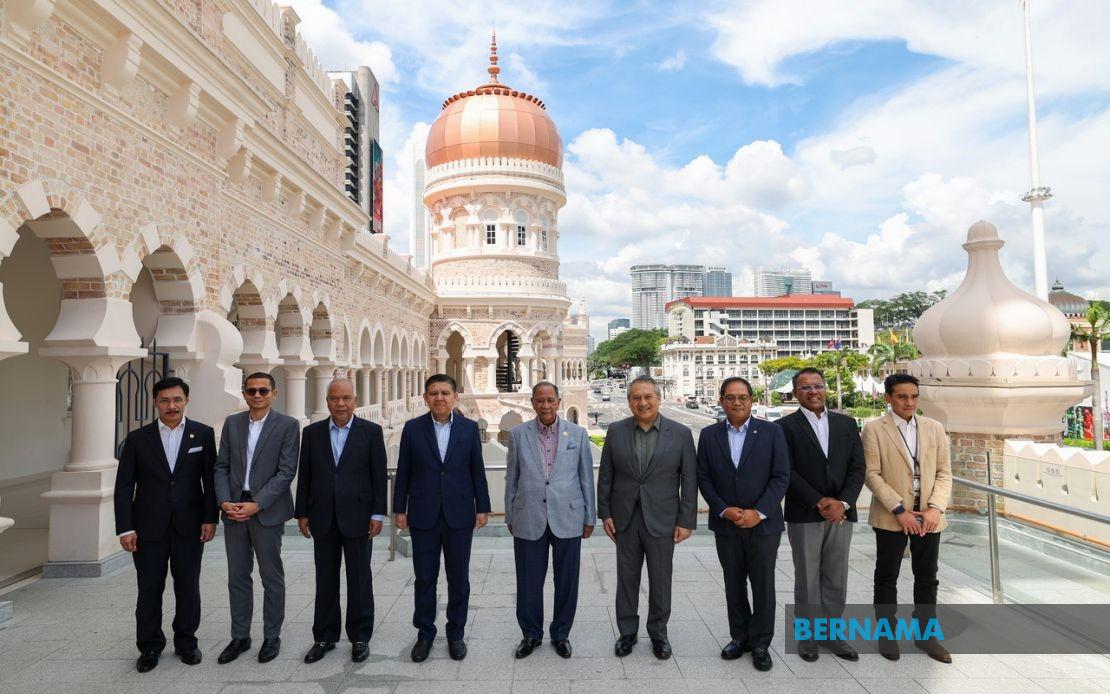
The Sultan of Kedah, Al Aminul Karim Sultan Sallehuddin Sultan Badlishah, spent Monday morning exploring the Sultan Abdul Samad Building, one of Southeast Asia's most historically significant administrative structures. Arriving at approximately 10.30 am on June 24, His Royal Highness was warmly received by Khazanah Nasional's managing director Datuk Amirul Feisal Wan Zahir, alongside other senior officials including chief corporate officer Datuk Mohamed Nasri Sallehuddin and head of real assets Selvendran Katheerayson. The three-hour visit underscored the building's cultural importance and the ongoing national commitment to preserving tangible connections to Malaysia's founding era.
The itinerary reflected the building's transformation into a public heritage venue rather than a purely administrative structure. His Royal Highness toured the Confluence Hall, a gallery space dedicated to showcasing Kuala Lumpur's origins and urban evolution, where Think City senior manager Mariana Isa provided detailed briefings on the curated exhibits. The displays trace the capital's journey from a modest tin-mining settlement into a major metropolis, emphasising the role of visionary leadership and strategic development. This narrative-driven approach helps contemporary visitors understand not merely what happened historically, but the forces and decisions that shaped modern Malaysia.
The tour also included a visit to the Visionary Hall, which complements the Confluence Hall's chronological focus by presenting conceptual models and interactive multimedia installations examining Kuala Lumpur's future trajectory and planned urban developments. Such exhibitions serve audiences ranging from schoolchildren to international visitors, making the building a educational institution as much as a heritage monument. The Sultan subsequently accessed the iconic balcony overlooking the Porte Cochere, an architectural feature that has witnessed countless ceremonial moments throughout the nation's political life. This particular vantage point carries symbolic weight, offering visitors the perspective from which colonial and post-colonial administrators once surveyed the city they governed.
The visit incorporated a practical dimension with a stop at the School of Hard Knocks, a social enterprise operated by Royal Selangor dedicated to providing skill development and employment opportunities for underprivileged youths. This segment demonstrated how heritage buildings can serve contemporary social purposes beyond tourism and cultural preservation. His Royal Highness subsequently participated in a light luncheon before departing the premises at approximately 1.15 pm, a schedule suggesting genuine engagement with the venue's multiple functions and stakeholder communities.
Managing director Amirul Feisal characterised the royal visit as deeply meaningful to Khazanah Nasional's institutional mission. He emphasised that the organisation's mandate extends well beyond the conservation of the building's physical fabric to encompassing the preservation and active presentation of Malaysia's historical narrative. The visit, in his assessment, represented recognition of efforts to maintain institutional memory about Selangor's development and the broader national story. Such acknowledgement from the royal institution carries particular significance within Malaysia's constitutional framework, where the Malay rulers occupy distinctive cultural and symbolic positions. The royal seal of approval for heritage initiatives provides both legitimacy and encouragement for ongoing preservation efforts.
Public engagement metrics demonstrate substantial interest in the restored facility. Since opening to visitors on February 2, the Sultan Abdul Samad Building has attracted approximately 200,000 visitors, indicating successful repositioning as an accessible heritage destination rather than an exclusively governmental institution. This visitation pattern suggests that Malaysians and international tourists possess genuine appetite for spaces that connect them tangibly to the nation's foundational moments. The reopening has therefore achieved its fundamental objective of democratising access to heritage that was previously restricted to official functions and governmental operations.
The building's restoration itself represents a significant conservation undertaking. His Majesty Sultan Ibrahim, King of Malaysia, officially inaugurated the completion of Phase One restoration works on January 31, following eleven months of intensive conservation labour funded through the Khazanah Heritage Fund programme. This phased approach indicates planning for continued work beyond the initial restoration, suggesting that the building will undergo ongoing adaptation to meet contemporary heritage management standards. The scale of resources committed demonstrates institutional recognition of the structure's paramount importance to the national identity.
Historically, the Sultan Abdul Samad Building carries weight that few structures in Malaysia can match. Originally conceived as the Secretariat Building during the colonial administration, it functioned as the operational nerve centre of the nation's governance. Most significantly, the building witnessed the symbolic pivot from colonial to independent rule in 1957, when the Union Jack was lowered and the Federation of Malaya flag was raised for the first time. This ceremonial moment, enacted within the building's precincts, crystallised the nation's transition into a new political era. Every subsequent visitor thus inherits access to a space physically saturated with the material significance of that historical rupture.
For Malaysian readers, the Kedah Sultan's visit carries implications extending beyond ceremonial courtesy or heritage tourism. It reflects among Malaysia's royal institution a commitment to active engagement with national heritage and institutional memory. The visit also exemplifies how state-level rulers participate in nation-building narratives and cultural preservation efforts that transcend parochial state interests. The Sultan of Kedah's interest in Kuala Lumpur's history and the capital's development signals recognition that Malaysia's heritage belongs to the federation collectively rather than to individual states in isolation. This integrative posture supports the inclusive nationalism that modern Malaysia continues to require.
The restoration and reopening of the Sultan Abdul Samad Building represents a broader pattern across Southeast Asia whereby nations are reclaiming and reinterpreting colonial-era architecture and administrative spaces through postcolonial lenses. Rather than demolishing such structures as symbols of foreign domination, Malaysia has chosen engagement and reinterpretation, converting the building into an instrument for understanding how the nation navigated imperial decline into independence. This approach creates opportunities for nuanced examination of the colonial period without uncritically endorsing colonialism or adopting wholesale rejection. Visitors encounter the building as a complex historical document worthy of sustained attention and study.

