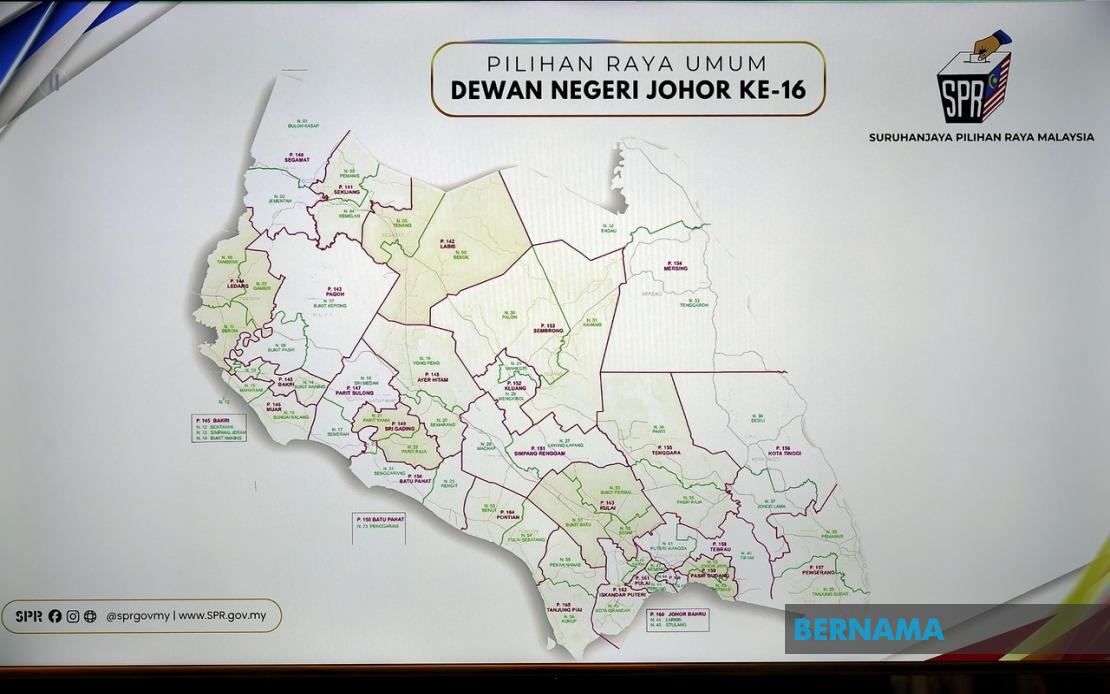
Johor's political landscape is set to transform tomorrow as nomination day officially opens the campaign for the 16th state election, marking a crucial juncture in the southern state's electoral calendar. The contests across all 56 state assembly seats will determine control of the Johor State Legislative Assembly following its dissolution on June 1, with voting scheduled for July 11 and early voting available on July 7. The Election Commission expects nearly 2.73 million voters to participate, including members of the security forces, in what analysts believe could reshape the state's political trajectory.
The nomination process begins at 9 am tomorrow at designated registration centres across Johor, with a tight one-hour window for candidates to submit their documentation. Once the screening process concludes, the official roster of contenders will be released, providing clarity on which candidates have met all regulatory requirements. This procedural stage carries considerable importance beyond mere formality, as the Election Commission has emphasised the need for prospective candidates to verify their nomination forms in advance at the Returning Officer's Office or State Election Office to prevent administrative rejections. Deposit payments must also be settled promptly, with receipts retained as proof during the formal submission of nomination papers.
Pakatan Harapan has committed to contesting every available seat, fielding 20 candidates from Parti Keadilan Rakyat, 19 from Amanah, and 17 from the Democratic Action Party. This comprehensive strategy reflects the coalition's determination to reclaim ground after its 2022 performance, when it secured only 12 seats. The composition reveals an attempt to balance various demographic constituencies and regional strengths, with the allocation between its three component parties reflecting negotiated power-sharing arrangements. PKR's larger contingent suggests its status as the largest opposition-aligned party in Johor, though Amanah's strong presence indicates the coalition's efforts to maintain Islamic credibility in a state with a significant Malay-Muslim majority.
Barisan Nasional has similarly adopted a full-slate strategy, deploying 36 UMNO candidates alongside 16 from the Malaysian Chinese Association and four from the Malaysian Indian Congress. As the incumbent coalition, which won 40 seats in 2022 and controls the state government, BN's approach reflects confidence in its organisational machinery and ground presence. The distribution heavily favours UMNO, which continues to dominate Johor's electoral landscape, though the inclusion of MCA candidates across substantial numbers suggests efforts to maintain Chinese-majority seat representation despite demographic shifts in recent years.
Perikatan Nasional's participation through its coalition partners—with PAS contesting 11 seats, Bersatu fielding 16, and the Malaysian Indian People's Party entering five contests—demonstrates the coalition's ambitions to expand its footprint beyond its 2022 tally of three seats. Bersatu's significant candidate deployment reflects its strategy to position itself as a major player in Johor politics despite being newly formed. PAS, which has strengthened its position in several Malaysian states, appears to be concentrating resources strategically rather than pursuing a full-slate approach, possibly reflecting calculations about where it holds competitive advantage.
Smaller parties have also entered the fray, with the Malaysian United Democratic Alliance contesting four seats and the Socialist Party of Malaysia fielding one candidate. Most notably, Parti Bersama Malaysia is making its debut in Johor with 15 candidates, suggesting it has invested considerable resources in this election as a platform for growth. These smaller entrants inject additional competitive dynamics, potentially fragmenting votes in certain constituencies and creating opportunities for unexpected outcomes where traditional strongholds face pressure from multiple challengers.
The total eligible electorate of 2,727,926 voters encompasses over 2.7 million ordinary citizens, plus 12,041 military personnel and spouses and 12,710 police officers and spouses. This composition gives Johor elections distinctive characteristics compared to federal or other state polls, with security force representation carrying particular political weight in a state with significant military and police presence due to its strategic location and maritime interests. The July 11 polling date falls during the school holidays, potentially affecting turnout patterns and logistical arrangements for voting centres.
Anticipating potential irregularities, the Malaysian Anti-Corruption Commission has issued formal reminders to all candidates and political parties to maintain strict adherence to electoral conduct standards under the MACC Act 2009 and the Election Offences Act 1954 (Amendment 2012). The MACC has established five dedicated 24-hour operations rooms stationed at Tampoi, Batu Pahat, Kluang, Segamat, and Mersing, creating accessible channels for the public to report suspected corruption or abuse of power throughout the election period. This enforcement posture reflects growing scrutiny of electoral integrity and political financing in Malaysian elections, particularly following concerns raised in previous cycles.
The 2022 results provide the baseline for assessing this election's dynamics. Barisan Nasional's commanding 40-seat advantage then translated into firm state government control, while Pakatan Harapan's 12 seats positioned it as the official opposition. Perikatan Nasional's three seats and MUDA's one seat carved out representation for newer political forces, yet neither substantially challenged the two-coalition dominance. The intervening two years have witnessed significant political developments nationally, including shifting alliances, internal party dynamics, and performance assessments of both state and federal governments that may have altered voter calculations.
Johor's electoral significance extends beyond state-level governance. As Malaysia's second-largest state by population and a crucial economic hub, electoral outcomes here carry implications for national political balance. A Barisan Nasional hold would reinforce federal coalition stability, while a Pakatan Harapan breakthrough would suggest shifting voter sentiment toward opposition alternatives. The performance of smaller parties and independent candidates may also indicate whether Malaysian voters are diversifying their political choices or consolidating around traditional blocs.
The campaign period ahead will test each coalition's messaging, grassroots mobilisation capacity, and ability to address voter concerns spanning economic management, infrastructure development, and social welfare provision. Nomination day tomorrow essentially sets the competition's parameters, determining who will compete and in what configuration the electoral battle will take shape across Johor's diverse constituencies over the coming weeks.

