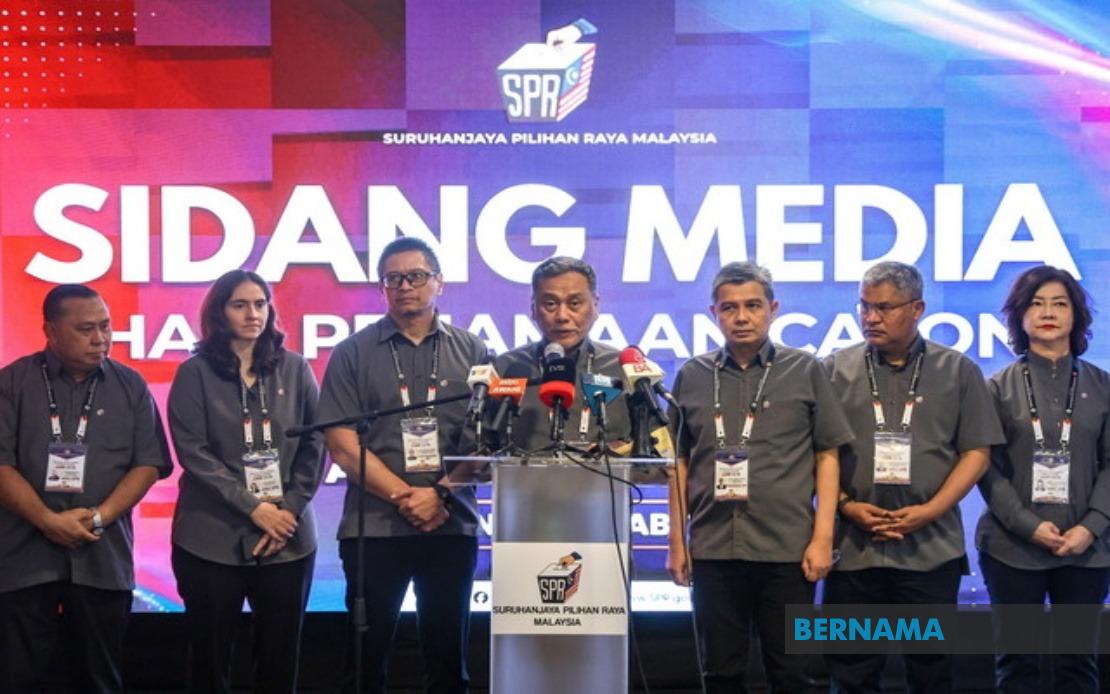
Johor's upcoming state election will feature a three-way battle for control across its 56 assembly seats, with 172 candidates officially cleared to contest after the nomination process concluded on June 27. Election Commission chairman Datuk Seri Ramlan Harun announced that all nomination papers submitted at the 56 designated centres were accepted without any disqualifications, setting the stage for what promises to be a competitive multi-party contest in one of Malaysia's most politically significant states.
The gender composition of the candidate field reflects ongoing diversity concerns within Malaysian electoral politics. Among the 172 contenders, 138 are men while 34 are women, representing roughly 20 percent female representation. This ratio, though not dramatically skewed by regional standards, underscores the persistent gender imbalance in political candidacy despite growing calls for greater inclusivity in party selection processes. The distribution across parties and independent status reveals how gender representation varies unevenly, with some political movements potentially fielding stronger female candidates than others.
Barisan Nasional and Pakatan Harapan have adopted parallel strategies by each nominating 56 candidates, effectively contesting every single seat in the state legislature. This blanket coverage reflects their status as Malaysia's major coalition blocs, positioning them as genuine contenders for state control. The equal numerical commitment signals mutual determination to wrestle dominance away from whichever side currently holds sway, transforming Johor into a genuine two-front battleground where ground organisation and messaging will determine outcomes.
Perikatan Nasional's fielding of 33 candidates represents a substantial third presence in the competition, though notably fewer than the 56-seat threshold. This positioning suggests that PN, despite its national political influence, is either conserving resources or operating with less grassroots machinery in Johor compared to the larger coalitions. The strategic calculation behind such selective candidacy—potentially focusing on winnable constituencies while ceding ground elsewhere—reflects pragmatic campaign assessments rather than symbolic gestures.
Smaller political entities have also registered their participation, with Parti Bersama Malaysia fielding 15 candidates, MUDA contributing four, and both Parti Orang Asli Malaysia and Parti Sosialis Malaysia nominating single representatives. This spread of smaller parties demonstrates the fragmentation visible across Malaysian electoral politics at state level, where niche political movements attempt to carve out constituencies around specific ideological or community-based platforms. Additionally, six independent candidates are contesting, suggesting some politicians either lacked party backing or chose to run without party affiliation.
The distribution of contest types across the 56 seats reveals the complex electoral mathematics that will determine final outcomes. Fourteen seats will be decided through straight fights between two candidates, typically the most straightforward contests where voter choice is binary. Twenty-seven seats feature three-way races, the most common configuration, where vote splitting and strategic voting considerations become critical. Twelve seats will involve four candidates, complicating the path to victory and potentially creating scenarios where plurality rather than majority support determines winners. Three seats will see five candidates contest, the most fragmented contests, where even modest vote shares could determine outcomes depending on how the broader vote divides.
This varied contest structure has significant implications for coalition strategy and individual party performance projections. In straight fights, the two nominated candidates will likely represent the major coalitions, effectively presenting voters with a clear binary choice between BN and PH visions. Three-cornered contests introduce PN or smaller party dynamics, potentially splitting anti-establishment votes or creating scenarios where coalition candidates inadvertently benefit from opposition fragmentation. The four- and five-way contests create maximum unpredictability, where traditional polling becomes less reliable and ground-level mobilisation capacity becomes paramount.
Johor's electoral significance within Malaysia's broader political landscape cannot be overstated. As the nation's second-largest state by population and a crucial economic contributor, control of Johor carries substantial implications for federal political calculations and resource allocation. Any decisive swing in Johor's partisan complexion could signal broader shifts in Malaysian voter sentiment, potentially affecting confidence in national leadership or coalition strength. The state has historically alternated between BN and opposition control, making this election a potential inflection point in Malaysian politics.
The nomination process itself, concluding without disqualifications, suggests that the Election Commission's scrutiny procedures functioned smoothly, with all submitted candidates meeting statutory requirements. This clean administrative execution contrasts with occasional nomination controversies in previous elections and reflects either improved EC procedures or more careful candidate vetting by political parties themselves. The absence of rejected nominations indicates that parties have internalised the EC's standards, reducing contentious disputes before campaigning formally begins.
Campaigning dynamics will now unfold across these 56 distinct contests, each with its own local character, candidate profile, and voter considerations. The three-week campaign period between nomination closure and election day will see intense activity across constituencies ranging from urban Johor Bahru areas to more rural districts in the state's interior. Ground-level organising, candidate visibility, and messaging resonance will ultimately determine which of these 172 candidates successfully secure the 28 seats necessary for coalition control of the state government.
The broad participation across multiple parties and independents demonstrates that Malaysian electoral competition extends beyond the BN-PH binary, even if that framework remains the primary competition lens. The actual electoral outcome will reveal whether these smaller political entities can translate their candidacy into meaningful seat gains or whether they function primarily as spoilers affecting the distribution of votes among major contenders. Johor's 16th state election thus represents a crucial test of Malaysian political dynamics at state level during a period of significant national political fluidity.

