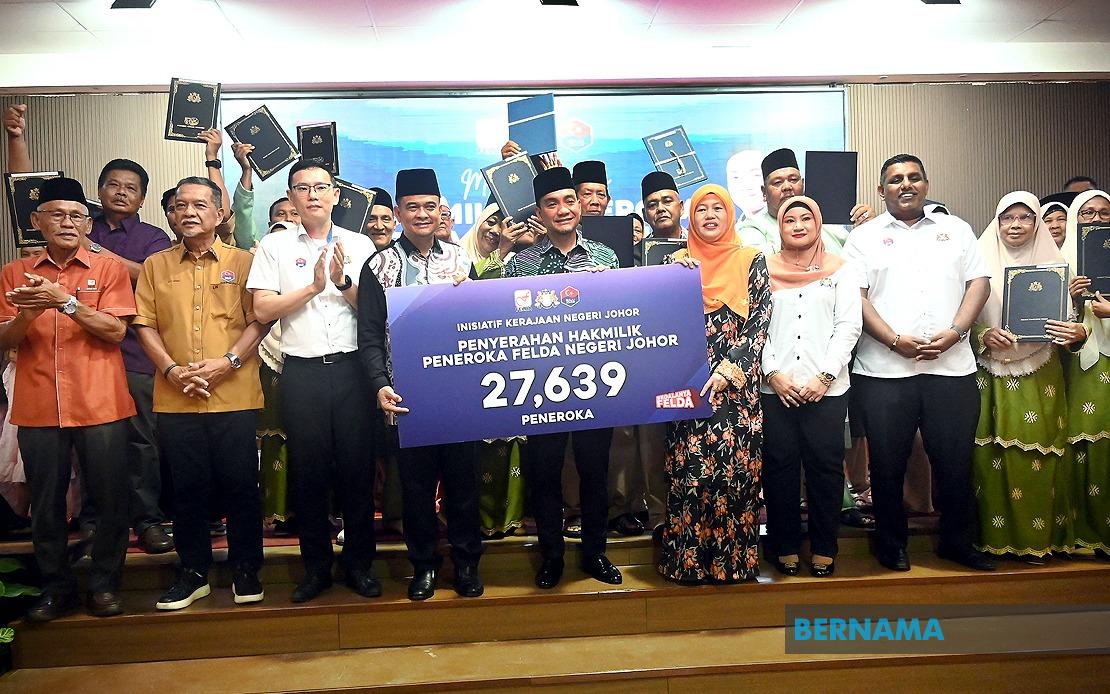
The Johor government has achieved a watershed moment in resolving a protracted land ownership crisis that has plagued Federal Land Development Authority (FELDA) settlers for decades. Menteri Besar Datuk Onn Hafiz Ghazi announced that 27,639 out of 27,642 land title applications have been successfully processed, representing a completion rate of 99.99 per cent. This breakthrough was marked at a formal land title presentation ceremony in Kluang on June 23, where 210 settlers from Kluang, Kota Tinggi and Mersing received their long-awaited land ownership documents.
The resolution of this administrative backlog holds particular significance for Malaysia's rural communities, where land tenure insecurity has historically constrained agricultural productivity and community development. FELDA settlers, many of whom have worked their plots for generations without formal documentation, have faced considerable uncertainty regarding their legal standing and inheritance rights. The completion of this titling process removes a major impediment to rural economic advancement and provides settlers with the collateral necessary to access agricultural financing and investment opportunities.
For Johor specifically, this achievement underscores the state government's strategic prioritisation of agrarian welfare within its broader development framework. Datuk Onn Hafiz emphasised that resolving land title issues remains a cornerstone of the state's commitment to protecting FELDA communities, signalling that ongoing support for these settlements will continue regardless of future administrative challenges. The formal presentation ceremony served not merely as a bureaucratic milestone but as symbolic recognition of the state government's accountability to rural constituents who have long waited for institutional confirmation of their property rights.
The historical context of FELDA land title delays reveals systemic challenges in Malaysia's land administration architecture. Federal Land Development Authority schemes, established from the 1950s onwards to redistribute agricultural land and develop rural infrastructure, created complex dual relationships between settler-farmers and the state apparatus. Ambiguities in documentation, administrative fragmentation between federal and state jurisdictions, and resource constraints in land offices created bureaucratic logjams that persisted for half a century in some cases. Johor's resolution of this backlog demonstrates that with dedicated political commitment and administrative resources, even deeply entrenched land governance problems can be overcome.
The achievement carries implications extending beyond Johor's borders. Malaysia's agricultural sector, increasingly pressured by urbanisation, labour shortages, and climate variability, requires secure land tenure as a foundation for modernisation and productivity improvements. When settler-farmers lack clear legal title, they cannot effectively implement long-term investments in soil conservation, crop diversification, or mechanisation. The resolution of land title uncertainty therefore creates conditions for agricultural transformation and may serve as a template for addressing similar backlogs elsewhere in the country.
Datuk Zahari Sarip, the Johor Agriculture, Agro-based Industry and Rural Development Committee chairman, represented the state government's explicit integration of land titling into its rural development strategy. This institutional positioning signals that land rights are understood not as peripheral administrative matters but as central to rural welfare and economic prosperity. The machinery of government has been mobilised to treat FELDA settlements as priority constituencies, reflecting an understanding that rural communities deserve the same institutional responsiveness as urban populations.
The symbolic dimension of the ceremony itself warrants attention. Public presentation ceremonies for land titles serve important functions beyond document transfer. They provide formal, dignified recognition of settlers' claims and demonstrate governmental respect for rural livelihoods. For communities that have experienced prolonged administrative neglect, such ceremonial acknowledgement has psychological and social significance, reinforcing their membership in the political community and their government's recognition of its obligations to them.
Looking forward, the remaining 0.01 per cent of unresolved cases—just three applications out of 27,642—should be expeditiously completed to achieve absolute closure on this issue. Johor's near-total resolution suggests that remaining obstacles are likely individual complications rather than systematic problems. The state government's demonstrated capacity to process this workload efficiently indicates that finalising these final cases should present no substantial difficulty, allowing the government to declare complete resolution of a longstanding grievance.
The broader significance of this achievement lies in its validation of institutional problem-solving through sustained political commitment. Land governance crises often persist not because solutions are technically impossible but because they lack sustained political priority and adequate resource allocation. Johor's success demonstrates that when state leadership chooses to prioritise rural grievances and dedicates administrative resources accordingly, transformative results become achievable. This lesson may inform approaches to other persistent governance challenges affecting marginalised communities throughout Malaysia and Southeast Asia, where land tenure insecurity remains a widespread impediment to development and social stability.

