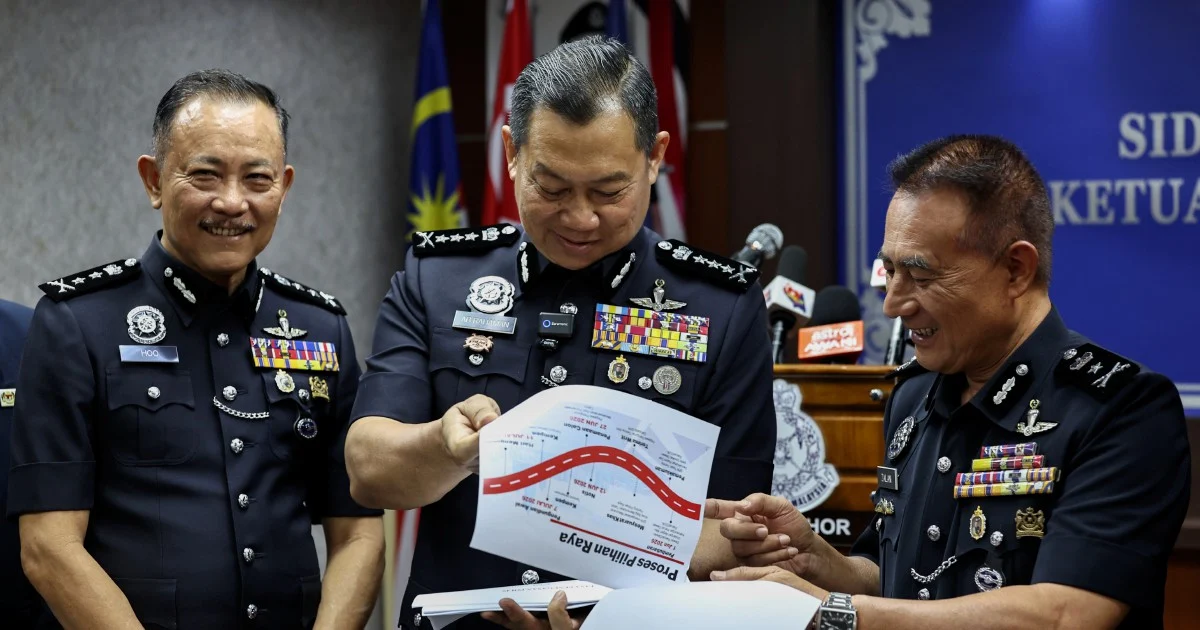
The Johor police force is preparing an unprecedented security operation for the 16th state election, deploying over 11,000 personnel across the southern state to maintain order and prevent violence during the electoral process. This substantial commitment of manpower reflects the authorities' determination to ensure a peaceful and orderly election in a state that has historically witnessed intense political competition and occasional eruptions of violence at polling stations and campaign events. The scale of the operation underscores how seriously law enforcement is treating the maintenance of security infrastructure during what promises to be a closely contested poll in one of Malaysia's most politically significant states.
State police have mapped out 39 hotspots throughout Johor that will receive concentrated attention from officers deployed across constituencies. These designated areas represent locations where intelligence suggests heightened risk of confrontation, disturbances, or incidents that could compromise the integrity and safety of the electoral process. The identification of these hotspots reflects months of assessment and intelligence gathering by the state police command, who have studied historical patterns of election-related incidents, demographic tensions, and areas where rival political factions maintain strong support bases.
The decision to single out specific geographic zones for enhanced monitoring reveals the strategic nature of modern election security planning in Malaysia. Rather than distributing resources uniformly across all polling stations and campaign venues, police are concentrating personnel where risk assessment suggests problems are most likely to emerge. This targeted approach allows for more efficient allocation of the available 11,000 officers while maintaining the flexibility to respond rapidly to incidents that develop in unexpected locations. The intelligence-driven methodology reflects evolution in how state and federal law enforcement have adapted their approach to managing elections following previous cycles that witnessed security challenges.
For Malaysian voters and political observers, the heavy police presence serves dual purposes. On one hand, it aims to reassure citizens that authorities are committed to protecting them from violence or intimidation as they exercise their franchise. Voters concerned about their safety at polling stations can presumably feel more confident knowing that substantial security resources are being mobilised. Conversely, the large-scale deployment might also serve as a deterrent to political operatives who might otherwise contemplate using coercive tactics to influence electoral outcomes or suppress voter participation among opposition supporters.
The election in Johor carries implications extending beyond the state itself. As Malaysia's second-largest state by population and a significant economic centre, political developments in Johor influence national political calculations. The security preparations undertaken by police suggest that authorities at state and federal levels anticipate that this particular election cycle may generate higher tensions than routine state polls. The substantial resource commitment indicates serious concern about potential disorder, suggesting that police intelligence has identified specific threat vectors or political dynamics that require careful management.
From a regional perspective, the deployment reflects broader Southeast Asian patterns where election periods frequently necessitate enhanced security measures. Indonesia, the Philippines, and Thailand have all implemented comparable police mobilisations during significant electoral events. Malaysia's approach, however, operates within a democratic framework that has generally maintained respect for voting rights and free political competition, even when elections become contentious. The 11,000-officer deployment represents security management consistent with Malaysia's institutional structures rather than reflecting the authoritarian election practices that characterise some neighbouring nations.
The identification of 39 specific hotspots suggests that Johor police command has divided the state into manageable operational zones while recognising that not all areas present equal security challenges. Urban constituencies, particularly in Johor Baru and other major cities, may feature disproportionately in the hotspot designation given their higher population density and more intense political rivalry. Agricultural and less densely populated areas may face lighter police presence despite still receiving baseline security coverage. This geographic stratification reflects practical considerations about where confrontations between political supporters are most likely to develop.
The logistics of deploying and sustaining 11,000 officers throughout an election cycle present significant operational challenges for the Johor police force. Officers must be scheduled to cover polling day itself, the period immediately preceding the election when campaign activities intensify, and potentially the post-election period if vote counting or result announcements trigger disputes. The coordination required to manage such a large deployment across multiple constituencies and hotspots demands sophisticated command structures and communication systems. The operation represents one of the largest single-purpose police mobilisations undertaken within the state during a non-emergency context.
Citizens and civil society organisations monitoring the election will likely scrutinise how police exercise their authority during this period. Concerns about potential bias, harassment of opposition supporters, or disproportionate use of force at particular hotspots could undermine public confidence in both the election process and police impartiality. Authorities will need to ensure that their security operation, while maintaining order, respects democratic principles and does not inadvertently suppress legitimate political participation or free expression. The manner in which police manage the 39 identified hotspots will signal whether security measures are being applied even-handedly or perceived as favouring particular political interests.

