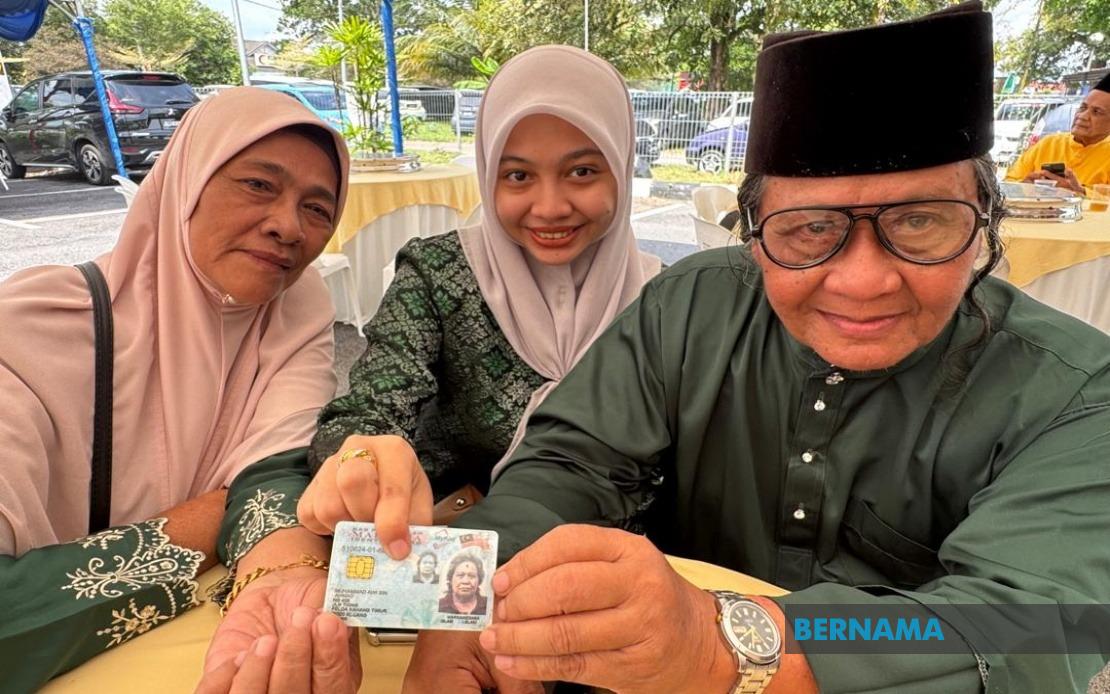
A milestone has been reached for Felda settlers in Johor after the state government approved the land title applications of thousands of farming families, many of whom have been waiting since the early 1990s to secure legal ownership of their cultivated plots. The Johor Felda Settlers Land Title Handover Ceremony, held in Kluang and presided over by Menteri Besar Datuk Onn Hafiz Ghazi, distributed ownership titles to 210 recipients from Kluang, Kota Tinggi and Mersing districts, marking the culmination of what has been a frustratingly lengthy bureaucratic journey for agricultural communities across the state.
Among those who benefited from the initiative is Muhammad Awi Ahmad, a 75-year-old settler from Felda Kahang Timur, whose application was finally approved after two previous rejections spanning three decades. Muhammad Awi first cultivated his 4.2-hectare plantation and residence in 1986, yet did not receive recognition of his ownership rights until 2024, despite submitting formal applications in both 1990 and 2000. The approval arriving on his birthday carries profound personal significance, representing not merely a property document but validation of his life's work and an end to years of legal uncertainty about his family's financial security and generational heritage.
The resolution process accelerated notably under the current state administration, which successfully processed Muhammad Awi's successful application within approximately one year—a dramatic contrast to the stagnation experienced over the previous three decades. This shift in administrative efficiency suggests either improved institutional capacity or a renewed policy commitment to address accumulated grievances within the Felda community. For individual families like Muhammad Awi's, this acceleration translates into concrete improvements: the ability to use land as collateral for loans, assured inheritance rights, and protection against disputes over property boundaries or ownership.
The implications extend beyond individual households to encompass generational dynamics within Felda settlements. Norliyani, the 25-year-old daughter of Muhammad Awi, emphasized how unresolved land ownership creates cascading hardship across successive generations. While first-generation settlers, many now in their sixties and seventies, retain cultural and emotional ties to their original villages, their children and grandchildren have no such safety net. For the younger generation, the Felda settlement represents home—the only residence they have ever known—making the absence of property rights a source of profound anxiety about their future economic stability and inheritance prospects.
Norliyani's perspective reveals an often-overlooked dimension of the land title issue: generational risk. Without formal ownership documentation, second and third-generation settlers face the possibility that their parents' lifelong labour could ultimately benefit outside parties rather than family members. This concern is not hypothetical but grounded in Malaysian property law, where unclaimed or disputed land can revert to state ownership or become subject to competing claims. For younger Felda residents seeking to establish agricultural businesses, obtain financing, or plan long-term family investments, the absence of clear title has represented a significant competitive disadvantage.
Mohd Farhan Mohamad's experience further illustrates the patience demanded of Felda applicants. Now 43, Mohamad Farhan initially lodged his application in 2006, acting on his father Mohamad Masek's wishes to formalize ownership of land cultivated since the 1980s. The family submitted their most recent application just the previous year, with minimal expectation of approval given the historical slowness of the process. When their application succeeded in 2024, it represented nearly two decades of persistent administrative engagement—a remarkable testament to both family determination and, finally, institutional responsiveness.
The overall achievement is quantitatively substantial: 99.9 percent of Johor Felda settlers who submitted applications—specifically 27,639 out of 27,642 settlers—have now received formal ownership titles. This near-universal success rate represents the resolution of what had become a systemic problem within the Federal Land Development Authority structure. Historically, many Felda settlers operated in a state of legal limbo, occupying and cultivating land without possessing the documentation that would provide security against eviction, enable borrowing against their assets, or establish clear inheritance rights.
The historical context underlying this initiative illuminates why the process took so long. The Federal Land Development Authority was established in 1956 with the objective of developing hitherto undeveloped land and settling landless Malaysians through agricultural schemes. However, the administrative infrastructure for eventually transferring individual land titles to settlers—as opposed to leaving authority vested collectively in Felda itself—developed unevenly across different states and settlement schemes. In Johor, the backlog of title applications accumulated over decades, creating a cohort of aging settlers who had never received documents reflecting their legal ownership despite paying applicable taxes and fees.
For Malaysian policymakers and land administrators, the Johor initiative offers practical lessons about the importance of resolving archival and administrative bottlenecks. The successful clearance of nearly 28,000 applications demonstrates that even deeply embedded bureaucratic problems can be addressed when prioritized by state leadership. The relatively rapid processing under the current administration—achieving approvals within a year rather than decades—suggests that the obstacles were partly administrative culture and resource allocation rather than legal impossibility.
The economic implications for Felda settlers should not be underestimated. Formal land ownership enables access to agricultural credit, facilitates the establishment of inheritance trusts, permits entry into property markets, and provides collateral for business expansion. For an aging cohort of settlers approaching or already in retirement, having their lifetime of labour formally acknowledged through ownership documentation provides both practical security and psychological closure. For younger generations, it removes a significant barrier to agricultural entrepreneurship and generational wealth transmission.
Beyond Johor, the initiative raises questions about similar backlogs affecting Felda settlers in other Malaysian states. While the federal agency operates nationwide, state governments exercise varying degrees of administrative capacity and political will in addressing such issues. The Johor precedent suggests that concentrated effort and political commitment can resolve what might otherwise appear to be intractable administrative problems. For settlers in other states who have submitted applications and waited for years without resolution, the Johor success story provides both hope and benchmarking evidence that faster processing is achievable.
The ceremony and distribution of titles also symbolizes a shift in how policymakers view the Felda program's social contract. Rather than viewing settlers as perpetual tenants within a federally administered system, contemporary approaches increasingly recognize the moral and practical case for converting cultivators into proprietors. This represents not merely administrative change but a philosophical recognition that those who have devoted decades to developing agricultural land deserve secure legal ownership of their family enterprises. For a 75-year-old settler receiving his title on his birthday after a 38-year wait since beginning cultivation, or for younger settlers contemplating their family's future, the initiative marks a overdue but consequential recognition of their long-deferred rights.

