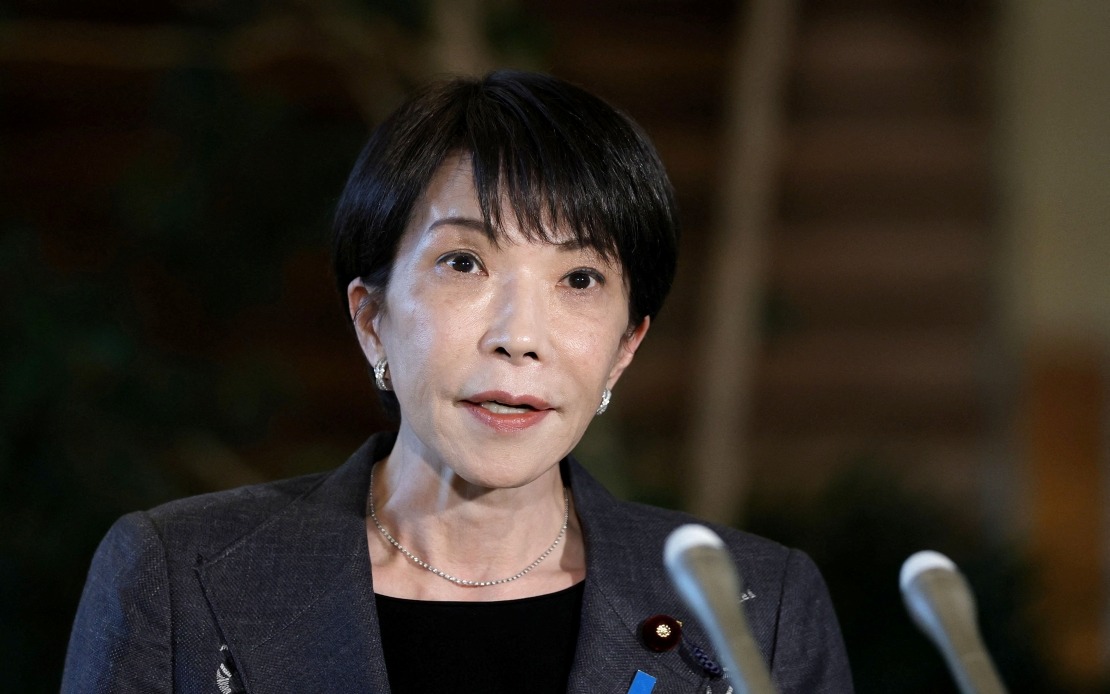
Japanese Prime Minister Sanae Takaichi has made an explicit commitment to reinstate the consumption tax on food and beverages to its full 8 per cent rate once a planned two-year reduction concludes, seeking to reassure both lawmakers and the public about the sustainability of the tax relief initiative. The announcement came during parliamentary questioning on Monday, as Takaichi addressed concerns that temporary tax cuts often become politically difficult to reverse once implemented. Her clarification appears designed to counter skepticism from opposition parties, particularly lawmakers who argue that restoring a reduced tax would inevitably trigger public backlash branded as a "tax increase."
The commitment reflects an evolving compromise within Japan's ruling coalition, which has shifted its election-season pledge to eliminate the consumption tax on food entirely toward a more modest 1 per cent rate for the two-year implementation period beginning April 2027. The Liberal Democratic Party made this adjustment proposal during deliberations at a cross-party council on taxation and social security, recognising practical constraints around retail infrastructure while attempting to maintain the spirit of inflation relief promised during February's lower house election campaign. The revised approach emerged from sustained discussions over multiple months and will be formally presented in an interim report due later this month, though the broader political consensus appears to favour proceeding with implementation once bureaucratic approval completes.
The rationale behind selecting a 1 per cent rate rather than zero stems largely from operational considerations. Retailers across Japan would face significant costs and logistical challenges in reprogramming point-of-sale systems to accommodate a zero rate, whereas maintaining even a nominal 1 per cent tax preserves existing payment infrastructure while still delivering meaningful price relief at supermarket tills. To bridge the gap between this reduced rate and the original campaign promise of complete exemption, the LDP proposed a supplementary mechanism involving annual cash handouts worth approximately 600 billion yen, equivalent to roughly US$3.7 billion, distributed directly to households. This hybrid approach attempts to satisfy electoral commitments while navigating the practical realities of implementation across Japan's diverse retail landscape.
The broader context surrounding this tax decision reveals deep tensions within Japanese economic policy. The nation continues battling persistent inflation that has strained household budgets, making targeted tax relief on essential food items politically attractive. Simultaneously, however, Japan's fiscal position has deteriorated significantly, with government bond yields recently climbing to decades-high levels and persistent weakness in the yen currency. These headwinds have intensified international scrutiny regarding Japan's debt sustainability, particularly given that the country already shoulders the worst fiscal condition among Group of Seven economies. A temporary consumption tax cut, even with a commitment to restoration, risks exacerbating these concerns among bond markets and currency traders closely monitoring Japan's government finances.
For Malaysian and Southeast Asian observers, Japan's fiscal dilemma offers instructive lessons about the tension between short-term electoral promises and long-term budgetary health. While inflation has moderated in many regional economies, policymakers across Asia remain cognisant that temporary relief measures can establish expectations difficult to modify later. The Japanese case demonstrates how coalitions between political parties—in this instance, the LDP and its junior partner, the Japan Innovation Party—must balance competing priorities: delivering tangible assistance to inflation-weary voters whilst maintaining macroeconomic credibility with international investors and bond holders. Several opposition parties in Japan similarly committed to food tax cuts during campaigning, reflecting broad political consensus that households require assistance, yet disagreement persists over sustainable funding mechanisms.
Takaichi has signalled that she intends to advance the tax reduction initiative "as soon as possible" once the national council delivers its interim report, suggesting momentum toward implementation despite the fiscal uncertainties. This timeline would position the tax cut to take effect in April 2027, providing several years for administrative preparations and public communication campaigns explaining the temporary nature of the measure. The administrative lead time also offers opportunities for Treasury officials to model the fiscal impact and develop contingency plans should Japan's debt situation deteriorate further during the intervening period. However, the extended runway also creates political risk: circumstances, leadership, or electoral outcomes could shift before April 2027, potentially complicating implementation of a policy that opposition figures already view with skepticism.
The parliamentary exchange between Takaichi and opposition Democratic Party for the People lawmaker Ken Tanaka highlighted the core political anxiety surrounding reversible tax measures. Tanaka explicitly articulated what public finance economists recognise as a genuine problem: once voters experience lower consumption taxes, perceiving their restoration as a tax hike becomes nearly inevitable, regardless of framing or temporary-measure language in original legislation. This dynamic has played out repeatedly across democracies where temporary tax measures become permanent fixtures despite original intentions. Takaichi's unequivocal public commitment to restoration represents an attempt to reset expectations beforehand, though political scientists note that such advance pledges, whilst useful, often prove insufficient when popular programmes face termination.
Japan's consumption tax system differs meaningfully from taxation structures in several Southeast Asian economies, though regional policymakers monitor Japanese fiscal developments carefully given that Japan remains an important investor and trading partner throughout Asia. Japan's relatively high consumption tax of 8 per cent (occasionally 10 per cent on certain items) generates substantial government revenue, whereas several regional economies operate value-added tax systems set considerably lower. The political difficulty Japan encounters in managing even temporary reductions illustrates why sustained high tax rates can become entrenched: voter expectations and consumption patterns adjust, and reversals trigger significant opposition. For Malaysia and other Association of Southeast Asian Nations members, the Japanese experience underscores the importance of fiscal decisions made with consideration toward long-term sustainability rather than electoral cycles.
The Japan Innovation Party, the LDP's coalition partner, supports this tax reduction framework as part of its broader effort to distinguish itself as responsive to household economic challenges. The party's endorsement of the temporary cut, paired with commitment to restoration, suggests that both major coalition members anticipate managing public perception successfully when the reduction eventually terminates. However, implementing a tax restoration two years after implementing a cut would occur during what may become a different political environment, with potentially different party leadership and electoral dynamics. The four-year lead time before April 2027 implementation provides ample opportunity for political circumstances to shift in ways that could undermine the stated restoration commitment.
Economists and fiscal analysts have offered mixed assessments of the food tax reduction proposal's macroeconomic implications. Proponents argue that targeted relief on essential items, which consume disproportionate shares of lower-income household budgets, provides meaningful inflationary relief whilst temporary nature prevents permanent erosion of the tax base. Critics counter that the reduction, combined with cash handouts totalling 600 billion yen annually, represents fiscal stimulus at a moment when Japan's already-stretched debt levels warrant consolidation rather than expansion. The yen's weakness and elevated government bond yields suggest that markets harbour concerns about Japanese fiscal sustainability, potentially making any new stimulus measures controversial among international investors evaluating Japan's creditworthiness.
Looking forward, Takaichi's explicit commitment to tax restoration may be tested as political and economic circumstances evolve. If inflation remains elevated in 2027, public pressure to extend the tax cut could intensify. Conversely, if fiscal conditions deteriorate markedly, pressure to maintain the reduction could emerge from opposition parties and interest groups highlighting household hardship. The success of this policy ultimately depends not merely on administrative execution or technological infrastructure updates, but on political courage to follow through with an unpopular measure once voters have grown accustomed to the benefits of lower food prices. Takaichi's advance commitment represents recognition that advance clarity matters, yet history suggests that clarity alone rarely suffices to overcome the political gravity of popular benefit termination.

